































Printable Fish Adaptations Word Search | Grades 7–8 Science

Paste this activity's link or code into your existing LMS (Google Classroom, Canvas, Teams, Schoology, Moodle, etc.).
Students can open and work on the activity right away, with no student login required.
You'll still be able to track student progress and results from your teacher account.
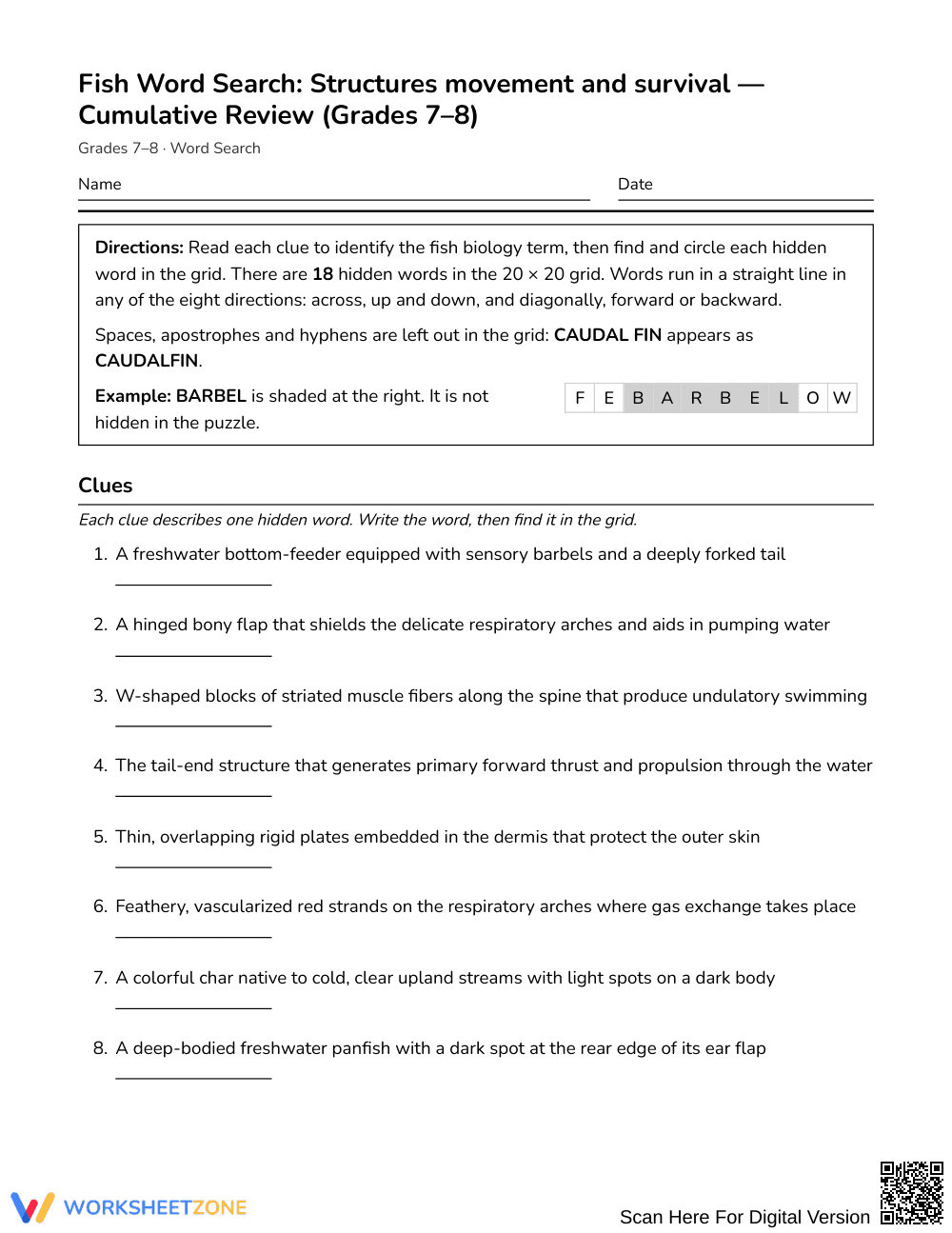
Reinforce essential life science concepts with this fish biology vocabulary word search. Students explore structural adaptations, locomotion mechanisms, and aquatic respiration by matching 18 scientific definitions to key terminology hidden in the grid. This cumulative review strengthens domain-specific academic vocabulary while solidifying student understanding of how freshwater organisms survive in aquatic ecosystems.
At a Glance
- Grade: Grades 7–8 · Subject: Science
- Standard: Not standards-assessed — vocabulary enrichment targeting life science adaptations and aquatic biology terms
- Skill Focus: Fish structures, locomotion mechanisms, respiration, and freshwater organism survival
- Format: 3 pages · 18 words · Answer key included · PDF
- Best For: Unit review, vocabulary reinforcement, fast finishers, and sub plans
- Time: 25–35 minutes
What's Inside
This 3-page science resource features an 18-word search puzzle accompanied by full descriptive biological clues instead of a simple word list. Students must read functional definitions—spanning hydrodynamics, buoyancy, sensory organs, and countercurrent gas exchange—to deduce each term before searching. The packet includes a complete full-size answer key across 4 pages showing exact word placements and coordinates.
Puzzle Structure and Mechanics
The activity is built upon a dense 20 by 20 letter grid designed to challenge middle school students. The 18 target vocabulary terms are hidden across all eight compass directions: north, northeast, east, southeast, south, southwest, west, and northwest. Words may read forward, backward, or diagonally, requiring systematic visual scanning and persistence alongside biological clue analysis.
Standards Alignment
This resource serves as targeted vocabulary enrichment and is not aligned to a single state or national content standard. Instead, it supports broader middle school life science units on animal adaptations, specialized anatomy, and homeostasis by reinforcing foundational scientific terminology before summative assessments or lab dissections.
How to Use It
Incorporate this activity toward the end of an animal adaptations unit to consolidate vocabulary after direct instruction. Alternatively, assign it as an independent task during station rotations or as a zero-prep emergency sub plan. While students work, circulate to observe whether they identify organ functions from clues before searching, which reveals conceptual comprehension versus rote letter-hunting. Typical completion takes 25 to 35 minutes.
Who It's For
This word search is designed for Grades 7–8 life science students mastering aquatic anatomy and organism structures. Provide struggling readers with a highlighter or small group peer support to parse complex multi-syllable clues like osmoregulation. Pair this review with an interactive fish anatomy diagram or a hands-on external anatomy observation lab.
According to Fisher & Frey (2014), intentional exposure to domain-specific vocabulary within meaningful contexts accelerates reading comprehension and disciplinary literacy across middle school science classrooms. This Grades 7–8 science word search delivers rigorous vocabulary enrichment focused on freshwater fish adaptations, movement structures, and respiratory survival mechanisms. Rather than passively scanning for isolated letters, students engage with 18 biological clues covering vital processes such as countercurrent exchange, osmoregulation, and neutral buoyancy. This dual-demand structure requires learners to connect functional physiological descriptions to precise anatomical terms like myomeres, operculum, and lateral lines before locating them in a 20 by 20 grid. Because scientific literacy depends heavily on cumulative vocabulary acquisition, solving clue-based puzzles consolidates complex terminology into long-term memory, preparing students for text-based analysis and lab investigations in aquatic biology. Such systematic reinforcement directly supports content retention during complex organism units.


