


























Views
Downloads
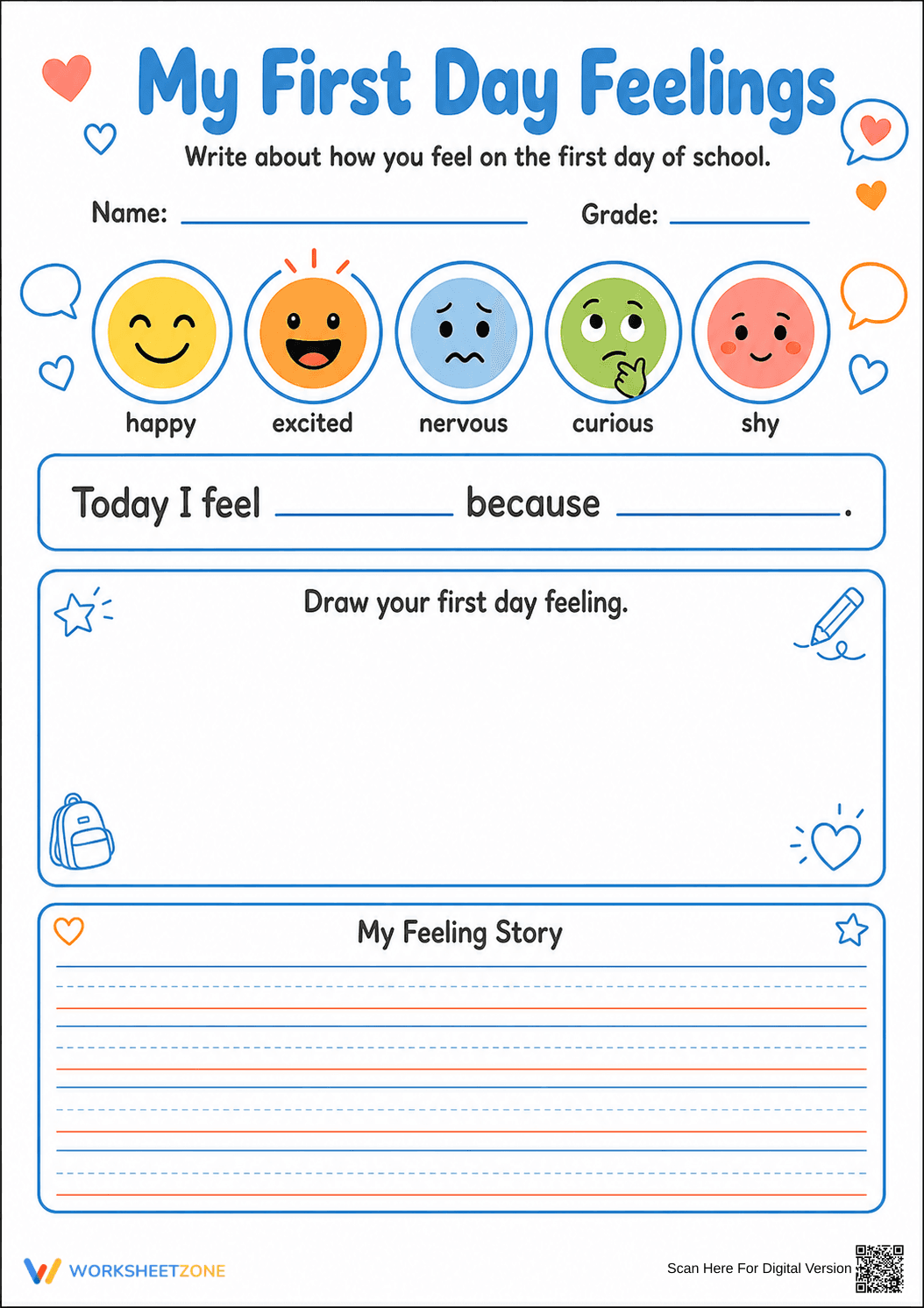

Printable First Day Feelings Worksheet | Grade 1 ELA
Paste this activity's link or code into your existing LMS (Google Classroom, Canvas, Teams, Schoology, Moodle, etc.).
Students can open and work on the activity right away, with no student login required.
You'll still be able to track student progress and results from your teacher account.
This printable Grade 1 worksheet helps students identify and express their emotions on the first day of school. By combining visual emotion cues with structured sentence frames and open-ended drawing space, young learners can safely process their feelings while practicing foundational writing skills in a supportive format.
At a Glance
- Grade: 1 · Subject: ELA
- Standard:
CCSS.ELA-LITERACY.W.1.8— Recall information from experiences to answer a question- Skill Focus: Expressing emotions and narrative writing
- Format: 1 page · 4 tasks · Open-ended · PDF
- Best For: First day morning work
- Time: 15–20 minutes
This single-page resource features four distinct tasks designed to guide students from simple identification to independent expression. It begins with a visual emotion bank containing five labeled faces. Students then complete a guided sentence frame to state their feeling and the reason behind it. A dedicated drawing box allows for visual storytelling, followed by primary-lined writing space for students to compose a short personal narrative about their first day experience.
This resource is designed for a seamless zero-prep workflow during the busy back-to-school season:
- Print (1 minute): Simply download the PDF and print a class set.
- Distribute (1 minute): Hand out the worksheet as students arrive on the first morning. The intuitive layout requires no complex teacher setup.
- Review (3 minutes): Quickly scan completed sheets to gauge the emotional climate of your new classroom.
With under two minutes of total teacher prep time, this activity is an ideal, self-explanatory task for the first morning of school or as a reliable emergency sub plan.
This activity is aligned to CCSS.ELA-LITERACY.W.1.8: With guidance and support from adults, recall information from experiences or gather information from provided sources to answer a question. Both standard codes can be copied directly into lesson plans, IEP goals, or district curriculum mapping tools.
Use this worksheet as a welcoming morning work activity as students settle into their desks on the first day of school. Alternatively, use it after a whole-group read-aloud about first-day jitters to prompt a guided discussion. As a formative assessment tip, observe how students utilize the primary writing lines and phonetic spelling to gauge their baseline writing readiness. Expect students to complete this activity in 15 to 20 minutes.
This resource is primarily designed for first-grade students, though it is highly adaptable for early second graders or kindergarteners with additional adult support. The inclusion of visual emotion faces and sentence frames provides built-in differentiation for emerging writers and English Language Learners who might struggle to generate vocabulary independently. Pair this worksheet with a classic back-to-school picture book to create a comprehensive social-emotional learning lesson.
Integrating social-emotional check-ins with academic tasks is a highly effective strategy for early elementary classrooms. This worksheet addresses CCSS.ELA-LITERACY.W.1.8 by having students recall information from experiences to answer a question about their current emotional state. According to a recent RAND AIRS 2024 report, embedding structured emotional reflection within routine literacy activities significantly reduces student anxiety during transitional periods, such as the beginning of a new academic year. By providing clear visual scaffolds alongside primary writing lines, educators can simultaneously assess foundational writing skills and monitor student well-being. This dual-purpose approach ensures that instructional time is maximized while fostering a supportive classroom environment from day one. The structured progression from identifying a feeling to writing a short narrative supports cognitive development and emotional regulation in young learners, making it an essential tool for back-to-school success.


