





























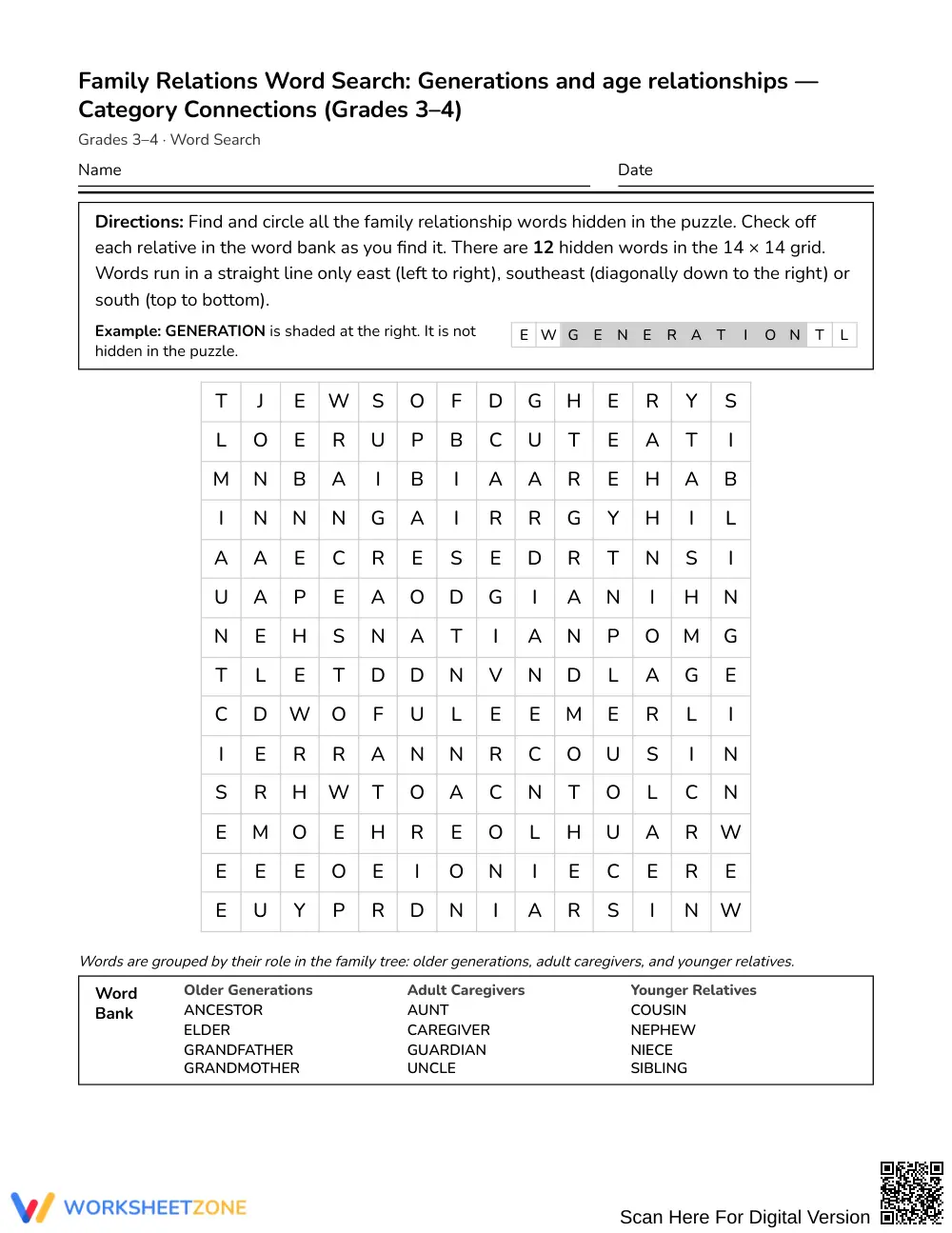


Printable Family Relations Word Search | Grades 3–4 ELA

Paste this activity's link or code into your existing LMS (Google Classroom, Canvas, Teams, Schoology, Moodle, etc.).
Students can open and work on the activity right away, with no student login required.
You'll still be able to track student progress and results from your teacher account.
This family relations word search helps elementary learners reinforce generational and kinship vocabulary through targeted pattern recognition. Students identify key terms that describe family trees, caregiver roles, and youth relationships, strengthening their word recognition and conceptual understanding of family structures across three distinct categories.
At a Glance
- Grade: Grades 3–4 · Subject: English Language Arts (ELA)
- Standard: Not standards-assessed — vocabulary enrichment
- Skill Focus: Generations and age relationships
- Format: 1 page · 12 words · Answer key included · PDF
- Best For: Vocabulary warm-up or early finisher work
- Time: 15–20 minutes
What's Inside
The activity features a 1-page printable word search with a organized word bank and explanatory contextual clues. Terms are categorized into older generations, adult caregivers, and younger relatives to support relational schema building. A complete 3-page answer key provides clear visual solutions for quick grading and student self-checking.
Puzzle Structure and Mechanics
The word search is built on a 14 x 14 grid containing 12 hidden vocabulary words. Words run in three directions: east (left to right), southeast (diagonal downward), and south (vertical downward). Learners use thematic categories alongside descriptive clues to locate each kinship term, keeping visual scanning accessible yet engaging for intermediate elementary readers.
Standards Alignment
This activity is designed as open vocabulary enrichment and is not aligned to a specific state or national standard. It supports foundational language acquisition, contextual comprehension, and social-emotional family discussions without testing constraints.
How to Use It
Distribute this sheet after introducing kinship concepts in an ELA or social studies unit, or assign it as an independent morning starter. During work time, observe whether students scan letter-by-letter or recognize whole phonetic chunks like prefixes and roots. Most learners will complete the search within 15 to 20 minutes.
Who It's For
This word search serves general education students in Grades 3–4, English language learners mastering kinship terminology, and students requiring low-stress spelling reinforcement. Pair this puzzle with an informational family tree reading passage or personal narrative writing assignment.
Vocabulary acquisition research highlighted in Fisher & Frey (2014) emphasizes that intentional word-learning tasks succeed when terms are anchored within clear thematic systems rather than isolated memorization lists. By grouping generations and age relationships into older generations, adult caregivers, and younger relatives, this printable activity engages 12 target words through visual search and orthographic mapping. Searching for words across structured directions strengthens spatial tracking, lexical retrieval, and spelling automaticity. Because students must verify correct letter sequencing across a 14 x 14 grid to find each term, they rehearse word boundaries and internal spelling patterns repeatedly. These structured encounters build confidence in early literacy, making thematic word puzzles an effective instructional supplement for vocabulary retention, reading fluency, and independent language practice across upper elementary classrooms.


