





























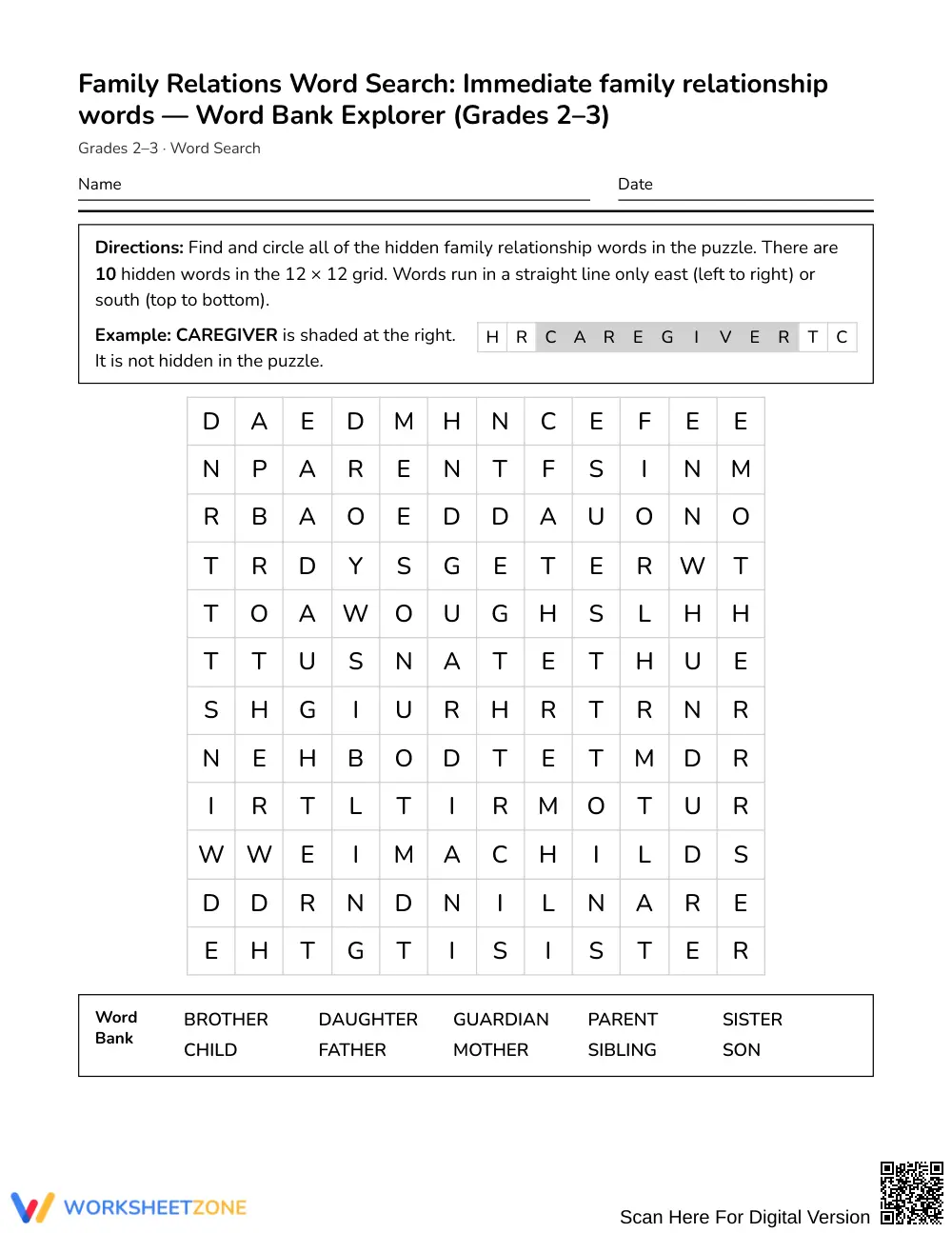


Printable Family Relations Word Search | Grades 2–3 ELA

Paste this activity's link or code into your existing LMS (Google Classroom, Canvas, Teams, Schoology, Moodle, etc.).
Students can open and work on the activity right away, with no student login required.
You'll still be able to track student progress and results from your teacher account.
This Grades 2–3 word search strengthens vocabulary retention by challenging students to find 10 immediate family relationship words in a letter puzzle. Young readers build word recognition and spelling accuracy as they identify common kinship terms, reinforcing core foundational language skills during independent seatwork or literacy centers.
At a Glance
- Grade: Grades 2–3 · Subject: English Language Arts (ELA)
- Standard: Not standards-assessed — vocabulary enrichment
- Skill Focus: Immediate family relationship words and spelling patterns
- Format: 1 student page · 10 hidden words · Full answer key included · Printable PDF
- Best For: Independent morning desk work, literacy centers, and fast finishers
- Time: 15–20 minutes
This 1-page vocabulary activity contains an engaging letter puzzle for early elementary learners. The page features an alphabetized word bank with 10 key terms related to immediate family units, including words like mother, father, sibling, and guardian. A comprehensive 2-page answer key provides a clearly marked grid solution that allows teachers or students to check hidden word locations quickly.
Puzzle Mechanics and Structure
The activity is built on a 12 × 12 letter grid tailored to second and third graders. To support young readers developing visual scanning skills, words are placed in two directions: East (left to right horizontally) and South (top to bottom vertically). There are no diagonal or backward placements, preventing unnecessary frustration while encouraging steady letter tracking. Students use an alphabetical word bank at the bottom of the page to guide their search and cross off words as they find them.
Standards Alignment
This word search serves as supplementary vocabulary enrichment and is not formally aligned to a specific Common Core or state standard code. Instead, it offers targeted language exposure that strengthens general orthographic awareness, spelling recognition, and reading fluency for second and third grade students.
How to Use It
Use this puzzle during independent practice following a direct instruction lesson on family vocabulary. Alternatively, assign it as a morning arrival task before reading instruction. While students work, observe scanning habits; learners struggling to scan lines can use a ruler to isolate grid rows. Most students complete the 10-word puzzle in 15 to 20 minutes.
Who It's For
This activity suits second and third grade general education classrooms and English language learners practicing relationship terms. For students needing support, highlight the initial letter of each word in the grid. Pair this puzzle with an illustrated family tree chart or a read-aloud book about diverse families.
Focused vocabulary activities targeting immediate family relationship words provide essential orthographic reinforcement for early elementary readers. While designed as an unaligned vocabulary enrichment resource rather than a standards-assessed test preparation measure, the puzzle structure directly reinforces visual word recognition and spelling memory. Research from Fisher & Frey (2014) highlights that purposeful word exposure and structural word-play build lexical automaticity, allowing young learners in Grades 2–3 to retrieve and decode high-frequency social vocabulary with greater confidence. By restricting puzzle searches to horizontal and vertical orientations within a 12 × 12 grid, this activity reduces cognitive load and allows emergent readers to focus squarely on letter sequences and spelling patterns. The accompanying answer key and alphabetized word bank ensure efficient verification during independent literacy stations, making it an effective supplement for foundational language development in elementary classrooms.


