



























Printable Droids & Vehicles Word Search | Grades 7–8 ELA
Paste this activity's link or code into your existing LMS (Google Classroom, Canvas, Teams, Schoology, Moodle, etc.).
Students can open and work on the activity right away, with no student login required.
You'll still be able to track student progress and results from your teacher account.
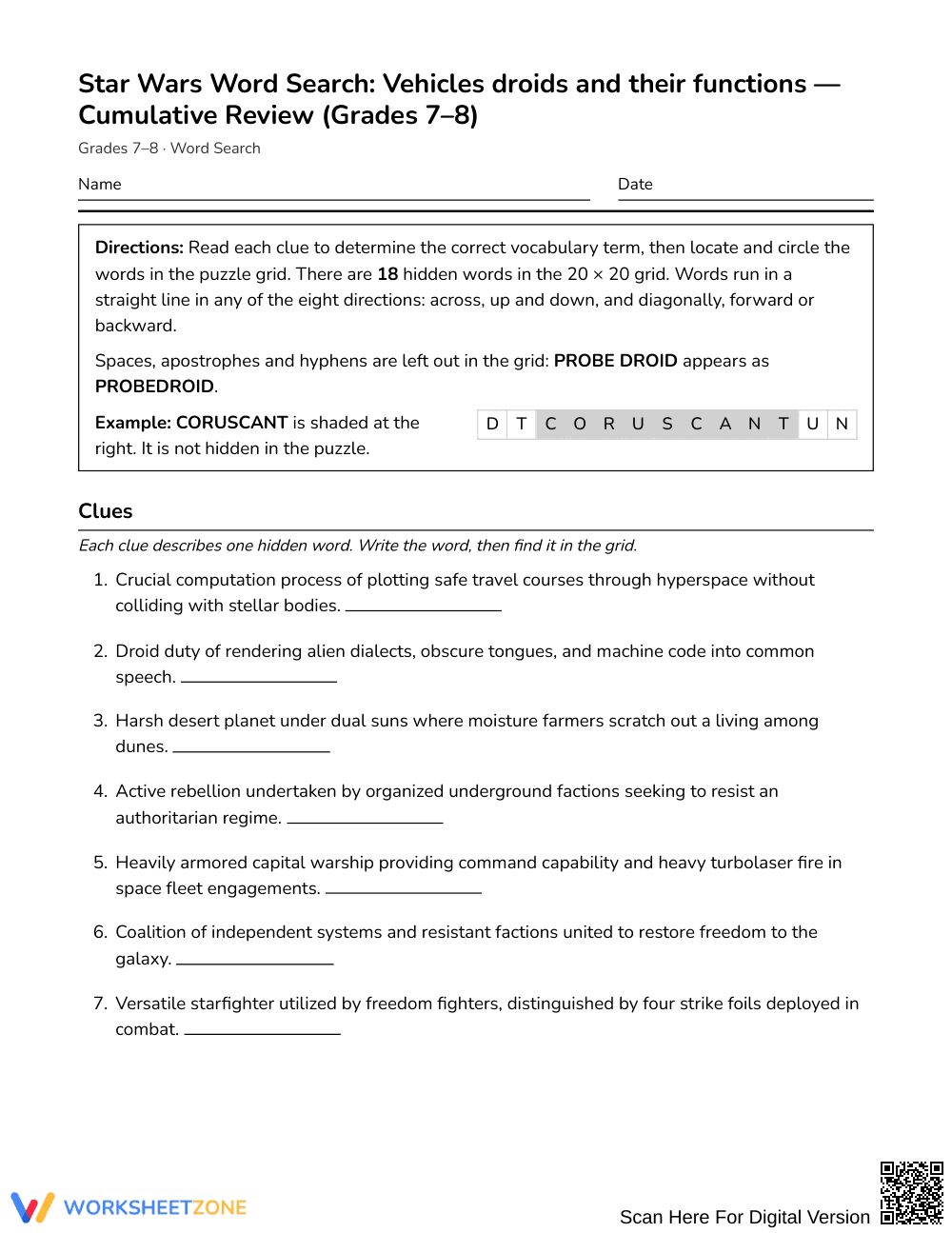
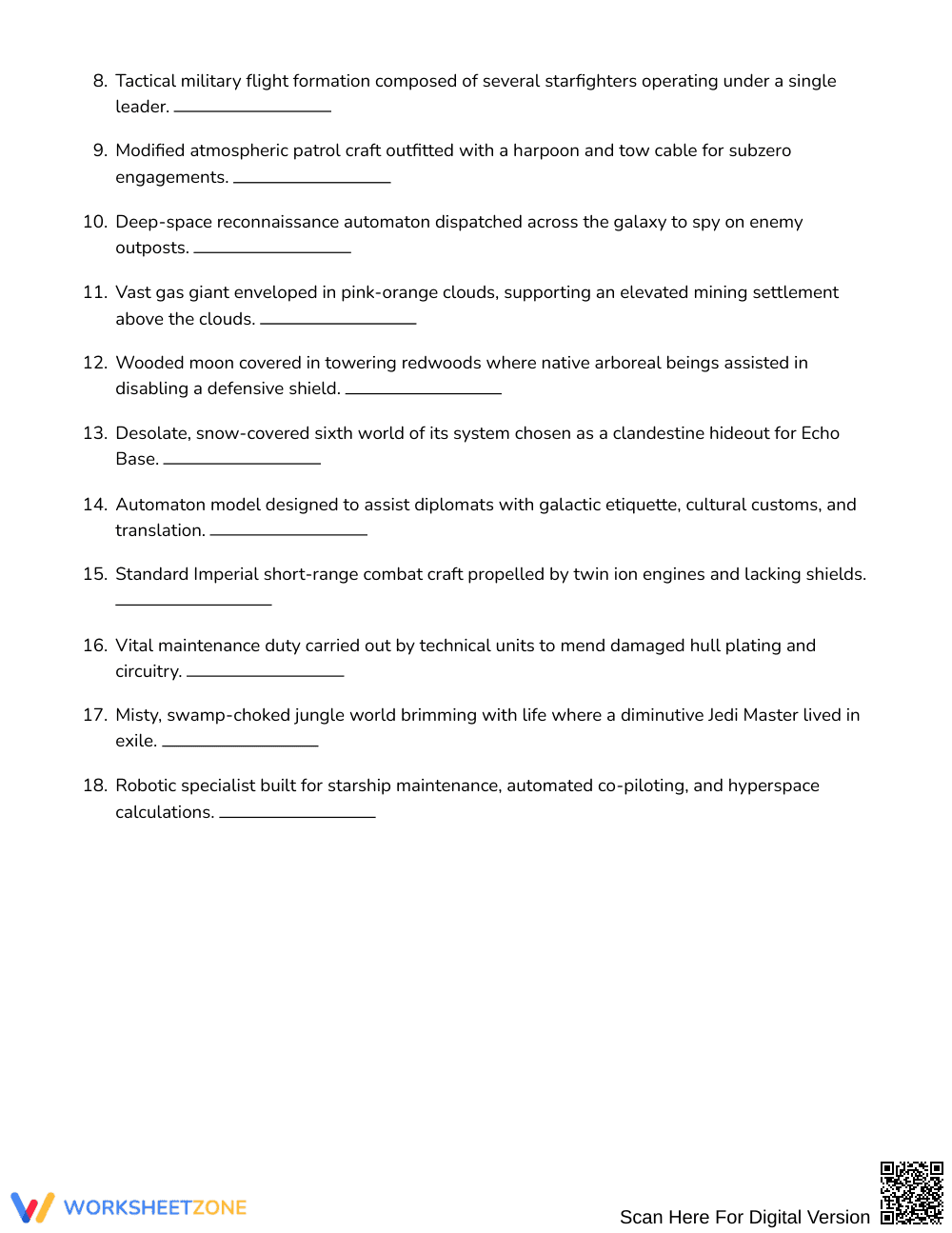
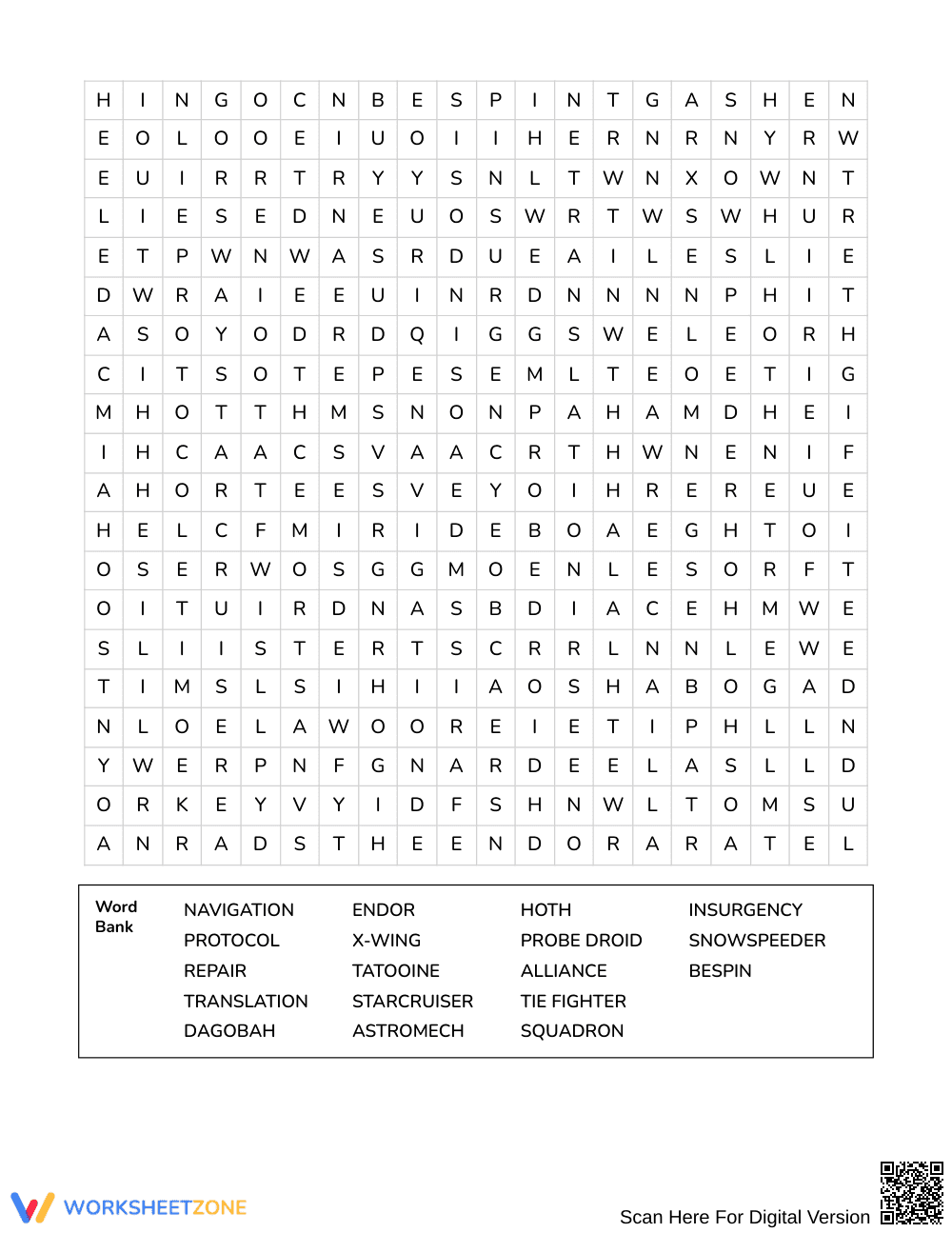
This Grades 7–8 vocabulary word search builds science fiction domain knowledge by challenging students to identify and locate 18 specialized terms related to vehicles, droids, and their operational functions. Learners analyze detailed technical clues before searching the puzzle, reinforcing contextual reading comprehension, orthographic recognition, and thematic terminology retention across three printable pages.
At a Glance
- Grade: Grades 7–8 · Subject: English Language Arts (ELA)
- Standard: Not standards-assessed — vocabulary enrichment
- Skill Focus: Vehicles, droids, and their functions
- Format: 3 pages · 18 words · Answer key included · PDF
- Best For: Vocabulary enrichment, sub plans, and independent review
- Time: 20–30 minutes
What's Inside
The 3-page document features a comprehensive 18-word puzzle alongside an extensive four-page answer key that highlights every term in place. Instead of relying on a plain list of terms, students interact with rigorous informational clues defining functions such as starship maintenance, hyperspace navigation, and diplomatic translation. This clue-first structure transforms recreational scanning into an active vocabulary review activity.
Puzzle Structure and Mechanics
This activity utilizes a dense 20 x 20 letter grid containing 18 hidden vocabulary items. Hidden terms run across all eight possible compass directions: North, Northeast, East, Southeast, South, Southwest, West, and Northwest. Because words appear forward, backward, vertically, horizontally, and diagonally, students develop sustained visual tracking stamina as they match each clue-derived term to its location in the grid.
Standards Alignment
This resource serves as targeted vocabulary enrichment and is not aligned to a formal state or national standard. It supplements middle school English Language Arts curricula by strengthening content-area literacy, contextual inference skills, and technical vocabulary acquisition without standard-specific testing constraints.
How to Use It
Deploy this word search during independent reading stations after introducing a science fiction novel study, or assign it as a zero-prep activity for substitute teachers. While students complete the 20 to 30 minute task, observe whether they solve clues prior to searching the grid or rely on random scanning, prompting them to highlight key function verbs in each definition to verify term accuracy.
Who It's For
Designed for middle school learners in Grades 7–8, this activity engages reluctant readers and advanced vocabulary students alike through high-interest thematic content. Pair this word search directly with a science fiction creative writing prompt or a technical nonfiction excerpt analyzing automated robotics to extend terminology application into extended student writing.
Vocabulary enrichment activities that integrate contextual definition clues with visual search tasks significantly strengthen orthographic memory and conceptual understanding for middle school readers. According to Fisher & Frey (2014), intentional exposure to domain-specific vocabulary within meaningful thematic contexts improves reading comprehension and long-term terminology recall across secondary learning environments. Rather than presenting isolated word banks, requiring students to interpret complex descriptions of technical droid functions, vehicle classifications, and mechanical roles before locating the 18 hidden words transforms passive puzzle completion into deliberate cognitive practice. Learners actively link precise operational definitions—such as diplomatic etiquette, hyperspace navigation, and automated starship maintenance—to specialized vocabulary terms. This dual-demand process deepens semantic associations while reinforcing spatial scanning stamina. Consequently, middle school educators can utilize this classroom-ready enrichment resource during independent learning blocks to consolidate informational vocabulary through structured, high-interest thematic exploration.


