




























Views
Downloads


Printable Dog Training Cues Word Search | Grades 4–5 ELA

Paste this activity's link or code into your existing LMS (Google Classroom, Canvas, Teams, Schoology, Moodle, etc.).
Students can open and work on the activity right away, with no student login required.
You'll still be able to track student progress and results from your teacher account.
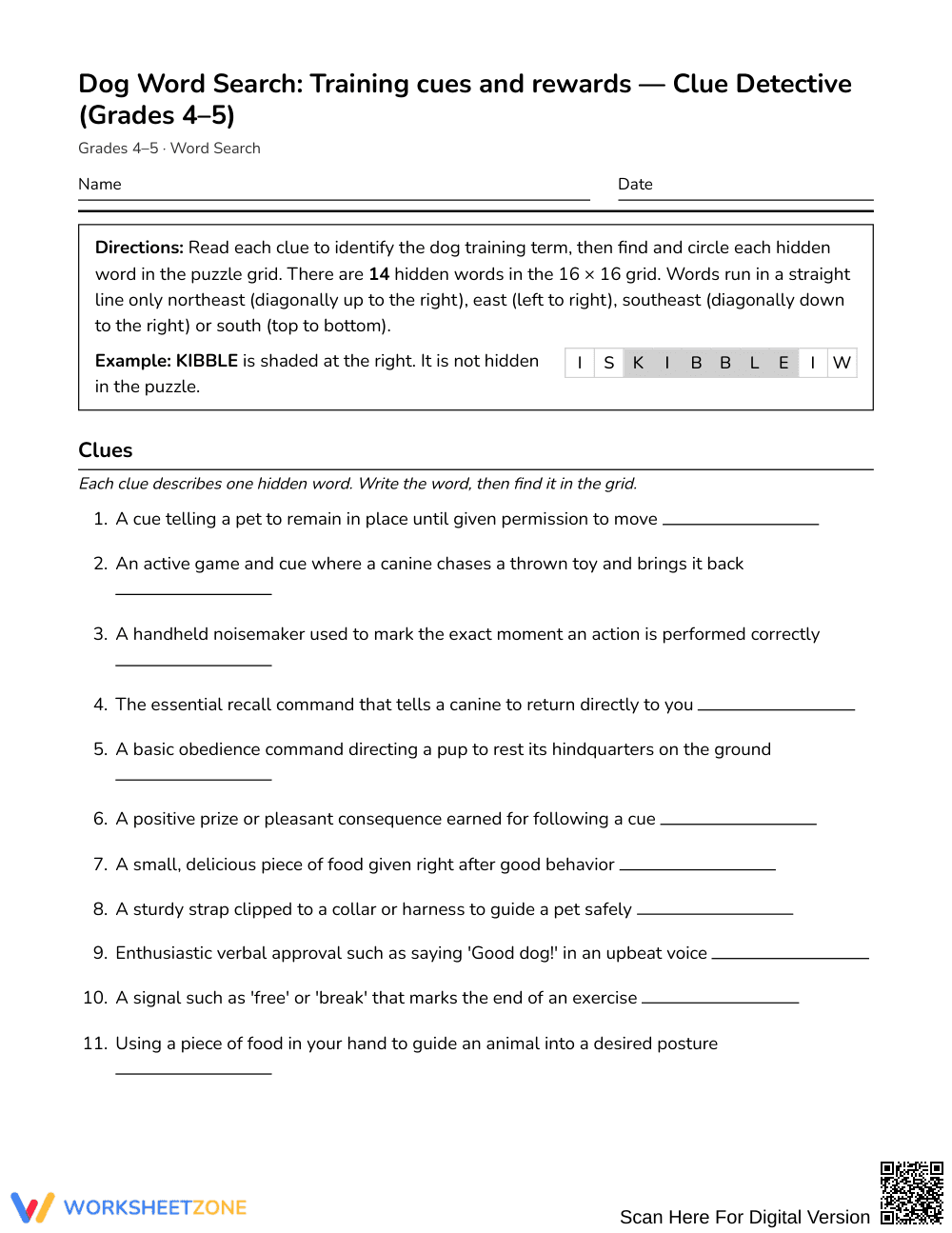
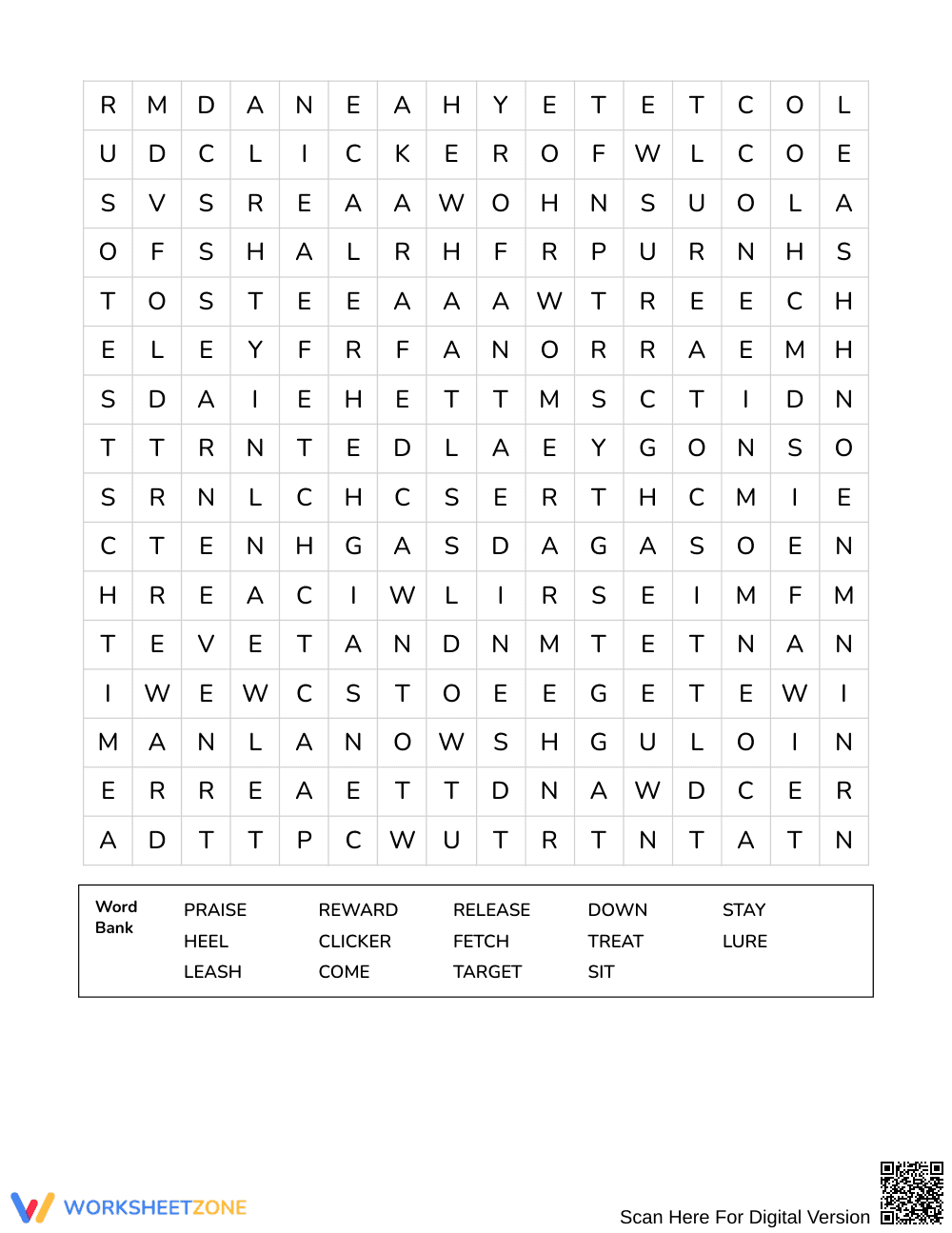
This Grades 4–5 English Language Arts word search challenges learners to build specialized vocabulary through an engaging clue-solving activity. Students read descriptive definitions of canine obedience commands and positive reinforcement concepts, identify the correct terminology, and locate 14 words hidden in the letter grid to reinforce comprehension and orthographic recall.
At a Glance
- Grade: Grades 4–5 · Subject: English Language Arts (ELA)
- Standard: Not standards-assessed — vocabulary enrichment focused on canine obedience terms and context definitions
- Skill Focus: Training cues and rewards vocabulary
- Format: 3 pages · 14 words · Full answer key included · Printable PDF
- Best For: Independent vocabulary enrichment and early finishers
- Time: 15–25 minutes
What's Inside
Inside, this 3-page printable activity pairs contextual clues with a word puzzle to deepen lexical retention. Rather than consulting an exposed target list immediately, students read clue sentences for commands like SIT, HEEL, and CLICKER before scanning the letter layout. A complete 3-page answer key provides fast verification for all hidden term placements.
Puzzle Structure and Mechanics
The puzzle features a compact 16 x 16 letter grid packed with 14 words. Words run in four specific directions: northeast (NE), east (E), southeast (SE), and south (S). Students use a shuffled word bank alongside clue definitions to identify terms before hunting through diagonal and straight paths across the puzzle board.
Educational Context
This activity is designed purely for vocabulary enrichment and is not aligned to a specific academic standard. It supports domain-specific language acquisition, contextual inference, and spelling automaticity across intermediate elementary reading contexts.
Classroom Implementation
Deploy this resource as an independent station after direct instruction on context clues, or hand it out as a high-interest task for early finishers. During completion, conduct brief formative checks by asking students to define target cues aloud before circling them. Most learners complete the full search in 15 to 25 minutes.
Student Audience
This word search is designed for Grades 4–5 readers developing vocabulary fluency and word recognition. For students requiring extra scaffolding, encourage highlighting key clue terms before searching the grid. The activity pairs naturally with informational texts about animal behavior, working dogs, or descriptive non-fiction reading units.
Domain-specific vocabulary acquisition relies on structured exposure to targeted terms embedded in meaningful contexts rather than isolated memorization. As emphasized by Fisher & Frey (2014), intentional word-learning routines that combine contextual definitions with active visual search strengthen orthographic mapping and lexical access. This word search engages Grades 4–5 students in decoding contextual clues for 14 canine training and behavioral terms before identifying letter patterns across a 16 x 16 grid. Engaging multiple cognitive modalities through clue deciphering and spatial recognition reinforces word boundaries, correct spelling sequences, and conceptual understanding. When learners connect concrete definitions to target vocabulary such as positive reinforcement and obedience cues, they solidify semantic associations that transfer to expository reading and content-area comprehension. Integrating structured vocabulary games provides effective, low-stakes practice that sustains student engagement while consolidating language mechanics across diverse classroom environments.


