




























Views
Downloads



Printable Dog Breed Vocabulary Word Search | Grades 7–8 ELA

Paste this activity's link or code into your existing LMS (Google Classroom, Canvas, Teams, Schoology, Moodle, etc.).
Students can open and work on the activity right away, with no student login required.
You'll still be able to track student progress and results from your teacher account.
This dog vocabulary word search strengthens middle school literacy by guiding students to evaluate canine traits objectively and dismantle breed stereotypes. Learners examine 18 precise veterinary, training, and behavioral terms across a dense letter grid, linking specialized terminology like bite inhibition and temperament to scientific animal care rather than generalized breed assumptions.
At a Glance
- Grade: Grades 7–8 · Subject: English Language Arts (ELA)
- Standard: Not standards-assessed — vocabulary enrichment
- Skill Focus: Comparing breeds without stereotypes through domain-specific terms
- Format: 3 pages · 18 hidden words · Full answer key included · Printable PDF
- Best For: Cumulative vocabulary review, fast finishers, and sub plans
- Time: 25–35 minutes of engaged practice
What's Inside
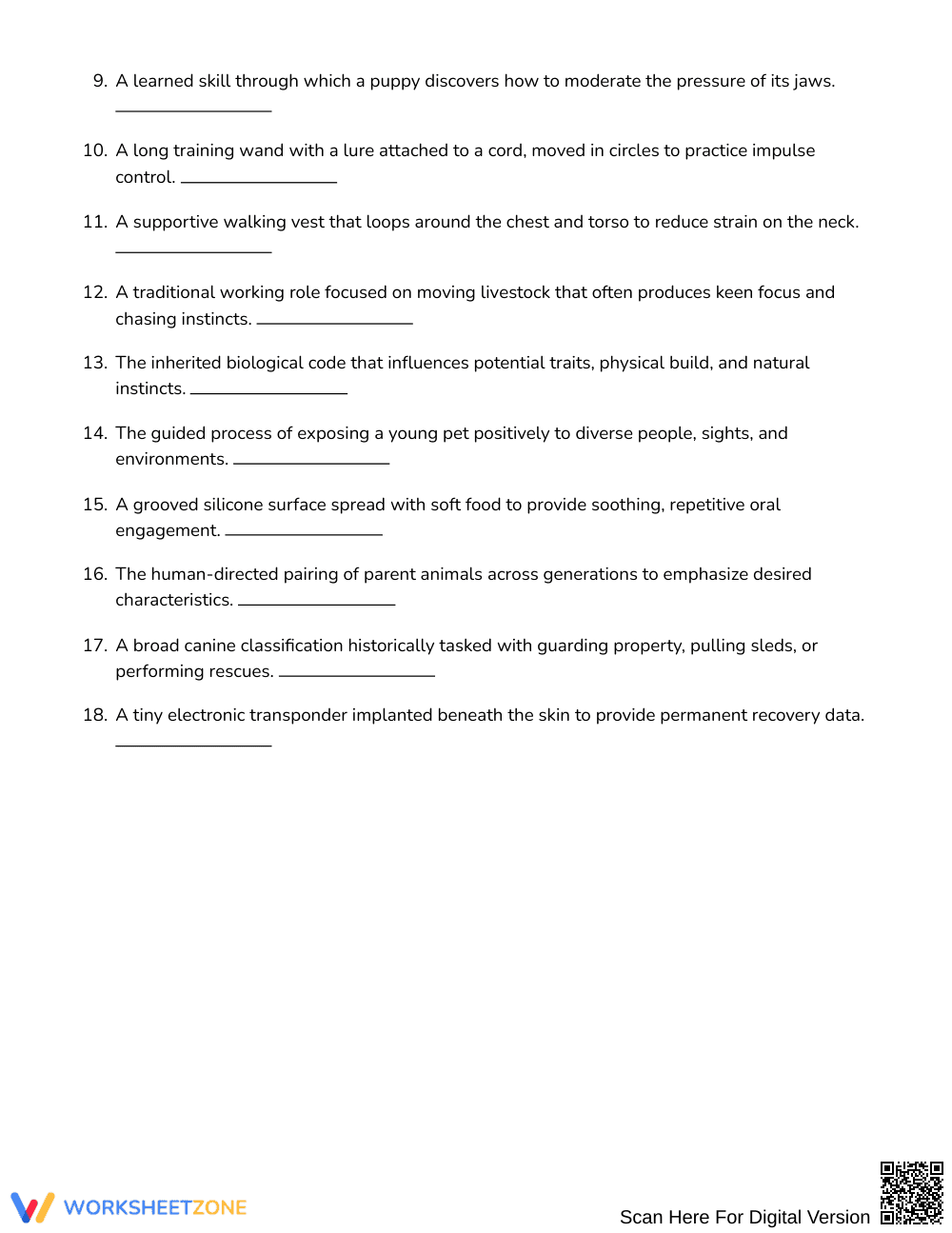
This 3-page printable resource includes an 18-word puzzle paired with detailed vocabulary definitions, followed by a comprehensive 4-page answer key. Students analyze clues detailing animal behavior, training gear, and genetics before identifying each term. The shuffled word list challenges students to process each definition actively rather than passively matching terms from an alphabetical list.
Puzzle Mechanics & Structure
The activity centers on a 20 x 20 letter grid containing 18 hidden vocabulary words running in all eight compass directions: north, northeast, east, southeast, south, southwest, west, and northwest. Words appear forward and backward, both horizontally, vertically, and diagonally. Instead of searching from a plain alphabetical list, students read thorough definitional clues that describe biological traits, working groups, and equipment. The shuffled word bank provides spelling verification while requiring students to connect each definition to its accurate term before circling it in the puzzle.
Standards Alignment
This resource serves as targeted vocabulary enrichment and is not aligned to an assessed state or Common Core standard. Instead of assessing mechanical grade-level benchmarks, it deepens informational reading comprehension and domain-specific terminology around biology, genetics, and animal behavior.
How to Use It
Deploy this word search during an informational text unit on animal science or as a mid-unit vocabulary check. Before students begin searching, have them complete a paired read of the 18 clues to predict terms, reinforcing contextual reading skills. During independent work, conduct a formative scan to observe whether students deduce terms directly from clues or rely heavily on the shuffled bank. Plan for 25 to 35 minutes of total instructional time.
Who It's For
This activity is designed for middle school students in Grades 7–8 exploring objective informational texts and scientific categorization. It supports emerging readers through clear contextual definitions, while the complex 20 x 20 grid engages advanced learners. Pair this puzzle with an expository passage on selective breeding or an anchor chart contrasting learned canine behaviors with genetic drives.
Domain-specific vocabulary acquisition functions as a core foundation for critical thinking and objective analysis in middle school literacy. According to Fisher & Frey (2014), intentional exposure to disciplinary terminology through structured word play and contextual definitions accelerates conceptual comprehension and retention. This vocabulary word search provides Grades 7–8 students with targeted practice in comparing breeds without stereotypes by decoupling broad generalizations from verifiable biological traits, training methodologies, and genetic drives. Rather than memorizing isolated definitions, learners synthesize 18 specialized terms across a multidirectional 20 x 20 grid, directly applying contextual clues that describe temperament, bite inhibition, and selective breeding. By integrating definitional clues with active visual search tasks, the activity bridges content-area science with English language arts instruction, ensuring that adolescent learners acquire precise academic language while developing critical literacy habits necessary for evaluating evidence-based texts.


