




























Views
Downloads
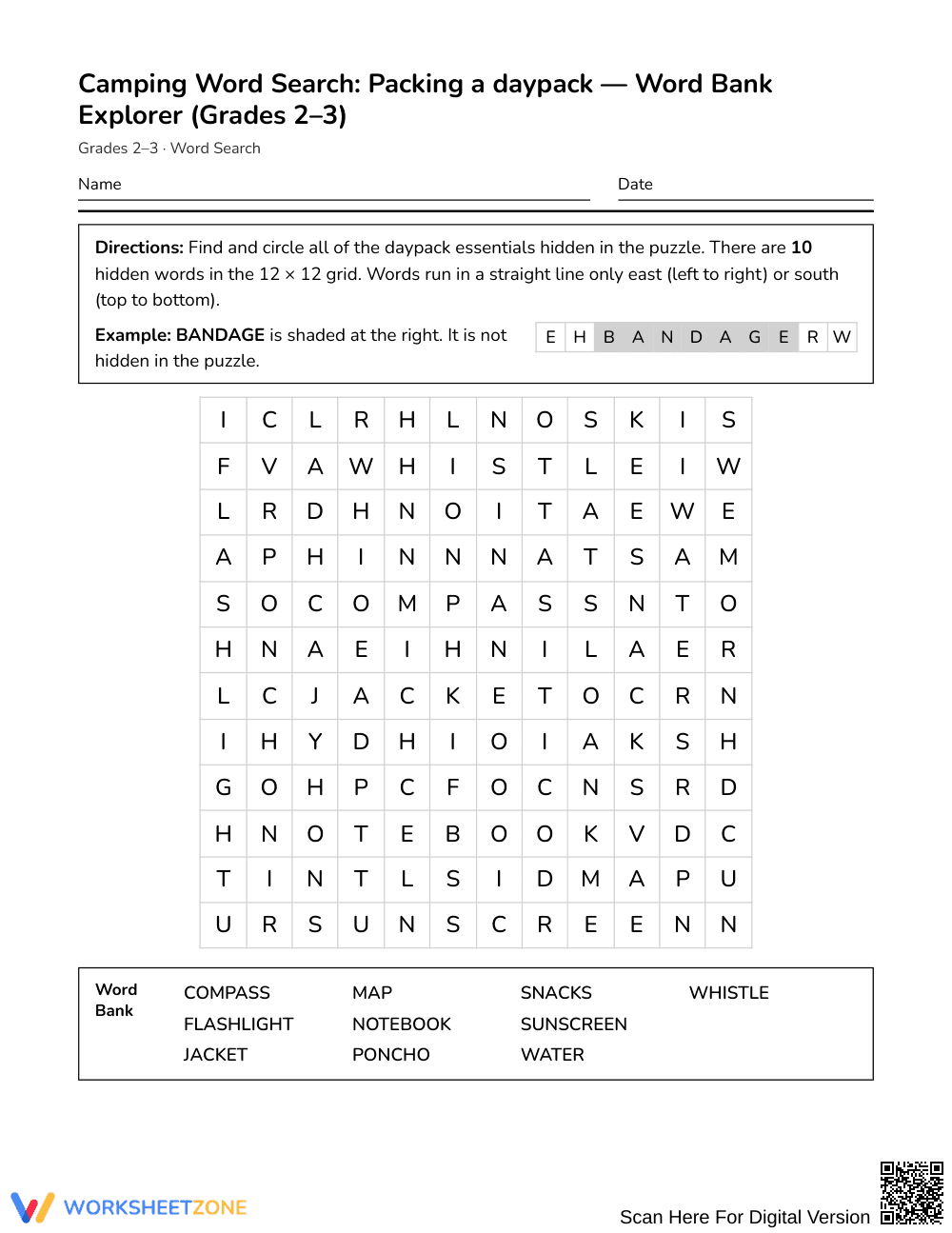

Printable Daypack Word Search | Grades 2–3 ELA

Paste this activity's link or code into your existing LMS (Google Classroom, Canvas, Teams, Schoology, Moodle, etc.).
Students can open and work on the activity right away, with no student login required.
You'll still be able to track student progress and results from your teacher account.
This camping-themed daypack word search introduces elementary learners to essential outdoor equipment while reinforcing letter recognition and reading fluency. Students locate 10 foundational vocabulary terms hidden within an approachable letter grid, building spelling familiarity and thematic knowledge independently without requiring upfront teacher direct instruction or special materials.
At a Glance
- Grade: Grades 2–3 · Subject: English Language Arts (ELA)
- Standard: Not standards-assessed — vocabulary enrichment
- Skill Focus: packing a daypack
- Format: 1 pages · 10 words · Answer key included · PDF
- Best For: Morning work, early finishers, sub plans
- Time: 15–20 minutes
What's Inside
The activity features a clean, single-page puzzle format containing an organized alphabetical word bank of 10 daypack items alongside corresponding child-friendly definitions. Words are placed within an age-appropriate 12 by 12 grid. A complete two-page solution key shows exact word paths, enabling rapid verification by educators or student self-checking during independent station rotations.
Zero-Prep Workflow
Designed for immediate classroom implementation, this puzzle eliminates setup hurdles entirely:
- Print (30 seconds): Send the single student sheet directly to your copier or printer without adjusting layout settings.
- Distribute (30 seconds): Hand out the page with highlighters, pencils, or crayons during transition periods.
- Review (60 seconds): Display or consult the visual answer key for instant visual verification.
Total preparation requires under two minutes, making the activity an exceptional standby option for guest teachers and unplanned schedule adjustments. Words run exclusively left-to-right (East) and top-to-bottom (South), avoiding confusing backwards diagonal orientations to keep frustration low.
Standards Alignment
This activity serves strictly as vocabulary enrichment and is not aligned to a specific academic standard. It supports foundational orthographic awareness and contextual language exploration through high-interest informational themes.
How to Use It
Deploy this puzzle as an independent literacy warm-up following an outdoor education read-aloud or as a self-directed station during small-group reading rotations. While students scan the grid, circulate to observe visual tracking habits and letter-cluster recognition strategies, noting learners who sound out words phonetically versus those using initial-letter scanning. Most students complete the task within 15 to 20 minutes.
Who It's For
This resource is crafted specifically for Grades 2–3 learners expanding their practical vocabulary. For developing readers, pair the activity with a concrete realia display featuring an actual backpack, flashlight, and compass to anchor word meanings in tangible objects before puzzle completion.
The RAND AIRS 2024 report emphasizes that low-stakes, context-rich word tasks reinforce vocabulary retention and orthographic mapping when integrated into broader topical literacy units. Engaging with thematic terminology—such as hiking safety and preparedness items—builds active schema that supports reading comprehension across informational science and social studies texts. By utilizing an accessible 12 by 12 grid structure with forward-facing orientations, this 10-word resource eliminates visual barriers, allowing young learners to concentrate on pattern recognition and precise spelling. Systematic exposure to structured print environments supports foundational decoding habits, fostering learner autonomy during independent seatwork while providing measurable practice in cross-curricular outdoor terminology without administrative planning overhead.


