































Printable Day of the Dead Word Search | Grades 3–4 ELA

Paste this activity's link or code into your existing LMS (Google Classroom, Canvas, Teams, Schoology, Moodle, etc.).
Students can open and work on the activity right away, with no student login required.
You'll still be able to track student progress and results from your teacher account.
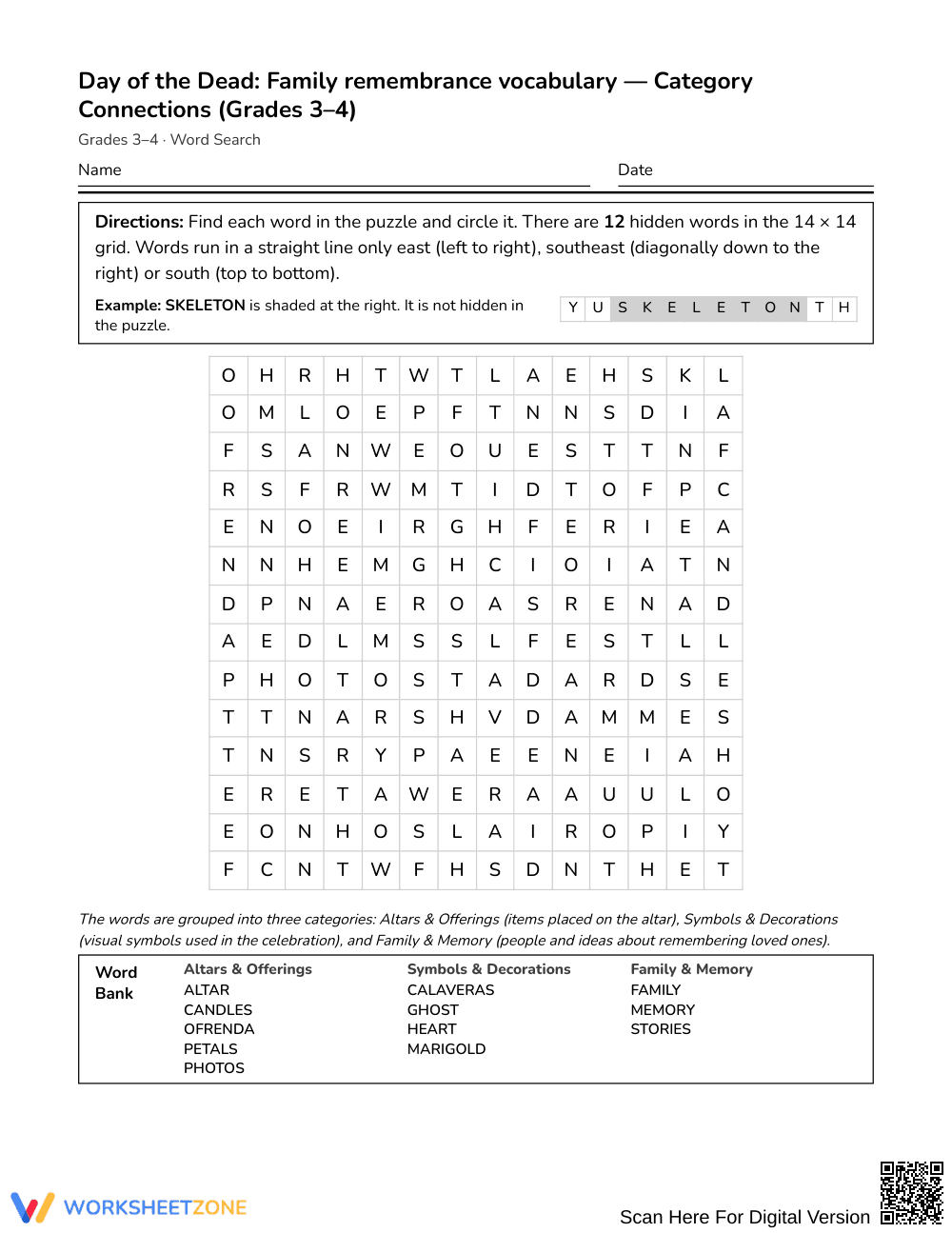
This Day of the Dead word search builds family remembrance vocabulary for third and fourth graders exploring cultural traditions. Students locate 12 thematic terms organized into meaningful categories, strengthening recognition of holiday customs, altar objects, and ancestral commemoration. The activity reinforces word knowledge while fostering cultural appreciation during seasonal ELA lessons.
At a Glance
- Grade: Grades 3–4 · Subject: English Language Arts (ELA)
- Standard: Not standards-assessed — vocabulary enrichment
- Skill Focus: Family remembrance vocabulary
- Format: 1 page · 12 words · Answer key included · PDF
- Best For: Cultural vocabulary enrichment and holiday study
- Time: 15–25 minutes
What's Inside
This single-page printable resource delivers an engaging letter grid paired with a categorized word list of 12 vocabulary terms. The activity groups words under three distinct headings—Altars & Offerings, Symbols & Decorations, and Family & Memory—giving students context for each concept. The document includes a three-page answer key that highlights exact letter coordinates and orientations for immediate verification.
How the Puzzle Works
The word search is built on a 14 x 14 letter grid designed specifically for intermediate elementary learners. All 12 hidden words run in three accessible reading directions: East (horizontal left-to-right), South (vertical top-to-bottom), and Southeast (diagonal downward-right). Students reference a structured word bank organized into thematic categories accompanied by descriptive clue definitions. These contextual definitions clarify terms such as ofrenda, calaveras, and marigold, enabling students to connect word meanings directly to holiday practices as they search.
Standards Alignment
This printable word search serves as vocabulary enrichment and is not aligned to a specific Common Core or state academic standard. Rather than measuring a discrete grade-level testing benchmark, the resource expands students' cultural lexicon and reinforces thematic reading comprehension during seasonal social studies or language arts units.
How to Use It
Deploy this activity during or after direct instruction on holiday traditions, community cultures, or family history. In an introductory context, educators can distribute the page after reading a partner text to activate schema and clarify key Spanish-origin terms. As a formative assessment observation, monitor how quickly students recognize word roots and identify whether they scan letter clusters methodically or search randomly. Most students complete the 12-word puzzle in 15 to 25 minutes.
Who It's For
This resource supports third- and fourth-grade classrooms, dual-language programs, and English Language Learners seeking accessible exposure to festive heritage vocabulary. Teachers can pair this activity with an informational read-aloud text about Mexican cultural celebrations or a family heritage sharing project.
As vocabulary enrichment outside formal standardized testing, this resource focuses on family remembrance vocabulary to deepen cultural literacy and word consciousness in intermediate elementary grades. Educational research by Fisher & Frey (2014) emphasizes that intentional exposure to domain-specific vocabulary across structured categories significantly enhances semantic networks and schema development. When students interact with culturally authentic terminology through organized categories like altars, offerings, and commemorative rituals, they form durable cognitive connections between print forms and conceptual definitions. This 14 x 14 puzzle presents 12 curated words oriented East, South, and Southeast, giving learners repeated orthographic exposures in a low-stakes format. Pairing thematic word puzzles with direct contextual definitions reinforces decoding accuracy and lexical acquisition, establishing foundational knowledge that supports reading fluency across social studies texts, informational read-alouds, and collaborative cultural discussions throughout upper-elementary language arts curricula.


