


























Views
Downloads


Printable Constant-Acceleration Worksheet | Grade 12 Physics
Paste this activity's link or code into your existing LMS (Google Classroom, Canvas, Teams, Schoology, Moodle, etc.).
Students can open and work on the activity right away, with no student login required.
You'll still be able to track student progress and results from your teacher account.
This worksheet helps Grade 12 physics students solve constant-acceleration problems by choosing the right kinematic equation, tracking signs, and splitting multi-stage motion into pieces. Students finish able to carry velocity and position between stages and explain what the signs of velocity and acceleration mean.
At a Glance
- Grade: 12 · Subject: Physics
- Standard: Not specified — students apply constant-acceleration equations using signed quantities
- Skill Focus: Solve Constant-Acceleration Relationships
- Format: 5 pages · 10 problems · Answer key included · PDF
- Best For: Kinematics practice after direct instruction
- Time: 40–50 minutes
What's Inside
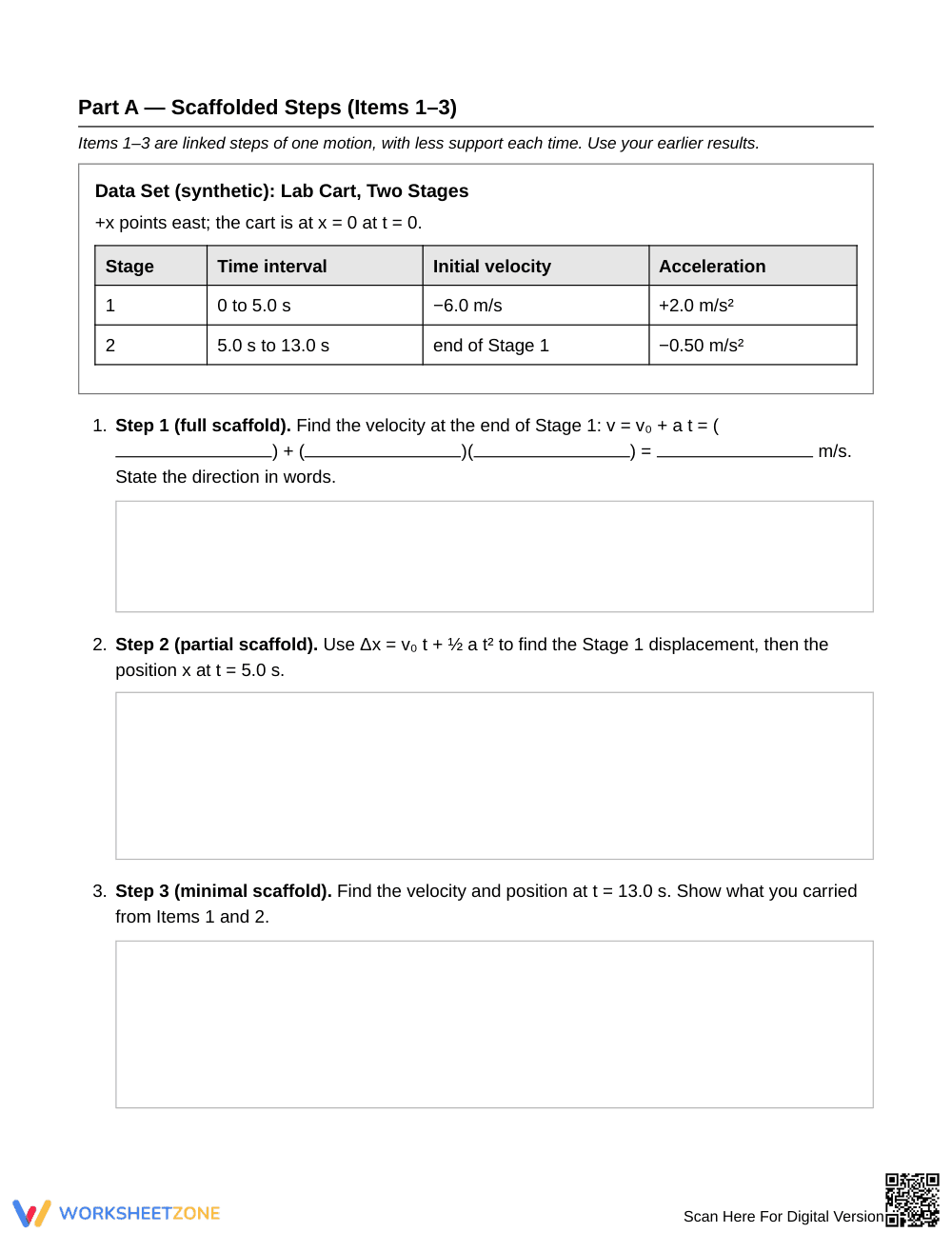
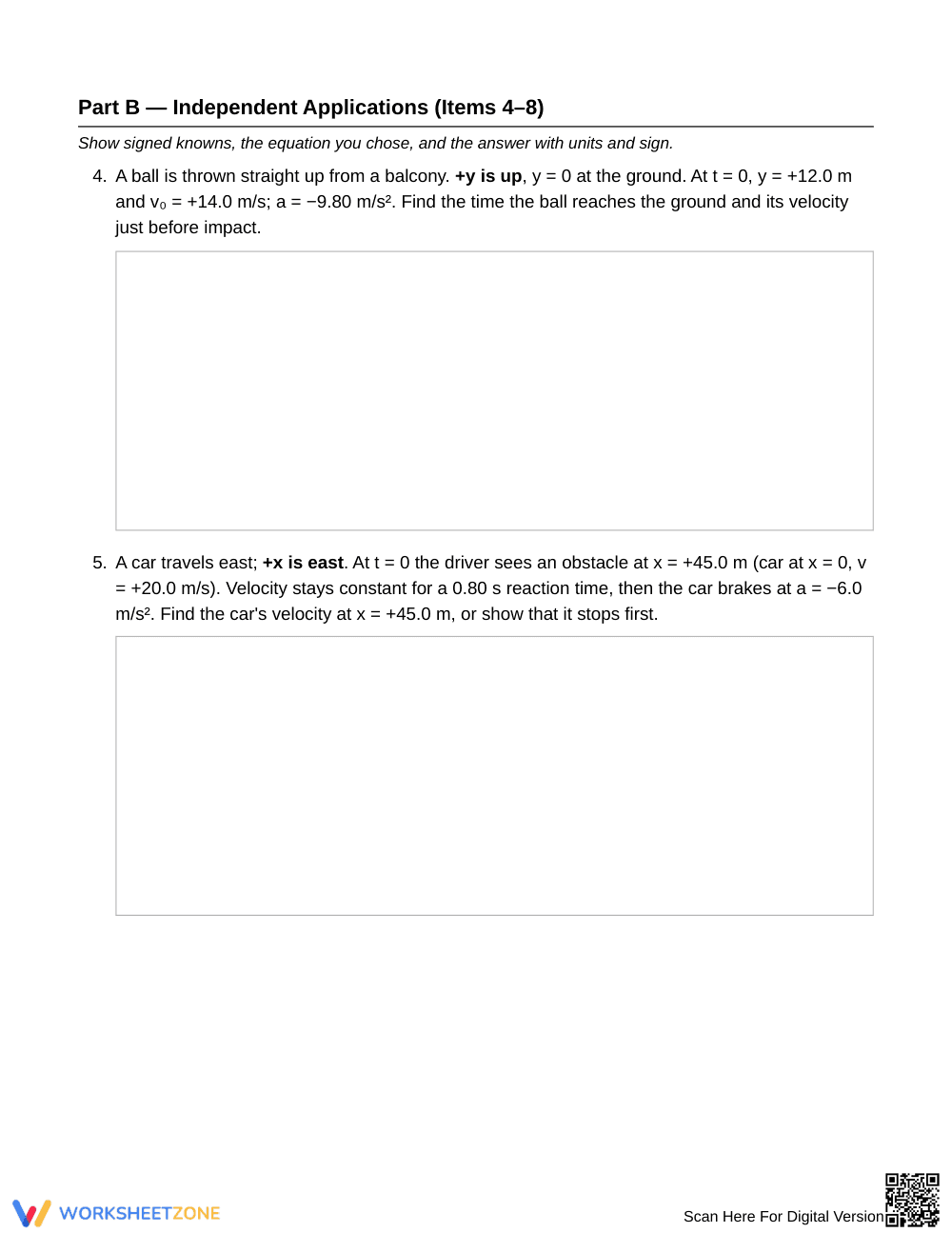
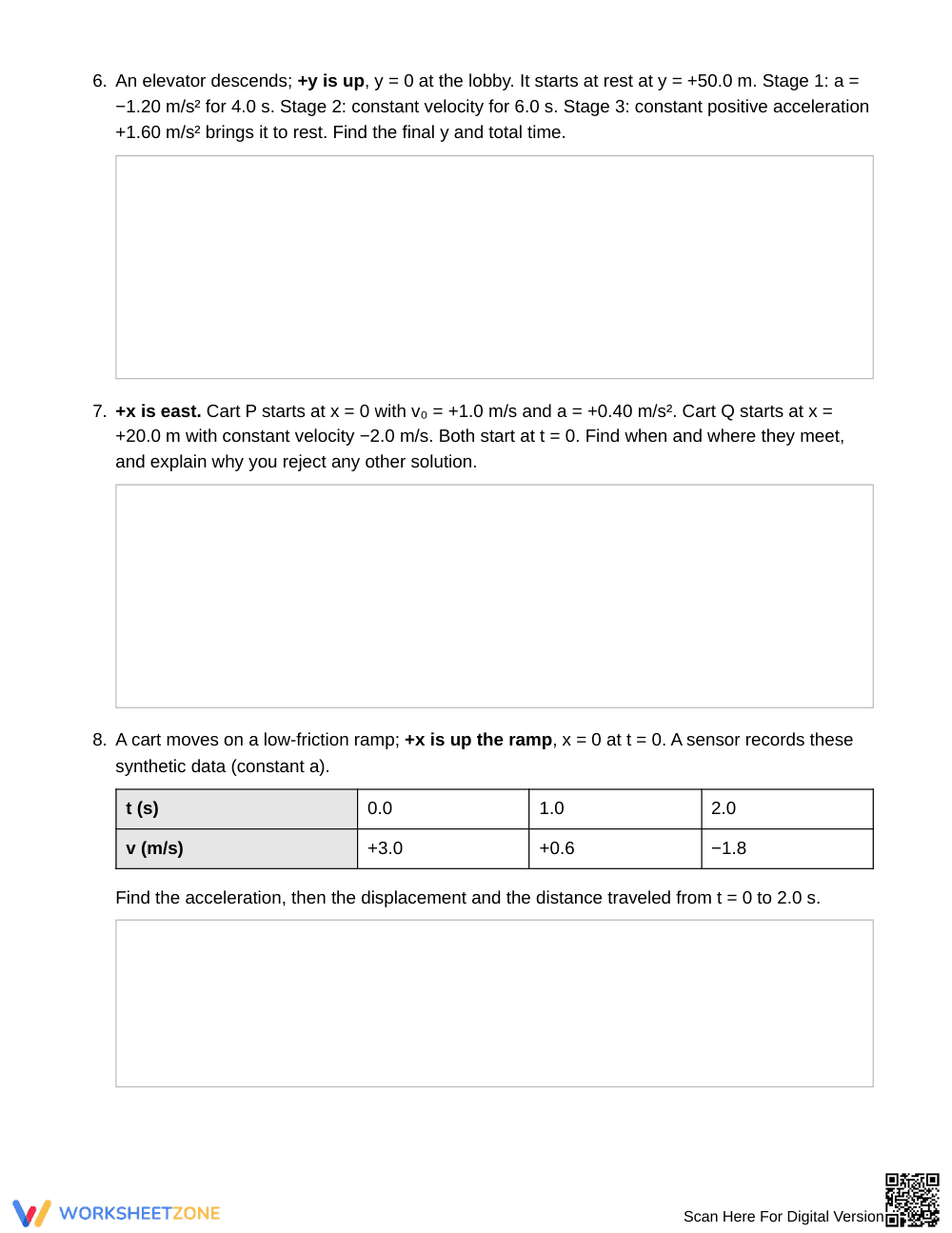
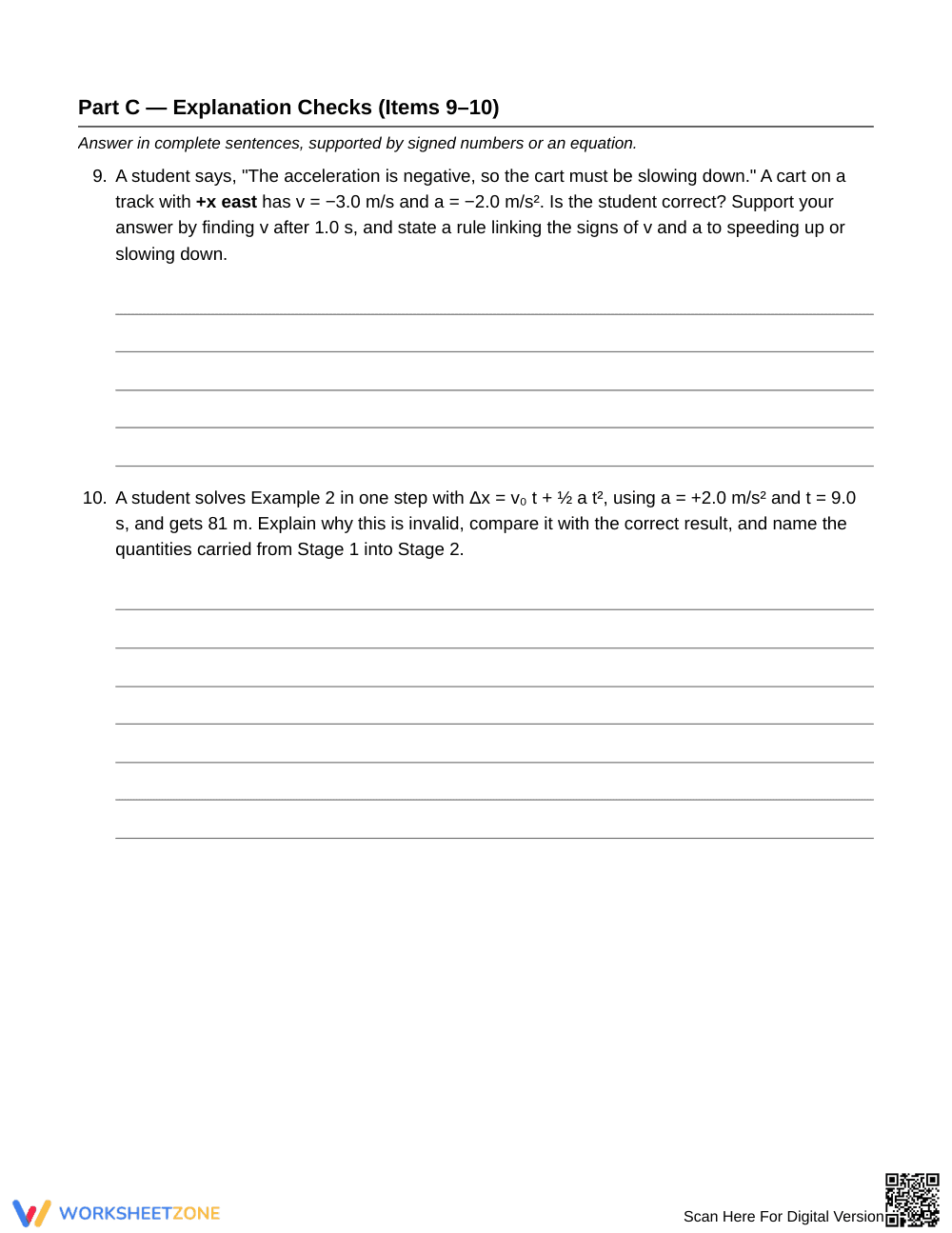
The five-page packet opens with a one-dimensional equation toolkit and two fully modeled examples. It then offers three linked scaffolded steps, five independent applications, and two written explanation checks. Data tables are included, and the answer key shows signed work, units, and directions.
Skill Progression
- Guided practice: Two worked examples show a reversal and a two-stage brake, with every sign explained.
- Supported practice: Items 1–3 follow one cart through two stages, with full, partial, then minimal scaffolding.
- Independent practice: Items 4–8 cover free fall, braking distance, an elevator, a meeting-point problem, and sensor data. Items 9–10 ask for written reasoning.
This sequence follows gradual release: I Do, We Do, You Do.
Standards Alignment
No standard code was supplied for this worksheet, so none is cited. It addresses one-dimensional motion with constant acceleration, including signed displacement, distance traveled, and multi-stage motion. Add your local standard code to lesson plans, IEP goals, or district curriculum mapping tools.
How to Use It
- After direct instruction: Assign Examples 1–2 and Items 1–3 as in-class practice, then Items 4–10 as independent work.
- Review session: Use Items 9–10 as a short discussion on sign conventions.
While students work, watch whether they name an axis and positive direction before substituting. Expect 40–50 minutes in total.
Who It's For
This worksheet suits algebra-based Grade 12 physics students who know the basic kinematic equations and need practice with signs and multi-stage motion. Students who need more support can stay with the scaffolded Items 1–3. Pair it with a direct instruction lesson on motion graphs.
This Grade 12 Physics worksheet on constant-acceleration kinematics asks students to solve one-dimensional motion problems using signed quantities and four equations that hold only while acceleration is constant. Ten tasks move from two modeled examples and a three-step linked scaffold to five independent applications and two explanation checks. Students define an axis and positive direction, split multi-stage motion at each change in acceleration, and carry final velocity and position into the next stage. Fisher & Frey (2014) describe gradual release of responsibility, moving from modeling to guided to independent work, as a reliable structure for building transfer, and this worksheet follows that sequence. The five-page packet includes a toolkit, data tables, and a full answer key. Answers keep units, signs, and directions. It suits an after-instruction practice session and gives teachers visible evidence of sign errors and equation choice.


