




























Printable Comparing Ordering Fractions: Error Analysis
Paste this activity's link or code into your existing LMS (Google Classroom, Canvas, Teams, Schoology, Moodle, etc.).
Students can open and work on the activity right away, with no student login required.
You'll still be able to track student progress and results from your teacher account.
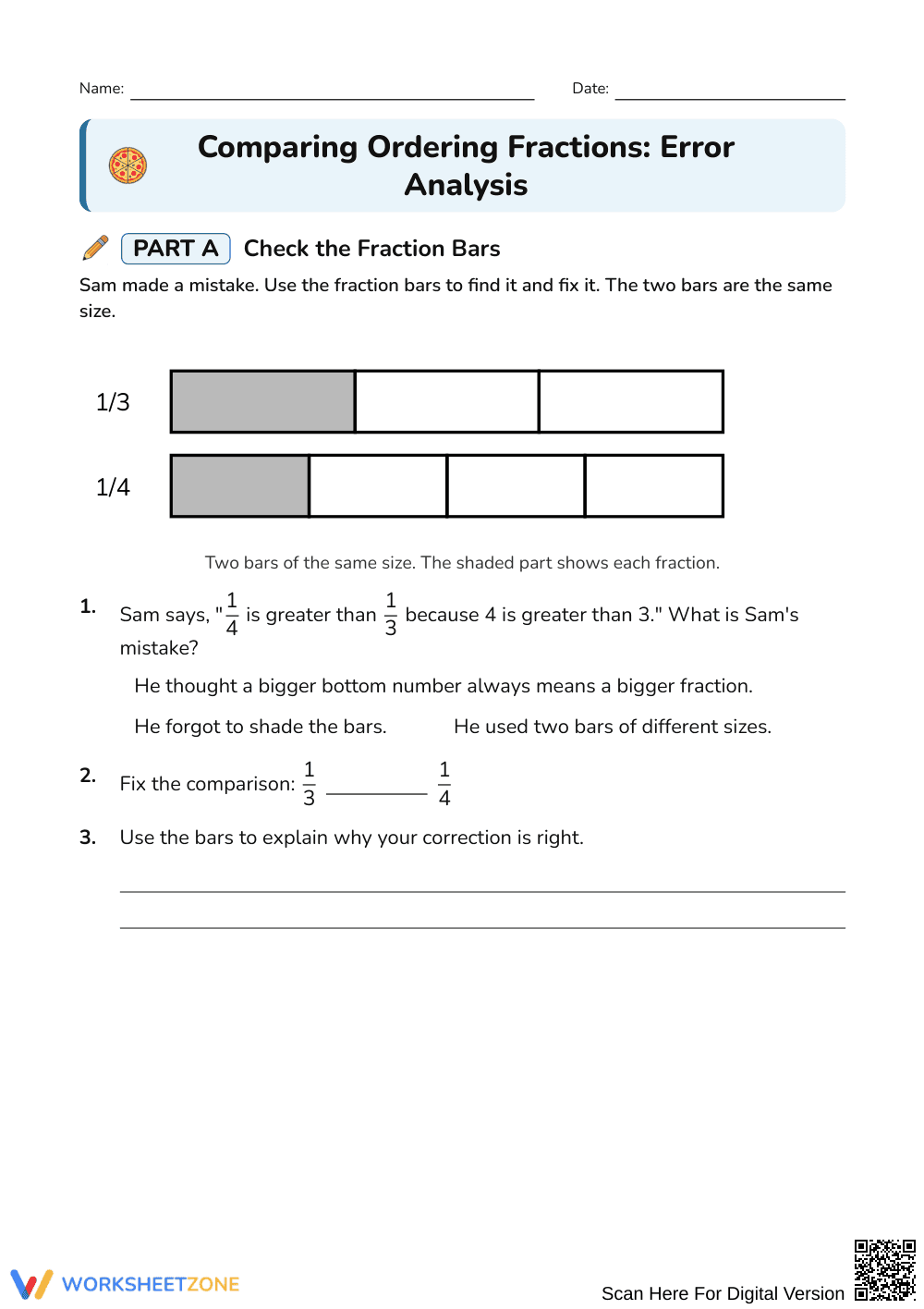
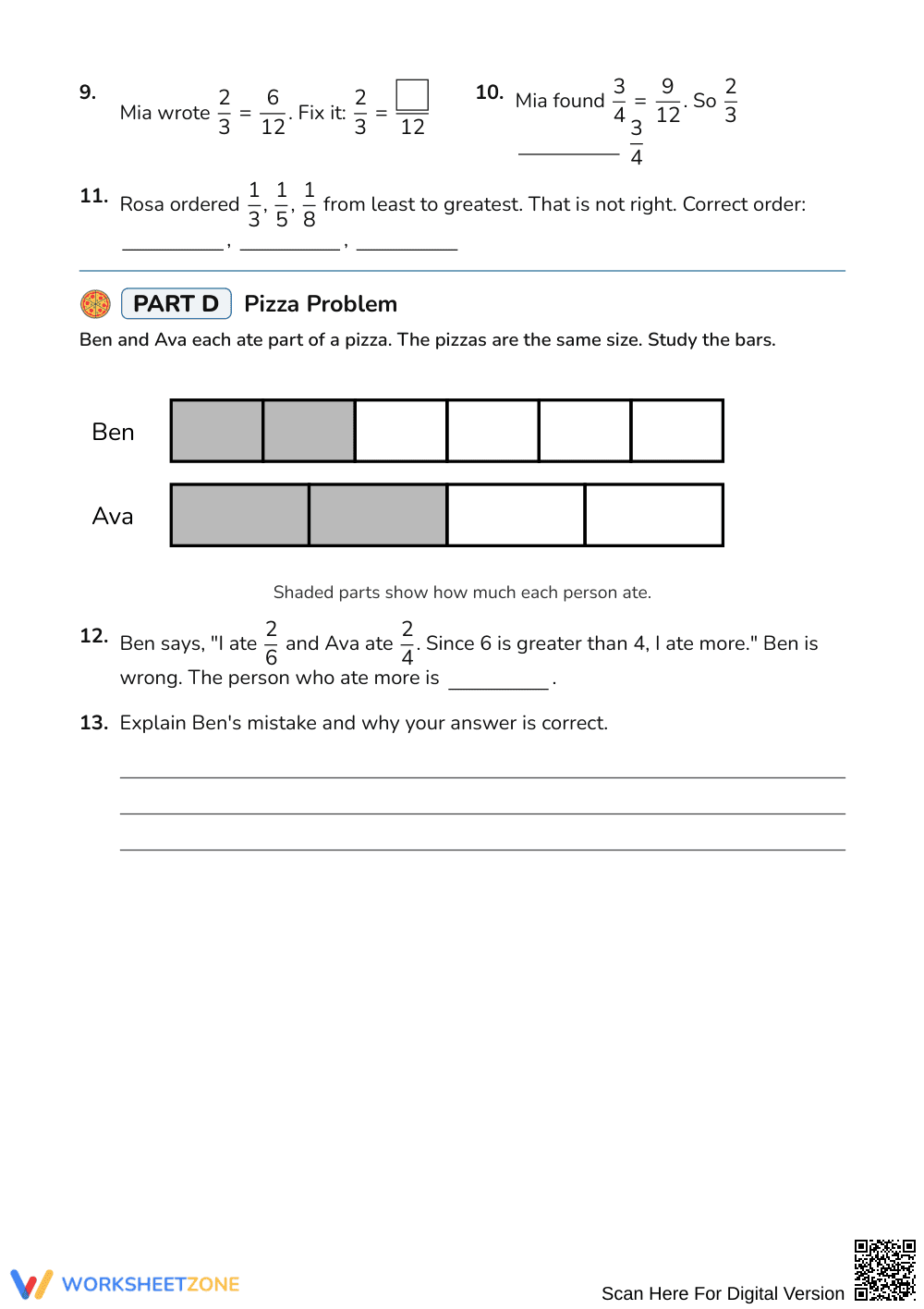
This Grade 4 math worksheet targets fraction comparison misconceptions through rigorous error analysis. Students evaluate 15 realistic errors, identify conceptual mistakes regarding numerator and denominator size, generate accurate corrections, and justify thinking with visual models. By examining flawed reasoning, learners deepen conceptual understanding of fraction magnitude.
At a Glance
- Grade: 4 · Subject: Math
- Standard:
4.NF.A.2— Compare fractions with different numerators and denominators using visual models and benchmarks.- Skill Focus: Fraction comparison error analysis and reasoning
- Format: 3 pages · 15 problems · Answer key included · PDF
- Best For: Targeted misconception intervention and collaborative math discourse
- Time: 30–45 minutes
What's Inside
Across 3 pages, students tackle 15 error-analysis tasks divided into four sections: fraction bar models, number line intervals, symbolic equations, and real-world word problems. A complete 3-page answer key provides clear corrections and explanations for efficient grading.
Skill Progression
- Guided practice (Part A, 3 problems): Students analyze fraction bars to identify denominator misconceptions and write visual justifications.
- Supported practice (Parts B–C, 8 problems): Learners correct number line tick-mark counting errors and evaluate equivalence statements with structured prompts.
- Independent practice (Part D, 4 problems): Fourth graders independently solve a multi-step pizza comparison problem, explaining why smaller denominators yield larger parts.
This sequence follows a gradual-release framework, advancing students from visual identification to independent written justification.
Standards Alignment
This worksheet aligns with primary standard `4.NF.A.2`: Compare two fractions with different numerators and different denominators by creating common denominators or comparing to benchmarks. It also reinforces supporting standard `4.NF.A.1` through equivalent fraction generation. Both standard codes can be copied directly into lesson plans, IEP goals, or district curriculum mapping tools.
How to Use It
Assign this worksheet after direct instruction on fraction comparison to uncover whole-number bias. During practice, observe whether students count number line intervals rather than tick marks in Part B. Expected completion time is 30 to 45 minutes.
Who It's For
Ideal for Grade 4 general math classrooms, Tier 2 intervention, and resource room support. Pair this resource with fraction tile manipulatives or a benchmark fraction anchor chart.
Mastering fraction comparison under standard 4.NF.A.2 requires students to evaluate relative fraction size by reasoning about numerators and denominators rather than applying rote rules. Error analysis provides an effective instructional vehicle for developing this conceptual fluency. According to Fisher & Frey (2014), analyzing non-examples and correcting flawed peer reasoning engages metacognitive monitoring and significantly strengthens conceptual transfer in elementary mathematics. When fourth graders identify why a larger denominator produces smaller unit pieces, they actively dismantle whole-number bias—a widespread barrier identified across national mathematics assessments. By combining visual fraction bars, number line representations, and written justifications, this 15-problem worksheet transitions learners from passive computation to active mathematical discourse. Students demonstrate genuine mastery not merely by producing a correct inequality sign, but by articulating why specific comparison strategies succeed across diverse visual representations and contextual problem scenarios.


