





























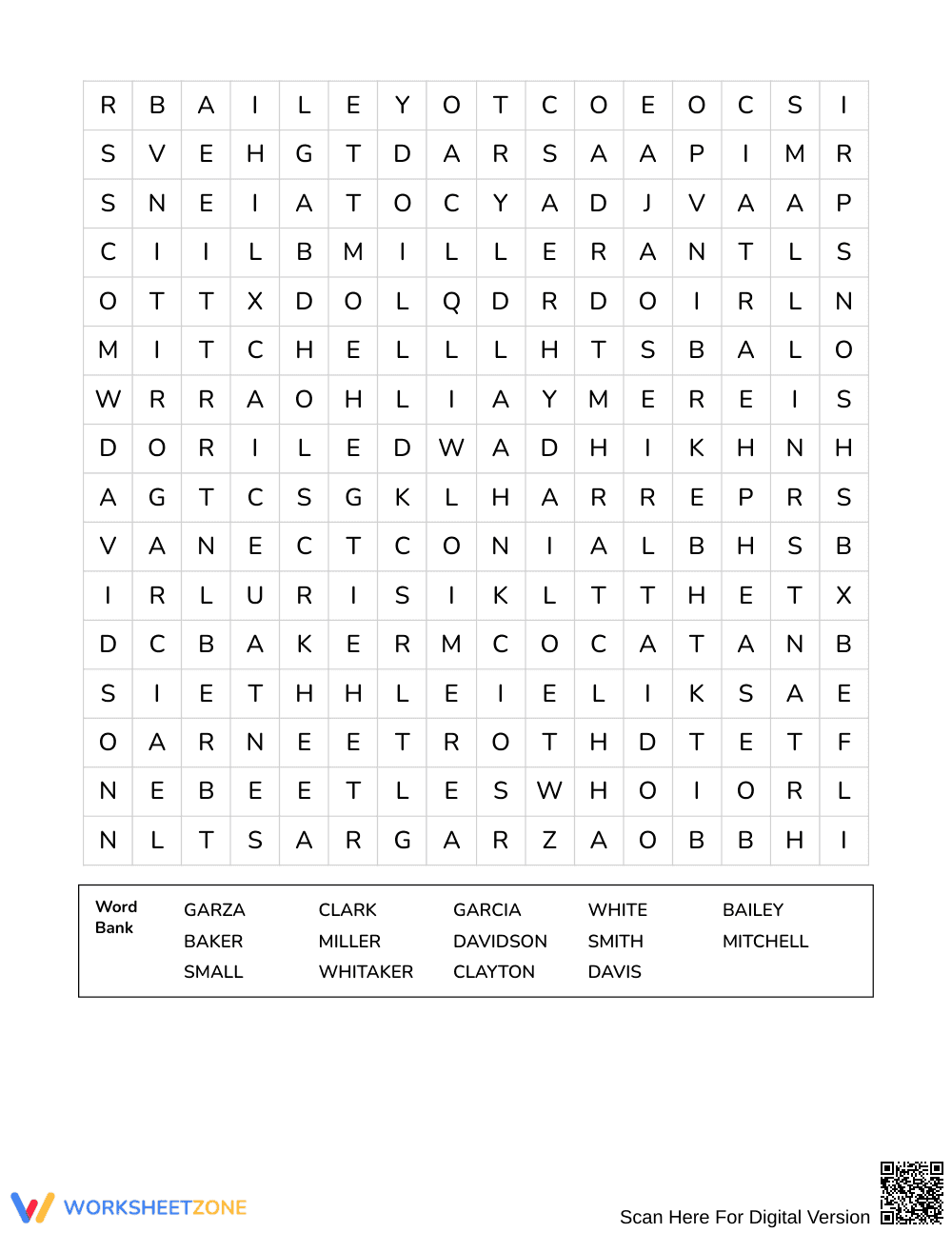


Printable Common Surnames Word Search | Grades 4–5 ELA

Paste this activity's link or code into your existing LMS (Google Classroom, Canvas, Teams, Schoology, Moodle, etc.).
Students can open and work on the activity right away, with no student login required.
You'll still be able to track student progress and results from your teacher account.
This historical surnames word search challenges upper elementary students to identify 14 shared-letter family names by solving rich etymological clues. Learners explore linguistics, history, and orthography as they read descriptive hints, deduce mystery names, and locate them across the grid, building robust word awareness and spelling pattern recognition.
At a Glance
- Grade: Grades 4–5 · Subject: English Language Arts
- Standard: Not standards-assessed — vocabulary enrichment
- Skill Focus: Surnames that share initial letter patterns
- Format: 3 pages · 14 words · Answer key included · PDF
- Best For: Vocabulary enrichment and early finisher work
- Time: 20–30 minutes
What's Inside: The printable PDF spans 3 total pages, pairing an organized historical clue detective sheet with an engaging word search grid. Students match 14 surnames—grouped in paired initial letter patterns like B, C, D, G, M, and W—to occupational, patronymic, and habitational clues before searching. A complete 3-page solution key shows exact letter coordinates for effortless verification.
Puzzle Mechanics and Structure: This activity centers on a dense 16 x 16 letter grid where all 14 target words are hidden. Words run in four specific orientations: northeast, east, southeast, and south. Rather than relying on a passive word list, students interact with a shuffled bank of detailed etymological clues. Learners analyze definitions—such as tracing occupational roots for Bailey, Baker, and Smith—deduce the correct spelling, and track letter sequences systematically across the grid.
Standards Alignment: This activity serves targeted vocabulary enrichment and is not aligned to a specific grade-level standard. It supports foundational orthographic awareness, morphemic exploration, and historical linguistic connections without requiring formal standards-based reporting.
How to Use It: Deploy this puzzle as an engaging bell ringer after introducing units on word origins, or assign it during independent literacy centers. During work time, observe whether students scan sequentially by initial letter clusters or cross-reference clue meanings to confirm spelling patterns before hunting. Most learners finish solving the clues and locating the vocabulary within 20 to 30 minutes.
Who It's For: Designed for students in Grades 4–5, this resource suits general education classrooms, gifted extensions, and structured independent study. Pair this activity with an anchor chart on occupational and patronymic naming conventions to deepen cross-curricular connections between language study and social studies.
Research from Fisher & Frey (2014) highlights that targeted word exploration and intentional vocabulary analysis significantly enhance morphological knowledge and orthographic retrieval for intermediate readers. By prompting students to deduce 14 historical surnames through contextual definitions before searching a 16 x 16 grid, this activity reinforces letter pattern awareness through active cognitive processing. Students examine how initial consonant clusters and root associations govern English surname conventions, transforming routine word-finding into meaningful etymological study. The integration of structured clue analysis encourages students to consolidate spelling recognition, evaluate language origins, and strengthen orthographic memory in an accessible, low-stakes format suitable for upper elementary literacy instruction.


