































Printable Common Surnames Word Search | Grades 4–5 ELA

Paste this activity's link or code into your existing LMS (Google Classroom, Canvas, Teams, Schoology, Moodle, etc.).
Students can open and work on the activity right away, with no student login required.
You'll still be able to track student progress and results from your teacher account.
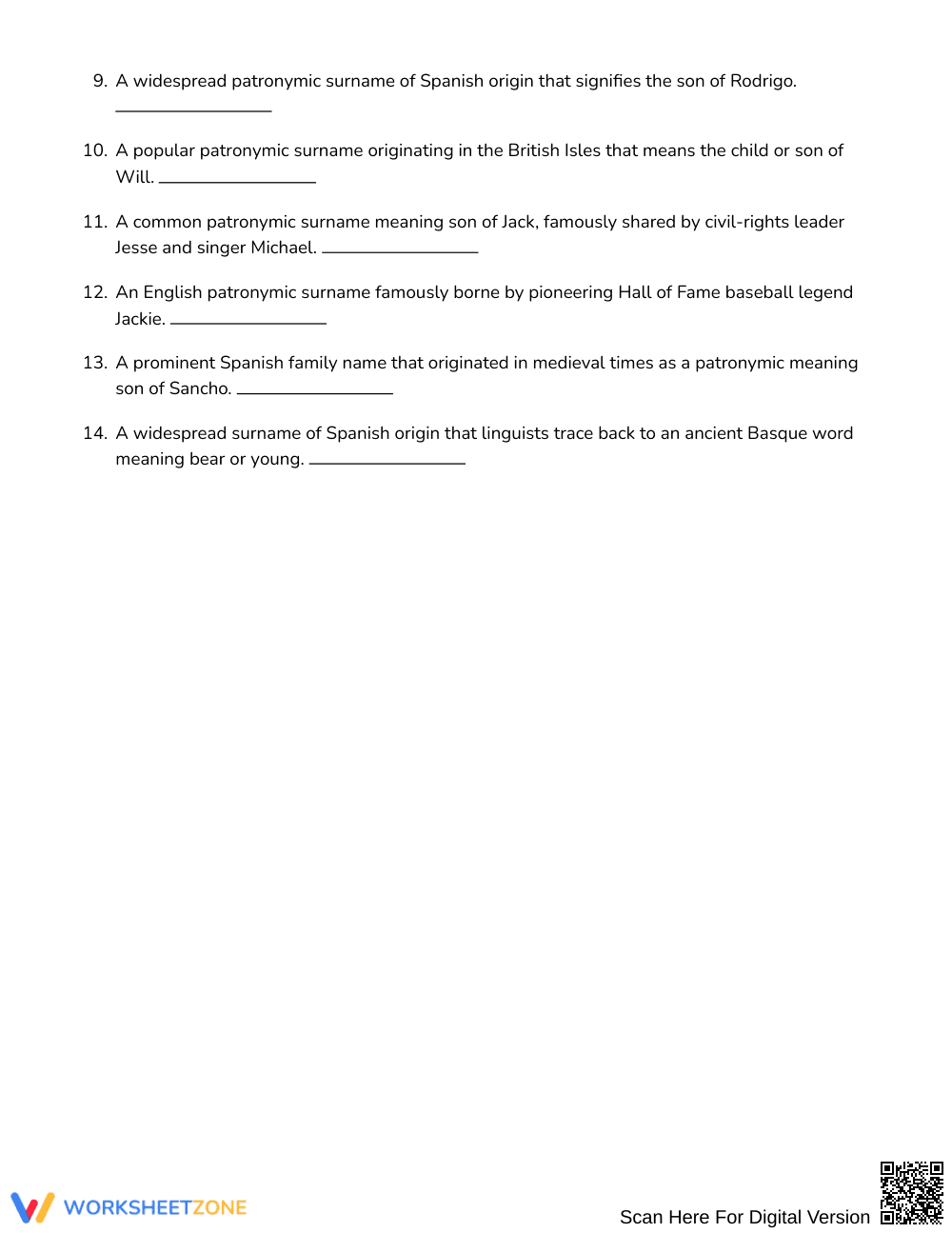
This Grades 4–5 word search builds etymological awareness and vocabulary skills by challenging learners to identify and locate 14 common surnames. Students read contextual historical clues to deduce each name before searching the letter grid, reinforcing orthographic patterns and morphemic memory through engaging, clue-driven language practice.
At a Glance
- Grade: Grades 4–5 · Subject: English Language Arts (ELA)
- Standard: Not standards-assessed — vocabulary enrichment through surname etymology and history
- Skill Focus: Longer surnames of six to nine letters and spelling patterns
- Format: 3 pages · 14 words · Full answer key included · Printable PDF
- Best For: ELA vocabulary stations, early finishers, and spelling enrichment
- Time: 20–30 minutes of independent or partner work
What's Inside
This 3-page printable activity features a clue detective format designed to build language connections. Students read 14 informative historical and linguistic clues that reveal common surnames—including Miller, Garcia, Robinson, and Rodriguez—ranging from six to nine letters. The activity includes a shuffled word bank and a 3-page answer key that highlights every target word directly on the grid for rapid checking.
Puzzle Mechanics and Structure
The word search is constructed around a 16 x 16 letter grid that houses all 14 hidden words. Words run in four distinct directions: northeast (NE), east (E), southeast (SE), and south (S). Instead of simply locating entries from an uncontextualized list, learners engage with etymology clues to deduce each surname before referencing the shuffled word bank and searching the grid, promoting active analytical processing.
Standards Alignment
This resource serves as targeted vocabulary enrichment and is not aligned to a specific grade-level academic standard. It focuses on morphemic familiarity, surname origins, and orthographic recognition across multisyllabic words, making it an ideal supplemental resource to reinforce general literacy and language curiosity.
How to Use It
Use this word search after direct instruction on multisyllabic spelling patterns or as an independent literacy station. It also functions well during morning work or for fast finishers. As students work, observe whether they read the historical clues to deduce surnames independently or rely strictly on the shuffled word bank to scan the grid. Most learners complete the activity within 20 to 30 minutes.
Who It's For
This activity is designed for students in Grades 4–5 developing fluency with longer spelling patterns and word roots. For students needing additional scaffolding, encourage collaborative partner solving or highlight the initial letters in the shuffled word bank. Pair this puzzle with an introductory mini-lesson on cultural onomastics and occupational surname history to deepen contextual comprehension.
Context-embedded word study and orthographic search activities offer substantial instructional value for upper elementary learners mastering complex spelling structures. According to Fisher & Frey (2014), intentional word exploration that connects semantic clues with orthographic recognition deepens lexical acquisition and long-term memory retrieval far more effectively than rote repetition. By prompting students in Grades 4–5 to decode cultural and occupational clues before locating 14 multisyllabic surnames of six to nine letters in a 16 x 16 letter grid, this puzzle bridges etymology, morphemic analysis, and spatial pattern recognition. Learners actively reinforce visual scanning strategies, letter-sequence recall, and language history as they track words across horizontal, vertical, and diagonal orientations. This purposeful integration of contextual clue interpretation transforms traditional puzzle mechanics into an authentic vocabulary enrichment experience that strengthens spelling confidence, linguistic curiosity, and independent literacy habits across diverse classroom environments.


