





























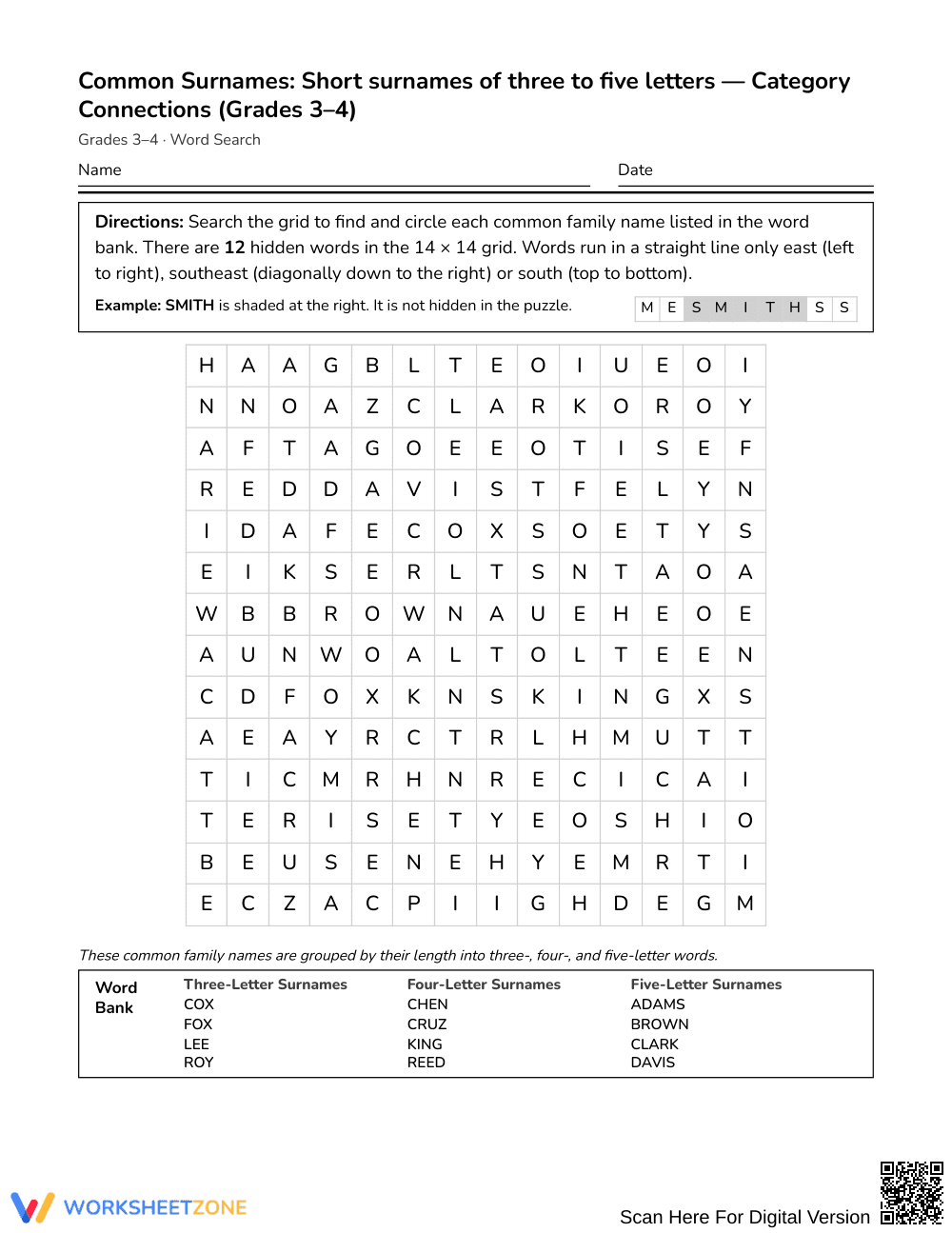


Printable Common Surnames Word Search | Grades 3–4 ELA

Paste this activity's link or code into your existing LMS (Google Classroom, Canvas, Teams, Schoology, Moodle, etc.).
Students can open and work on the activity right away, with no student login required.
You'll still be able to track student progress and results from your teacher account.
This printable word search helps elementary students identify common English surnames while reinforcing foundational spelling patterns and letter recognition. Learners search for 12 high-frequency three-letter, four-letter, and five-letter family names organized by word length. The activity builds orthographic awareness, visual scanning habits, and general cultural literacy in an engaging, self-directed format.
At a Glance
- Grade: Grades 3–4 · Subject: English Language Arts (ELA)
- Standard: Not standards-assessed — targeted vocabulary enrichment and cultural literacy
- Skill Focus: Short surnames of three, four, and five letters
- Format: 1 page · 12 words · Answer key included · PDF
- Best For: Independent vocabulary enrichment, morning work, and spelling practice
- Time: 15–25 minutes of focused student work
What's Inside
The activity sheet contains a clean puzzle grid presenting 12 target words, supported by a categorized word bank and clue list. Hidden surnames are organized into groups of three-letter, four-letter, and five-letter names. A comprehensive three-page answer key provides complete grid solutions and clear visual answer placements for rapid grading.
Puzzle Mechanics
The puzzle is built around a compact 14 x 14 letter grid designed specifically for intermediate elementary learners. Target words run in three forward-oriented directions: East (horizontal left-to-right), Southeast (diagonal downward-right), and South (vertical top-to-bottom). Students use the length-categorized bank and informational clue prompts to locate every surname without encountering reverse or backward-facing letter sequences.
Standards Alignment
This word search serves strictly as vocabulary enrichment and cultural literacy reinforcement; it is not aligned to a specific Common Core or state academic standard. It provides supplementary orthographic practice that complements formal language arts instruction, spelling lists, and etymology lessons.
How to Use It
Distribute this activity directly after a lesson on common English naming conventions or during an independent literacy workstation. It also serves effectively as a quiet morning starter or sub-plan filler. While students work, observe scanning strategies—such as tracking initial consonant blends—and prompt them to verify letter sequences. Expected completion time is 15 to 25 minutes.
Who It's For
This puzzle is tailored for Grade 3 and Grade 4 students developing spelling fluency and visual word-recognition skills. It provides accessible reinforcement for English language learners and striving readers who benefit from predictable letter groupings. Pair this activity with a biographical read-aloud or a class chart exploring family history and naming traditions.
Vocabulary enrichment activities focusing on short surnames of three to five letters strengthen elementary word-pattern recognition, letter-sequence awareness, and orthographic mapping. According to research on balanced literacy and gradual cognitive acquisition by Fisher & Frey (2014), purposeful word-recognition tasks and categorized print puzzles reinforce orthographic memory by prompting students to analyze letter groupings within structured visual fields. Although this puzzle is not standards-assessed and remains dedicated to vocabulary enrichment rather than formal benchmarks, it directly supports reading fluency. Searching across a 14 x 14 grid in forward East, Southeast, and South orientations encourages systematic visual scanning habits. By grouping common surnames by character count, the task enables intermediate elementary learners in Grades 3 and 4 to notice recurring consonant clusters and vowel pairs. Consequently, incorporating targeted word searches into independent literacy routines offers accessible, low-stress practice that reinforces foundational spelling schemas and lexical familiarity.


