





























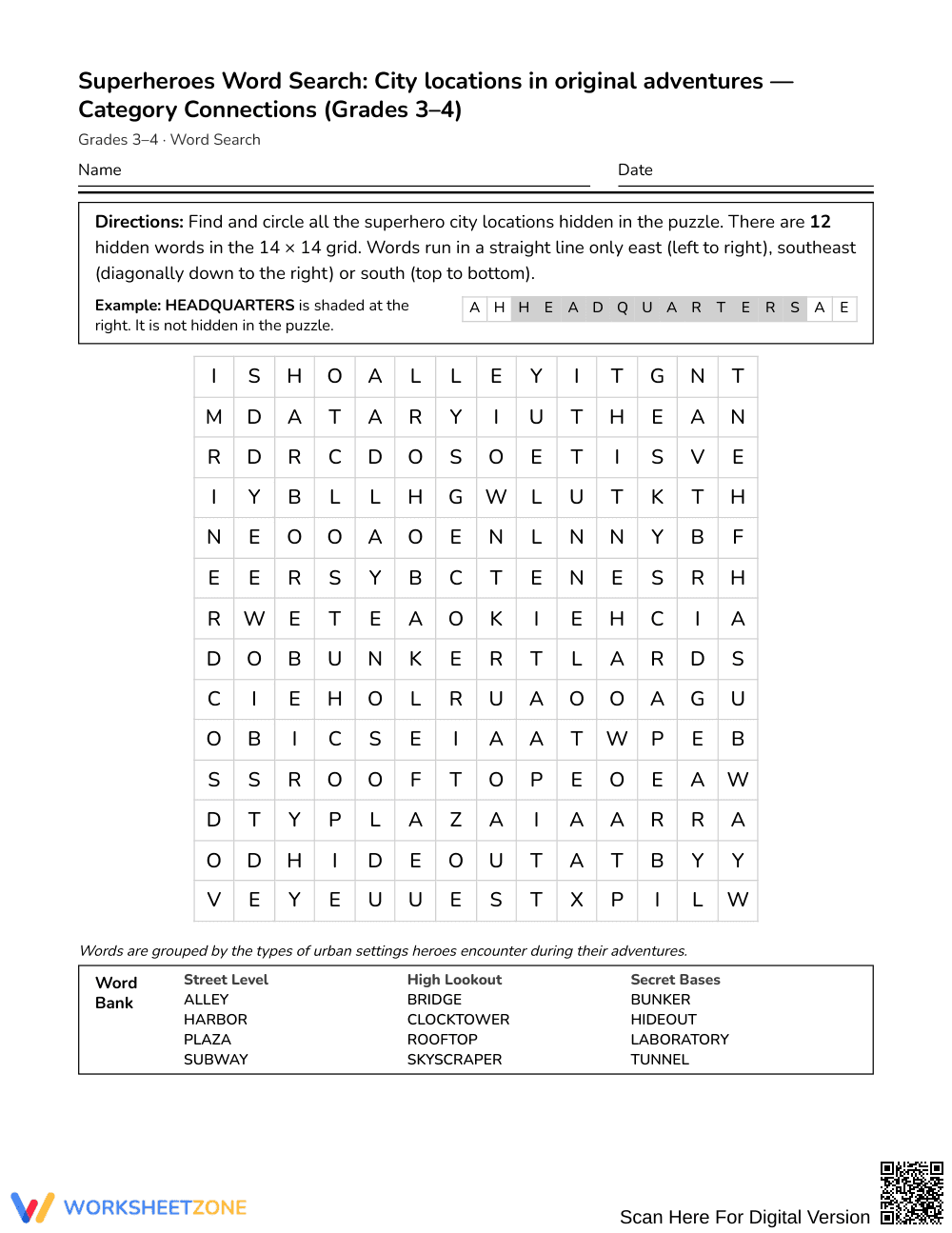


Printable City Locations Word Search | Grades 3–4 ELA

Paste this activity's link or code into your existing LMS (Google Classroom, Canvas, Teams, Schoology, Moodle, etc.).
Students can open and work on the activity right away, with no student login required.
You'll still be able to track student progress and results from your teacher account.
This printable word search introduces elementary students to descriptive urban vocabulary through an engaging superhero theme. Students locate thematic terms across categorized settings, reinforcing spatial reasoning and spelling patterns while expanding their background knowledge for creative writing and reading comprehension tasks.
At a Glance
- Grade: Grades 3–4 · Subject: English Language Arts (ELA)
- Standard: Not standards-assessed — vocabulary enrichment
- Skill Focus: City locations in original adventures
- Format: 1 pages · 12 words · Answer key included · PDF
- Best For: Vocabulary warm-up or fast-finisher activity
- Time: 15–20 minutes
What's Inside
This one-page activity features 12 urban location vocabulary terms arranged beneath a clean 14-by-14 letter grid. Terms are organized into three thematic categories: Street Level, High Lookout, and Secret Bases. Accompanying narrative definitions give context to words like bunker, harbor, and skyscraper, supported by a 3-page solution key for rapid review.
Zero-Prep Workflow
The activity operates on a compact 14-by-14 grid designed specifically for intermediate elementary readers. Target terms run in three accessible directions: East (horizontal left-to-right), Southeast (diagonal downward), and South (vertical downward). Categorized word lists and thematic definitions eliminate student hesitation, allowing teachers to print single copies in seconds, distribute immediately with no scissors or glue required, and conduct a visual check using the comprehensive answer key in under 2 minutes. The intuitive structure also makes it an ideal emergency sub plan resource.
Standards Alignment
This activity provides targeted vocabulary enrichment and is not aligned to a specific grade-level standard. It supports general language acquisition, orthographic recognition, and category association skills across intermediate literacy blocks.
How to Use It
Deploy this puzzle as an opening hook prior to an adventure narrative writing workshop to prompt vivid setting descriptors, or offer it during center rotations as an independent fast-finisher station. To assess student understanding formatively, circulate and ask learners to explain how their found word relates to its category heading before they mark it off. Most students complete the full 12-word search within 15 to 20 minutes.
Who It's For
Designed for students in Grades 3–4, this resource benefits general education classrooms, English language learners developing tier-two environmental vocabulary, and students receiving reading intervention. It pairs naturally with hero-themed anchor charts or narrative mentor texts exploring dynamic metropolitan story settings.
Explicit exposure to categorized tier-two vocabulary enhances semantic mapping and contextual recall in intermediate readers. According to Fisher & Frey (2014), purposeful word-learning tasks that connect structural orthography with thematic categorization build the durable cognitive schemas necessary for sustained reading comprehension and expressive writing. This 12-word puzzle challenges Grades 3–4 learners to scan a 14-by-14 grid along East, South, and Southeast orientations while reviewing narrative definitions for complex setting nouns such as laboratory and clocktower. By linking spatial search strategies with structured semantic clusters, students reinforce word recognition without cognitive fatigue. The included multi-page key guarantees immediate feedback, establishing an efficient, research-informed resource for independent vocabulary enrichment across elementary English Language Arts classrooms.


