































Printable China Variation Word Search | Grades 6–7 ELA

Paste this activity's link or code into your existing LMS (Google Classroom, Canvas, Teams, Schoology, Moodle, etc.).
Students can open and work on the activity right away, with no student login required.
You'll still be able to track student progress and results from your teacher account.
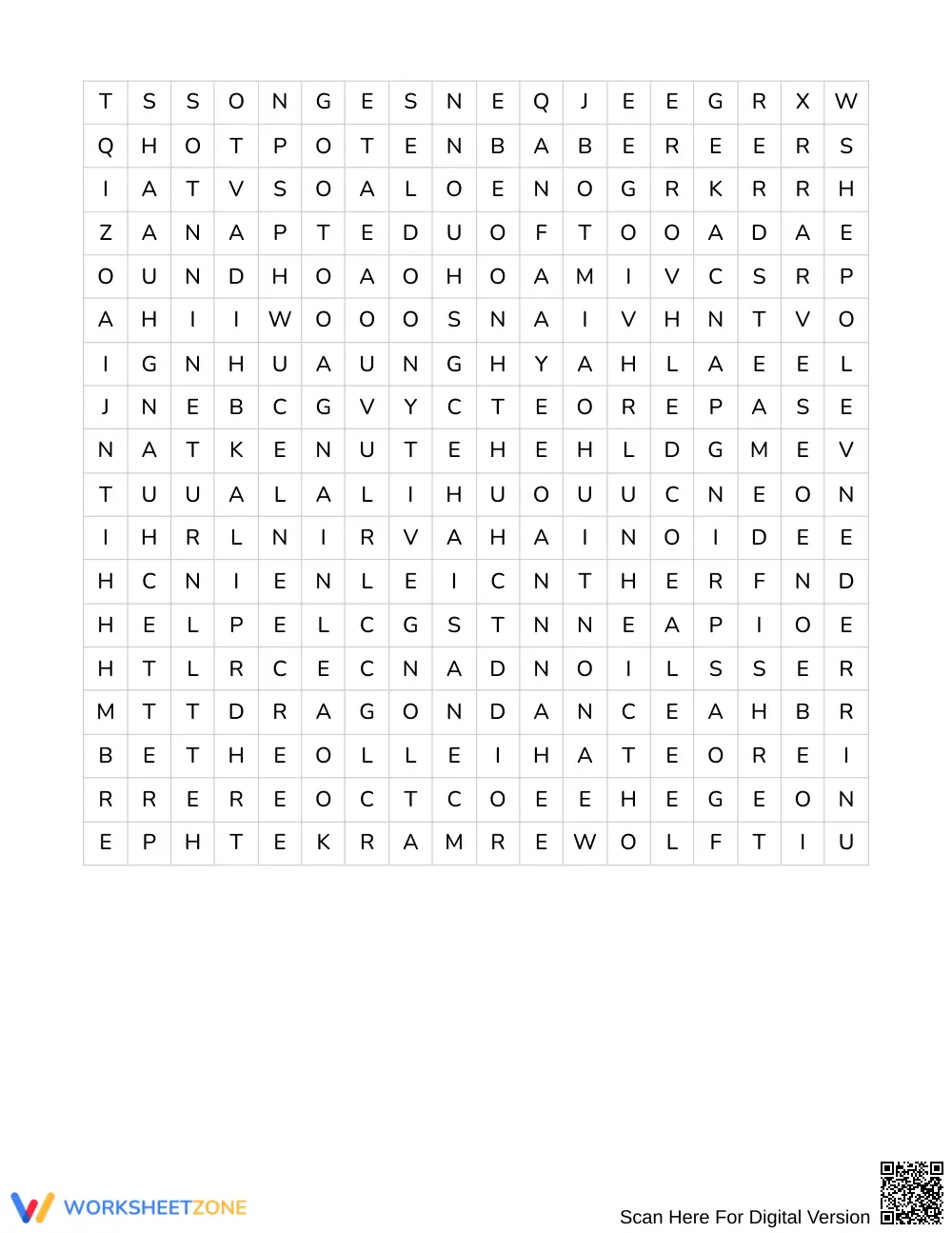
Students explore regional variations of Chinese New Year celebrations while searching for sixteen hidden vocabulary terms, reinforcing cultural knowledge and spelling accuracy in a single, engaging activity. The word search prompts learners to read concise clues, locate each term in an 18 × 18 grid, and then discuss the significance of each tradition.
At a Glance
- Grade: Grades 6–7 · Subject: English Language Arts (ELA)
- Standard:
Not standards-assessed — vocabulary enrichment— Identify regional Chinese New Year traditions and locate related terms for classroom learning- Skill Focus: regional variation in china
- Format: 3 pages · 16 words · Answer key included · PDF
- Best For: vocabulary enrichment and cultural awareness
- Time: 10–15 minutes
The activity spans three printable pages, featuring an 18 × 18 letter grid that runs in all eight compass directions (N, NE, E, SE, S, SW, W, NW). Sixteen culturally rich terms are hidden, each paired with a concise clue that explains its regional significance. An answer key on a fourth page provides the completed grid for quick verification.
- Print: Open the PDF and print the 3‑page packet (including answer key) in under 30 seconds.
- Distribute: Hand the word search to each learner; a brief 1‑minute introduction suffices.
- Review: After completion, use the answer key for a 5‑minute class debrief, reinforcing each tradition.
Total teacher preparation time is typically under two minutes, making the activity ideal for a quick sub‑plan or pop‑in enrichment slot.
This word search serves as vocabulary enrichment and is not aligned to any state or Common Core standard. It simply broadens learners’ cultural lexicon around Chinese New Year traditions.
Use the puzzle as a warm‑up before a lesson on global festivals, allowing students to activate prior knowledge while you model clue‑reading strategies. Alternatively, assign it as an independent activity after a cultural presentation; observe students’ ability to locate terms as a quick formative check, typically taking 10–15 minutes.
Designed for Grades 6–7 ELA learners, the activity supports emerging readers and English language learners by providing visual context and clear clues. Pair it with a short informational article on Chinese New Year or an anchor chart of regional customs for deeper exploration.
Research shows that culturally authentic word searches boost both vocabulary acquisition and student engagement (Fisher & Frey, 2014). This printable activity invites Grades 6–7 learners to identify regional Chinese New Year traditions while locating sixteen target terms, reinforcing spelling, meaning, and cultural context. By coupling concise clues with an 18 × 18 grid, the puzzle offers repeated exposure to key vocabulary, a strategy proven to improve retention for middle‑school readers. Teachers can quickly integrate the search into any ELA unit, confident that the brief, zero‑prep format respects classroom time while delivering meaningful enrichment. The included answer key streamlines assessment, allowing immediate feedback that aligns with formative‑assessment best practices highlighted in the literature. Additionally, the activity supports language learners by providing visual scaffolds, and the cultural focus aligns with multicultural education goals that foster empathy and global awareness.


