































Printable Character Emotions Word Search | Grade 3 ELA

Paste this activity's link or code into your existing LMS (Google Classroom, Canvas, Teams, Schoology, Moodle, etc.).
Students can open and work on the activity right away, with no student login required.
You'll still be able to track student progress and results from your teacher account.
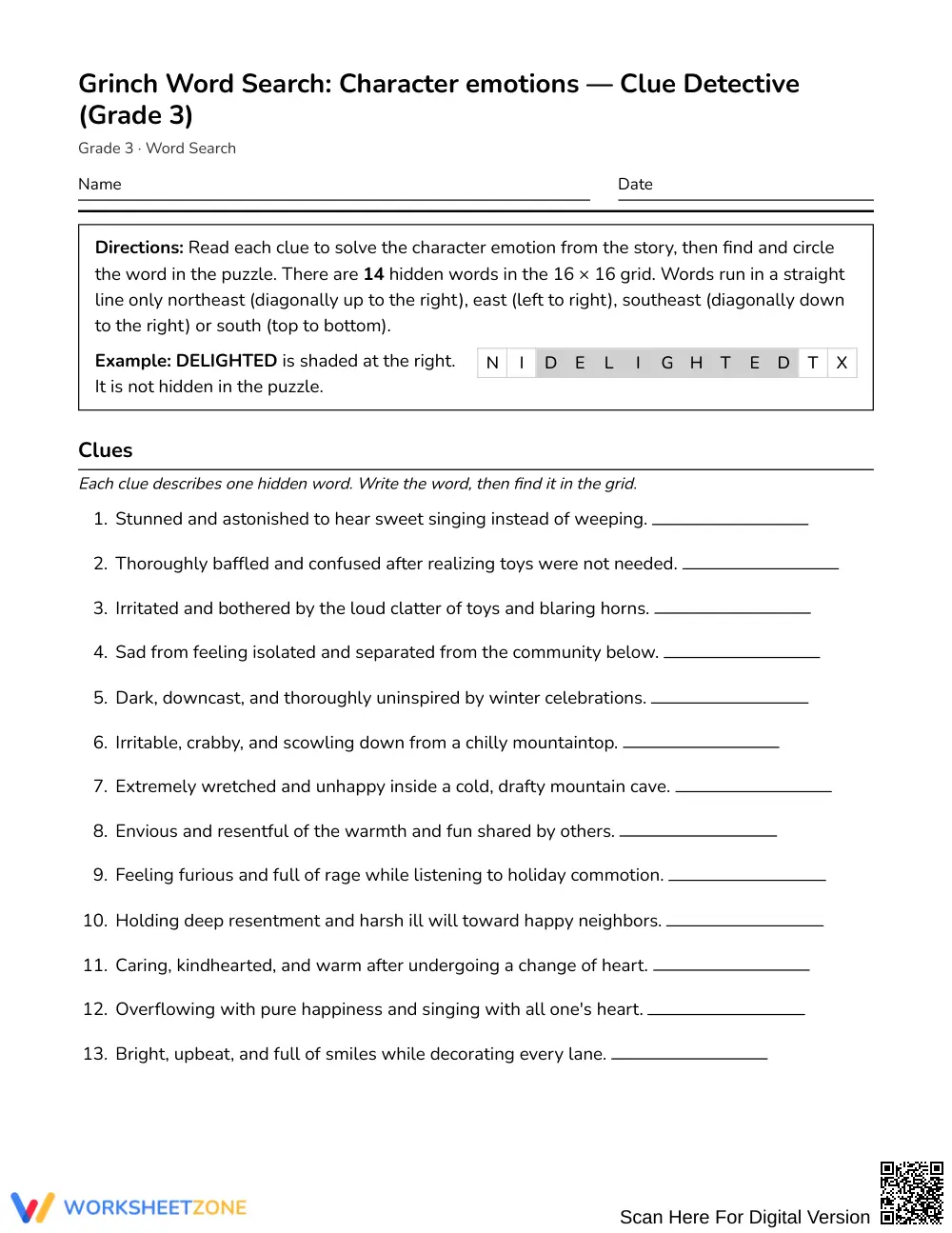
This Grade 3 character emotions word search reinforces literary vocabulary by challenging students to decipher emotion terms from context clues before hunting for them in the puzzle grid. Learners connect descriptive narrative scenarios to words like bitter, jealous, and joyful, strengthening reading comprehension and emotional vocabulary through engaging, targeted wordplay.
At a Glance
- Grade: Grade 3 · Subject: English Language Arts
- Standard: Not standards-assessed — vocabulary enrichment
- Skill Focus: Character emotions vocabulary
- Format: 2 pages · 14 words · Answer key included · PDF
- Best For: Independent vocabulary practice and review
- Time: 20–30 minutes
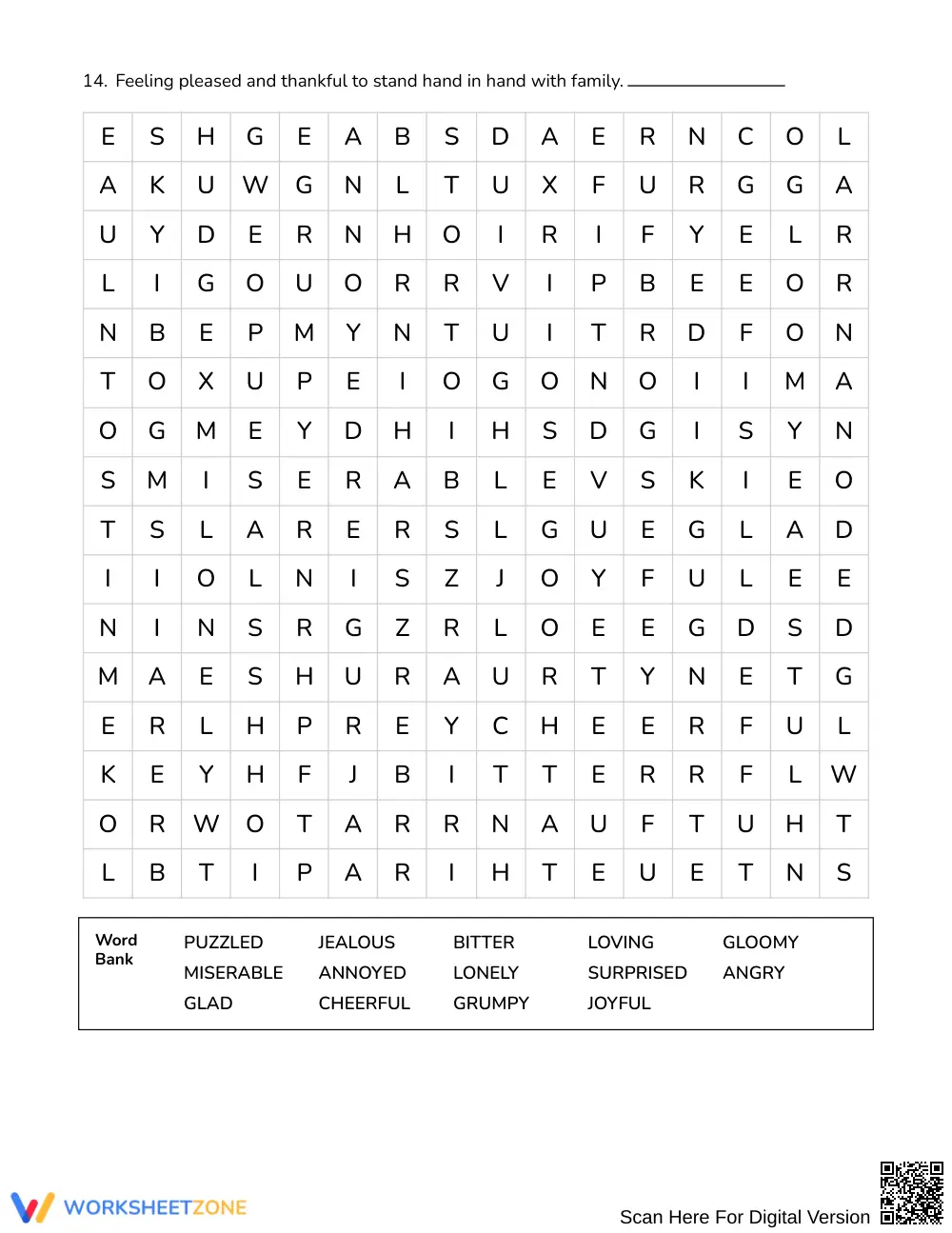
The activity spans 2 pages and features 14 words hidden inside a custom puzzle grid alongside 14 narrative-themed clue sentences. Instead of simply copying words from an alphabetized list, students read contextual clues describing character feelings—such as feeling irritated by holiday clatter or caring after a change of heart—to deduce each target emotion. A comprehensive 3-page answer key provides clear solution paths for fast grading.
This word search operates on a 16 x 16 letter grid designed to balance approachable challenge with vocabulary reinforcement. The 14 words run in four distinct directions: northeast, east, southeast, and south. Students encounter a shuffled word bank paired with contextual story clues, requiring them to read each clue, determine the matching emotion term, and locate the spelled word across diagonal, vertical, or horizontal letter paths.
This resource serves as targeted vocabulary enrichment and is not aligned to a specific academic standard. It supports foundational literacy by expanding descriptive vocabulary and encouraging students to analyze character reactions within narrative texts.
Introduce this word search after reading a character-driven winter story or novel chapter to solidify emotion-based vocabulary. During small-group instruction, ask learners to identify whether each clue represents an internal reaction or external behavior before searching the grid. This puzzle takes 20 to 30 minutes to complete.
This activity is designed for Grade 3 readers learning to describe internal character states, motive, and emotional transformation. Pair this printable puzzle with an anchor chart detailing shades of meaning or emotion synonyms to deepen textual analysis.
According to Fisher & Frey (2014), purposeful vocabulary instruction that links contextual definitions with active processing enhances long-term word acquisition and reading comprehension across elementary classrooms. This Grade 3 character emotions word search supports vocabulary enrichment by prompting students to analyze narrative clues before locating 14 vocabulary terms within a letter grid. Rather than completing isolated memorization drills, students engage in contextual retrieval by identifying emotional states such as feeling bitter, gloomy, or joyful within story-based descriptions. Educational research affirms that combining explicit clue analysis with structured print tasks increases student engagement and verbal fluency. Fisher & Frey (2014) demonstrate that integrating intentional vocabulary acquisition alongside joyful language discovery solidifies semantic networks, allowing young learners to recognize emotional subtleties in complex stories and express nuanced personal interpretations during literary discussions.


