





























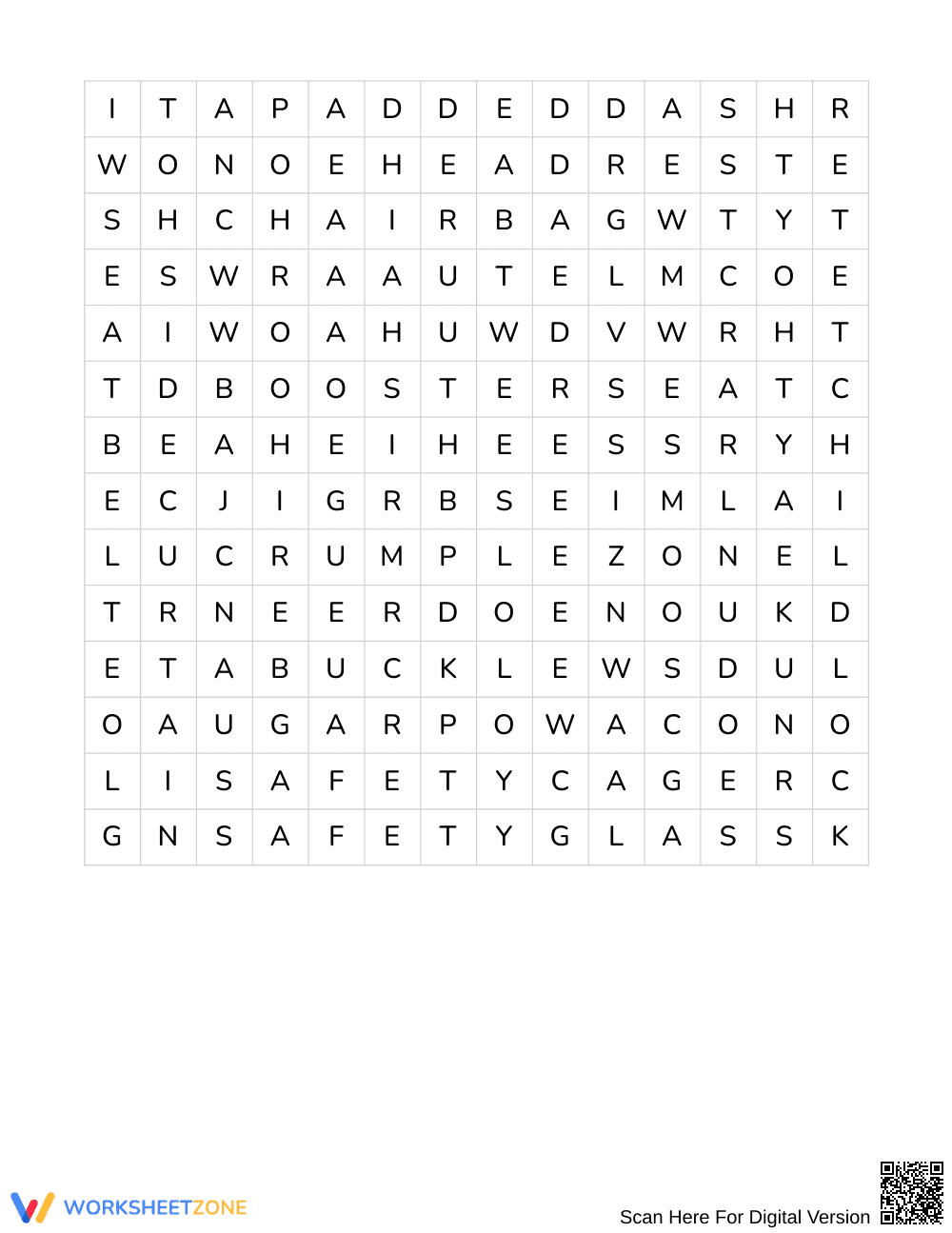


Printable Car Safety Word Search | Grades 3–4 ELA

Paste this activity's link or code into your existing LMS (Google Classroom, Canvas, Teams, Schoology, Moodle, etc.).
Students can open and work on the activity right away, with no student login required.
You'll still be able to track student progress and results from your teacher account.
This car safety features word search introduces elementary readers to vehicle safety concepts while reinforcing domain-specific vocabulary. Students locate key terms across categorized groups, connecting precise technical phrases to concrete vehicle protections.
At a Glance
- Grade: Grades 3–4 · Subject: English Language Arts (ELA)
- Standard: Not standards-assessed — vocabulary enrichment
- Skill Focus: passenger safety features
- Format: 2 pages · 12 words · Answer key included · PDF
- Best For: Vocabulary enrichment and early finisher work
- Time: 15–25 minutes
What's Inside
This 2-page vocabulary resource features a clean letter puzzle alongside an organized reference list containing 12 words. Terms are arranged across three thematic categories: restraints and seats, airbags and cushioning, and structural door protection. Accompanying student clues offer concise definitions for each term, supported by a 3-page solution guide that highlights completed letter paths for rapid visual checking.
Puzzle Mechanics and Structure
The activity is built on a 14 x 14 letter grid designed specifically for intermediate elementary learners. Target vocabulary terms run exclusively in three orientations: east (left to right), south (top to bottom), and southeast (diagonal downward). Rather than scanning random lists, students interact with a categorized word bank and explanatory clues that illuminate vehicle mechanics as they search.
Standards Alignment
This activity provides targeted vocabulary enrichment and is not aligned to an assessed state academic standard. It supports cross-curricular informational reading by developing specialized technical language in automotive safety and engineering.
How to Use It
Deploy this puzzle during independent reading rotations or as an engaging literacy center following an informational reading passage about transportation technology. For formative observation, watch whether students read the protective definitions to guide their search or rely purely on letter matching, noting which domain-specific compound nouns require clarification. Most learners complete the activity in 15 to 25 minutes.
Who It's For
Designed for Grades 3–4 learners, this word search suits general education classrooms, science-literacy integration blocks, and structured quiet-work periods. It pairs naturally with non-fiction articles on simple machines, physics of motion, or community safety rules.
Contextual vocabulary exposure accelerates domain-specific language acquisition when terms are grouped by semantic relationships rather than isolated definitions. According to Fisher & Frey (2014), intentional word exposure through structured categorizations strengthens student lexical retention and enhances background knowledge across informational domains. While this Grades 3–4 automotive word search is not standards-assessed, its focus on passenger safety features gives students repeated visual interactions with multi-word safety terminology such as crumple zones and side curtains. Engaging with technical terminology inside structured 14 x 14 puzzle grids reinforces word-pattern recognition, orthographic memory, and cross-curricular concept synthesis. By embedding informative definitions directly beside categorized search lists, the activity bridges early mechanical literacy and language fluency, fostering purposeful reading confidence during independent classroom study.


