





























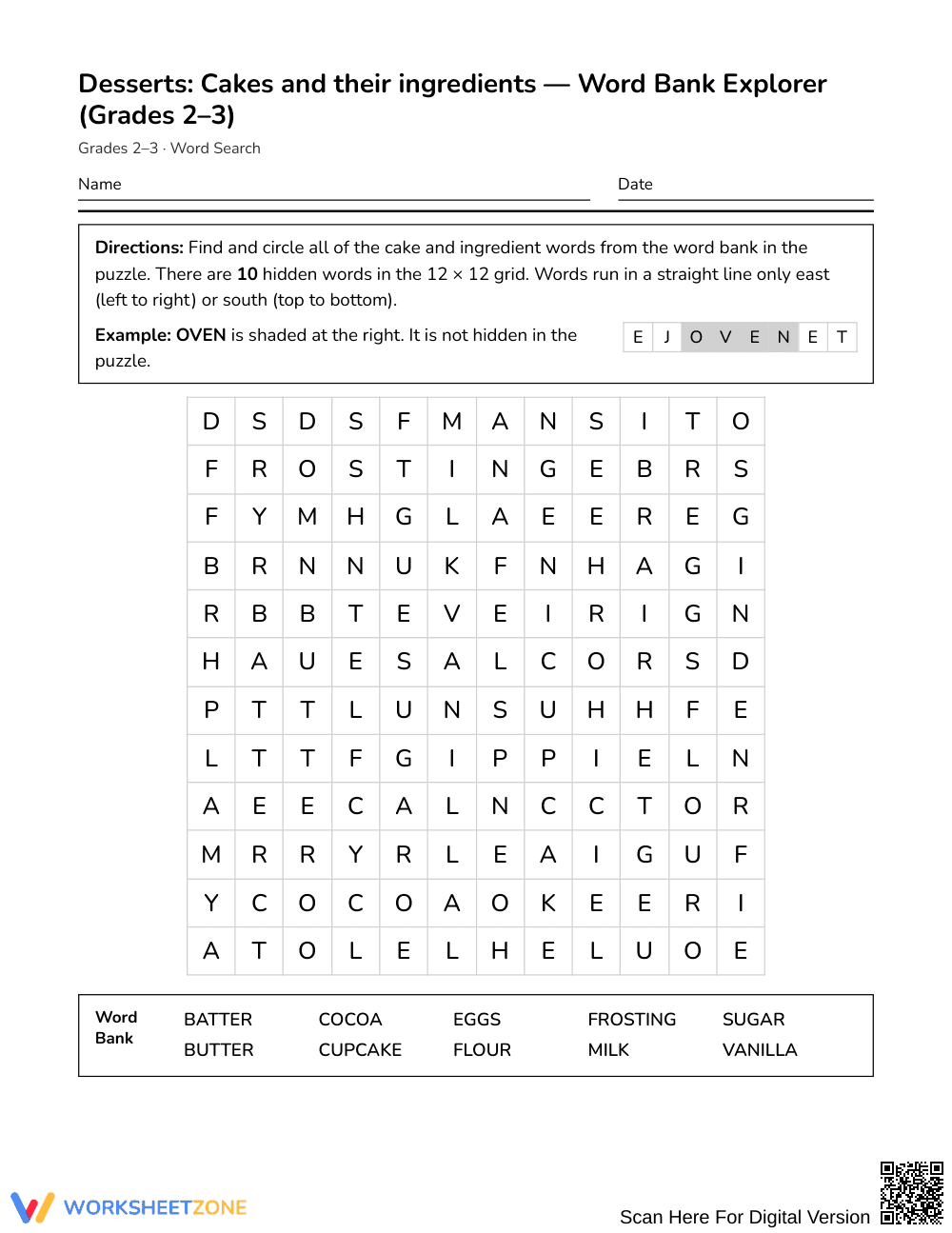


Printable Cake Ingredients Word Search | Grades 2–3 ELA

Paste this activity's link or code into your existing LMS (Google Classroom, Canvas, Teams, Schoology, Moodle, etc.).
Students can open and work on the activity right away, with no student login required.
You'll still be able to track student progress and results from your teacher account.
This Grades 2–3 vocabulary word search helps young readers recognize and reinforce ten essential terms related to cakes and baking ingredients. Students read definitions, connect culinary terms to clear descriptions, and track each target word across an age-appropriate letter grid to strengthen word recognition and orthographic memory.
At a Glance
- Grade: Grades 2–3 · Subject: English Language Arts (ELA)
- Standard: Not standards-assessed — vocabulary enrichment
- Skill Focus: cakes and their ingredients
- Format: 1 pages · 10 words · Answer key included · PDF
- Best For: Early finishers, sub plans, and literacy centers
- Time: 15–20 minutes
What's Inside
This 1-page vocabulary activity features an alphabetical word bank paired with child-friendly definitions for all 10 words, including items such as batter, vanilla, and cupcake. A complete 2-page answer key displays exact letter grid positions for rapid verification, making visual tracking and self-monitoring straightforward for early elementary learners.
Puzzle Mechanics & Design
The activity is built specifically for early readers in Grades 2–3. The hidden words sit within a clean 12 x 12 grid, with entries running in only two beginner-friendly directions: East (left-to-right) and South (top-to-bottom). By omitting backwards and diagonal orientations, the layout supports developing spatial awareness without visual frustration. An alphabetical word bank and glossary provide structured scaffolding that encourages context-based comprehension before searching.
Standards Alignment
This activity is designed as open vocabulary enrichment and is not aligned to a formal grade-level standard. It supports foundational literacy by strengthening decoding, spelling automaticity, and thematic concept development across primary reading blocks.
How to Use It
Use this activity during independent reading stations after direct vocabulary instruction on cooking and procedural texts, or distribute it as an engaging, low-stress sub plan. As a formative tip, observe whether students read the full word before searching or scan letter-by-letter to pinpoint decoding efficiency. Most students complete the full 10-word puzzle in 15 to 20 minutes.
Who It's For
This resource serves general education classrooms, English learners developing food-related vocabulary, and intervention groups targeting visual scanning and spelling accuracy. It pairs naturally with instructional baking read-alouds, procedural recipe writing lessons, and classroom kitchen thematic units.
Targeted word searches serve as effective orthographic reinforcement tools in early elementary literacy blocks. According to Fisher & Frey (2014), intentional exposure to thematic vocabulary across multiple modalities solidifies semantic connections and accelerates print-word recognition for developing readers. By presenting 10 words embedded in a focused 12 x 12 grid restricted strictly to East and South directions, this resource provides manageable orthographic practice. Students associate concrete definitions with target terms such as batter, cocoa, and frosting, bridging contextual meaning and spelling patterns. The accompanying answer key ensures that teachers and support staff can monitor word acquisition with zero prep time. Serving as foundational vocabulary enrichment rather than formal standards-based assessment, the activity provides Grades 2–3 students with deliberate practice that bolsters visual discrimination and reading stamina during independent literacy centers.


