





























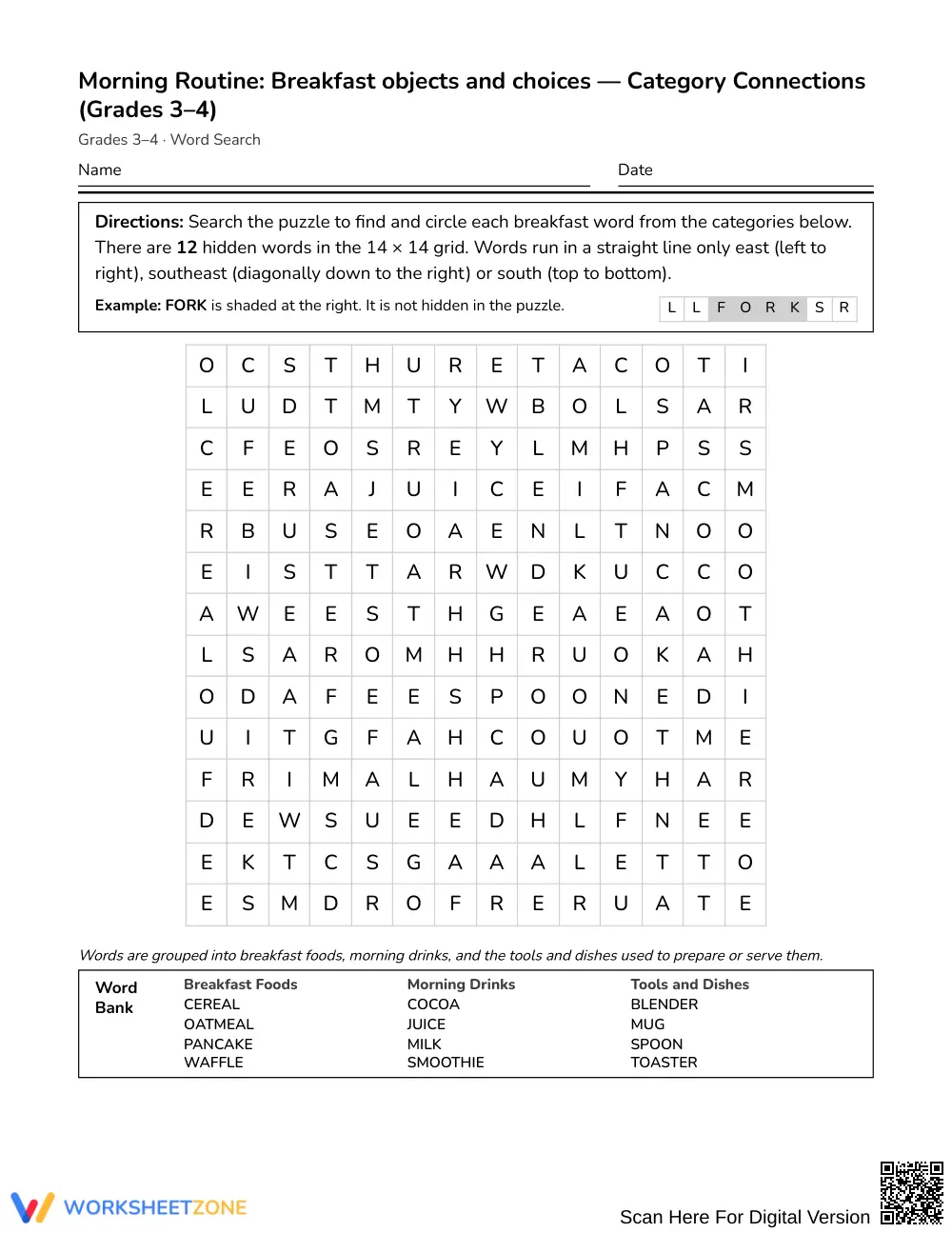


Printable Breakfast Vocabulary Word Search | Grades 3–4 ELA

Paste this activity's link or code into your existing LMS (Google Classroom, Canvas, Teams, Schoology, Moodle, etc.).
Students can open and work on the activity right away, with no student login required.
You'll still be able to track student progress and results from your teacher account.
This breakfast-themed word search strengthens Grades 3–4 vocabulary recognition through semantic sorting and puzzle solving. Students identify and locate 12 morning routine terms organized across three distinct categories, reinforcing word associations and orthographic mapping. It provides purposeful spelling practice and vocabulary engagement for elementary English Language Arts classrooms.
At a Glance
- Grade: Grades 3–4 elementary · Subject: English Language Arts (ELA)
- Standard: Not standards-assessed — vocabulary enrichment
- Skill Focus: Breakfast vocabulary objects, drinks, and tools
- Format: 1 page · 12 words · Full answer key included · Printable PDF
- Best For: Morning work, literacy centers, and fast finishers
- Time: 15–20 minutes
What's Inside
This single-page vocabulary activity contains a 14-by-14 letter grid alongside 12 themed vocabulary entries. Words are classified under three categorical headings: Breakfast Foods, Morning Drinks, and Tools and Dishes. Each entry features an explanatory definition clue to support reading comprehension, while a comprehensive 3-page answer key provides clear solution pathways for quick checking.
Puzzle Mechanics and Word Layout
The word search challenges learners within a 14-by-14 letter grid. Hidden words run in three specific directions: East (horizontal left-to-right), Southeast (diagonal downward-right), and South (vertical top-to-bottom). Students read the category-based word bank or utilize the descriptive definition clues to locate all 12 target terms without backward or upward orientations, keeping the search accessible and rewarding.
Standards Alignment
This printable word search serves as a vocabulary enrichment resource and is not aligned to a specific grade-level standard. It supports foundational literacy by strengthening word recognition, contextual classification, and letter pattern awareness through focused semantic categories.
How to Use It
Deploy this word search during morning arrival routines or as a transition task following direct vocabulary instruction. For an effective formative check, circulate while students search and ask them to explain which category a word belongs to before circling it. Most learners will complete the activity within 15 to 20 minutes.
Who It's For
Designed for students in Grades 3–4, this puzzle supports emerging spellers, general education classrooms, and English language learners developing everyday situational vocabulary. For differentiated support, pair this activity with an illustrated morning routine anchor chart or a short descriptive passage about healthy breakfast foods.
Categorical word searches provide effective orthographic and conceptual reinforcement for elementary learners developing foundational literacy skills. According to Fisher & Frey (2014), purposeful vocabulary acquisition relies on multiple meaningful encounters where students connect terms to broader conceptual networks and semantic categories. By organizing 12 breakfast objects and choices into logical groups—such as morning drinks, morning foods, and kitchen preparation tools—this Grades 3–4 activity reinforces thematic classification alongside spelling patterns. Searching a 14-by-14 letter grid for vocabulary terms oriented horizontally, vertically, and diagonally strengthens visual scanning, letter sequence recognition, and word retention. Furthermore, integrating brief descriptive definitions alongside the word bank anchors word meaning in daily living contexts, ensuring that puzzle completion serves active reading comprehension rather than passive letter hunting. This structured design delivers focused vocabulary practice that supports literacy growth across diverse elementary classroom settings.


