




























Views
Downloads




Printable Bonding Models Worksheet | Grade 11 Chemistry

Paste this activity's link or code into your existing LMS (Google Classroom, Canvas, Teams, Schoology, Moodle, etc.).
Students can open and work on the activity right away, with no student login required.
You'll still be able to track student progress and results from your teacher account.
This worksheet helps Grade 11 chemistry students distinguish ionic bonds, covalent bonds, and intermolecular forces, then use that understanding to write formulas, name compounds, and predict properties. Students finish able to explain what breaks when a substance melts or boils and to justify claims with charge, distance, and electronegativity.
At a Glance
- Grade: 11 · Subject: Chemistry
- Standard: Bonding models — Explain bonds, name compounds, and justify property predictions with evidence.
- Skill Focus: Ionic and covalent bonding models
- Format: 5 pages · 12 problems · Answer key included · PDF
- Best For: Unit review after bonding instruction
- Time: 40–50 minutes
What's Inside
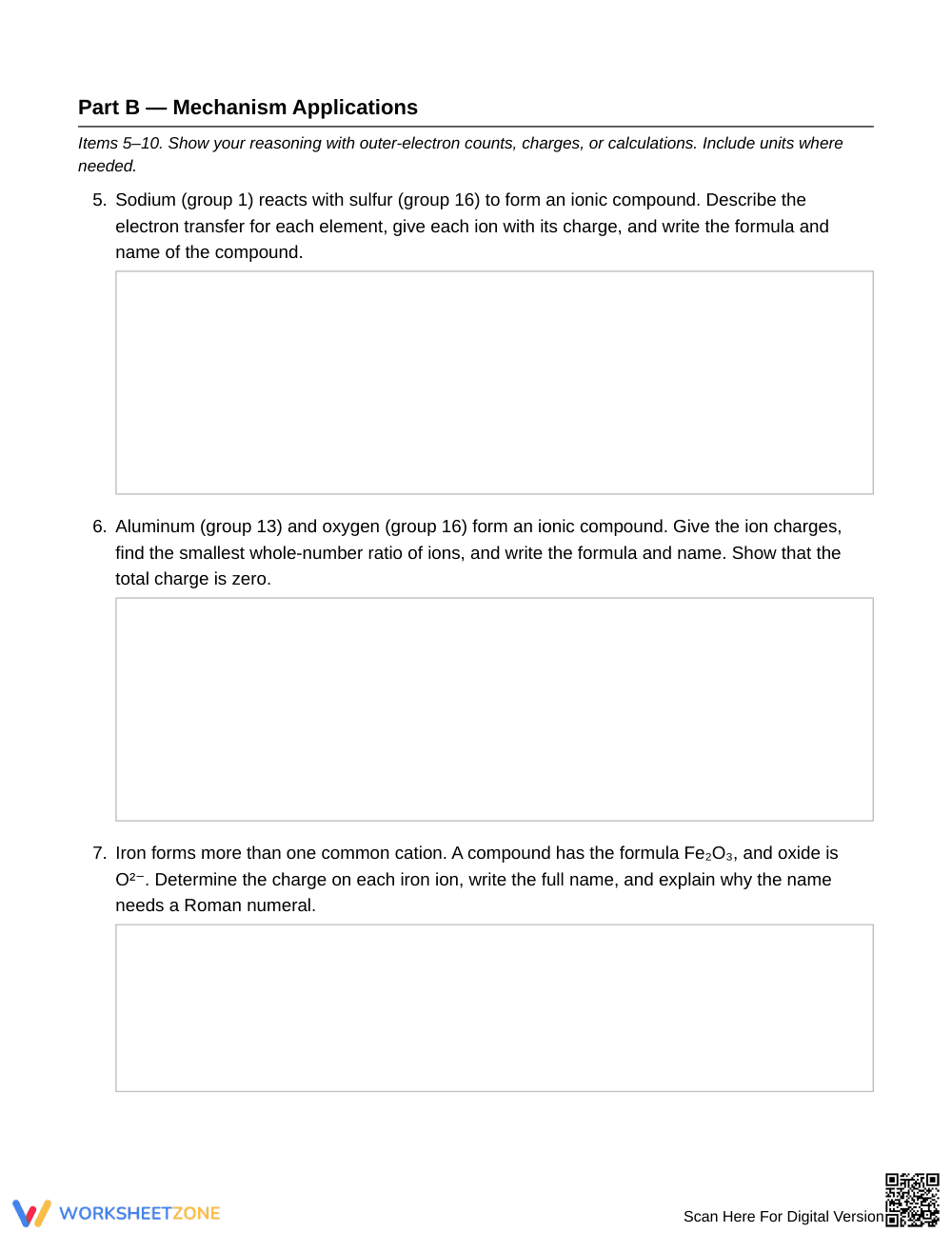
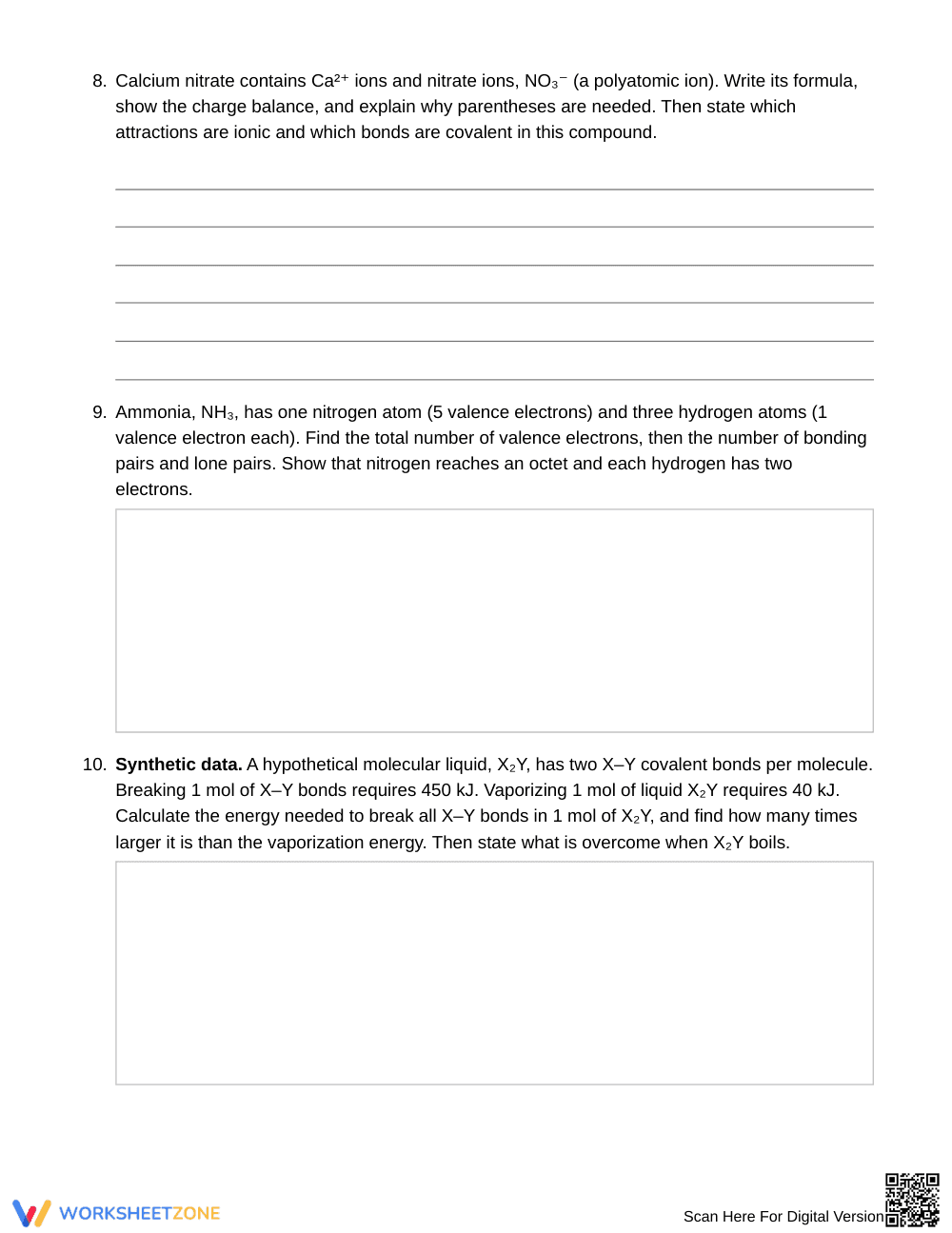
Five pages hold a concept box and 12 tasks in three parts: four concept-distinction items, six mechanism applications, and two justified predictions. Tasks include a classify-and-name table, charge-balance work with a polyatomic ion, a valence-electron count for NH₃, an energy calculation, and ion-radius reasoning. A two-page answer key follows.
Skill Progression
- Guided practice: Part A, 4 items. Students use the concept box for a multiple-choice particle model, a naming table, and short explanations.
- Supported practice: Part B, 6 items. Students show outer-electron counts, ion charges, and calculations.
- Independent practice: Part C, 2 items. Students predict and justify using only the data given.
The sequence follows gradual release: I Do, We Do, You Do.
Standards Alignment
No standard code is listed for this worksheet. It supports the common high school chemistry expectation that students use models of bonding and electrostatic forces to explain the structure and properties of substances. Teachers can map it to their own state or district standards in lesson plans, IEP goals, or curriculum mapping tools.
How to Use It
- After direct instruction: Assign Parts A and B as in-class practice while students apply new naming and bonding rules.
- Before a unit assessment: Assign Part C as a review task, then discuss answers in small groups.
Formative tip: listen for students who say covalent bonds break when a molecular substance boils. Expect 40–50 minutes for the full set.
Who It's For
Grade 11 chemistry students who have met ions, molecules, and basic nomenclature. Students who need support can start with Part A and the concept box, while advanced students can spend extra time on Part C. Pair it with an electronegativity and polarity anchor chart.
The Grade 11 Ionic and Covalent Bonding Models worksheet is a five-page chemistry resource with 12 tasks and a two-page answer key. It teaches students to separate ionic bonding, covalent bonding, and intermolecular forces, name compounds correctly, and justify property predictions using charge, distance, and electronegativity. Tasks move from concept distinctions to mechanism applications to justified predictions, so students practice the explanation as well as the procedure. The set targets a common misconception: that boiling a molecular substance breaks its covalent bonds. This design reflects Fisher & Frey (2014), who describe gradual release of responsibility as a reliable structure for moving learners from guided to independent work. Teachers can use the worksheet for review, formative assessment, or homework after instruction on bonding and nomenclature.


