































Printable Blue Objects Word Search | Grades 6–7 ELA

Paste this activity's link or code into your existing LMS (Google Classroom, Canvas, Teams, Schoology, Moodle, etc.).
Students can open and work on the activity right away, with no student login required.
You'll still be able to track student progress and results from your teacher account.
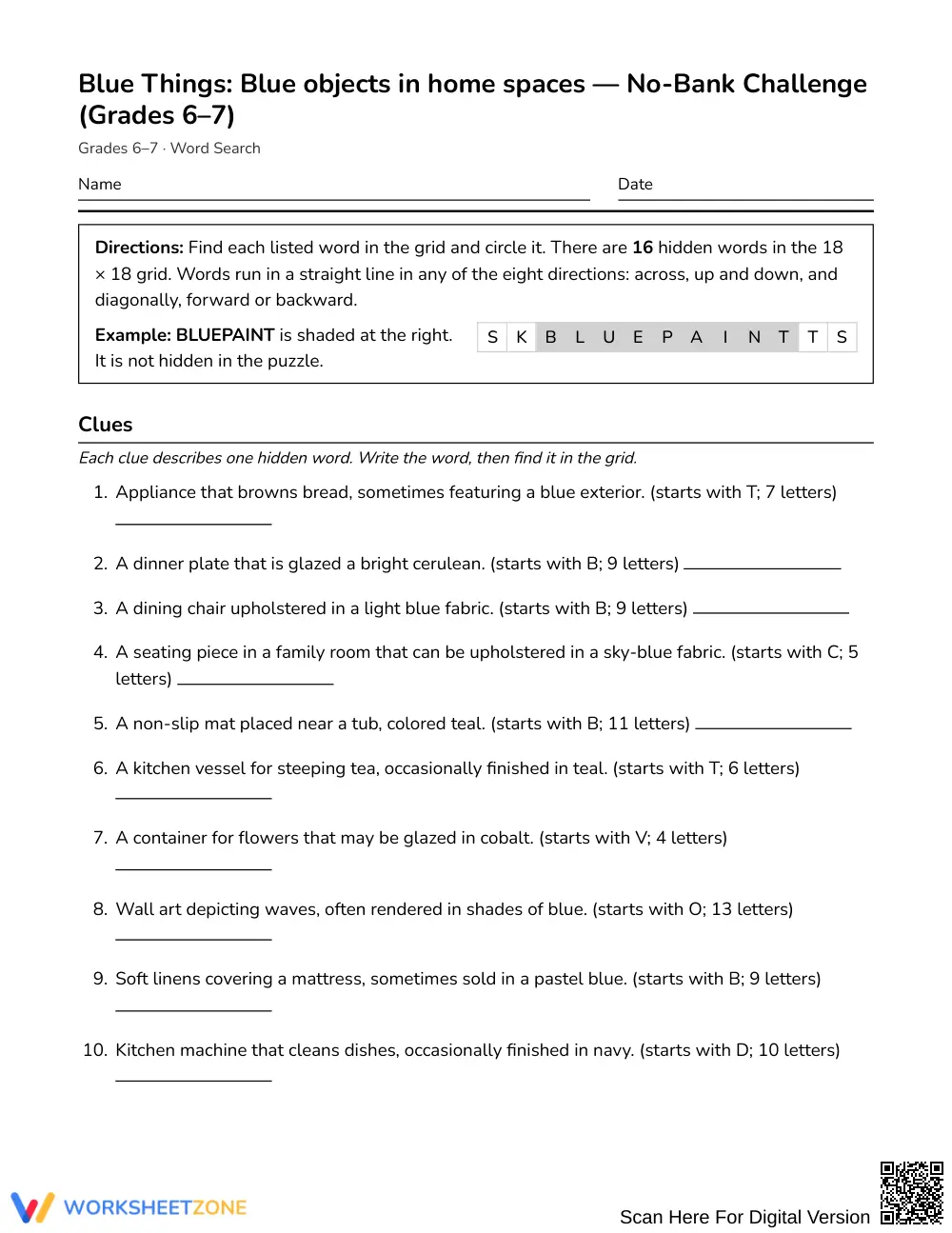
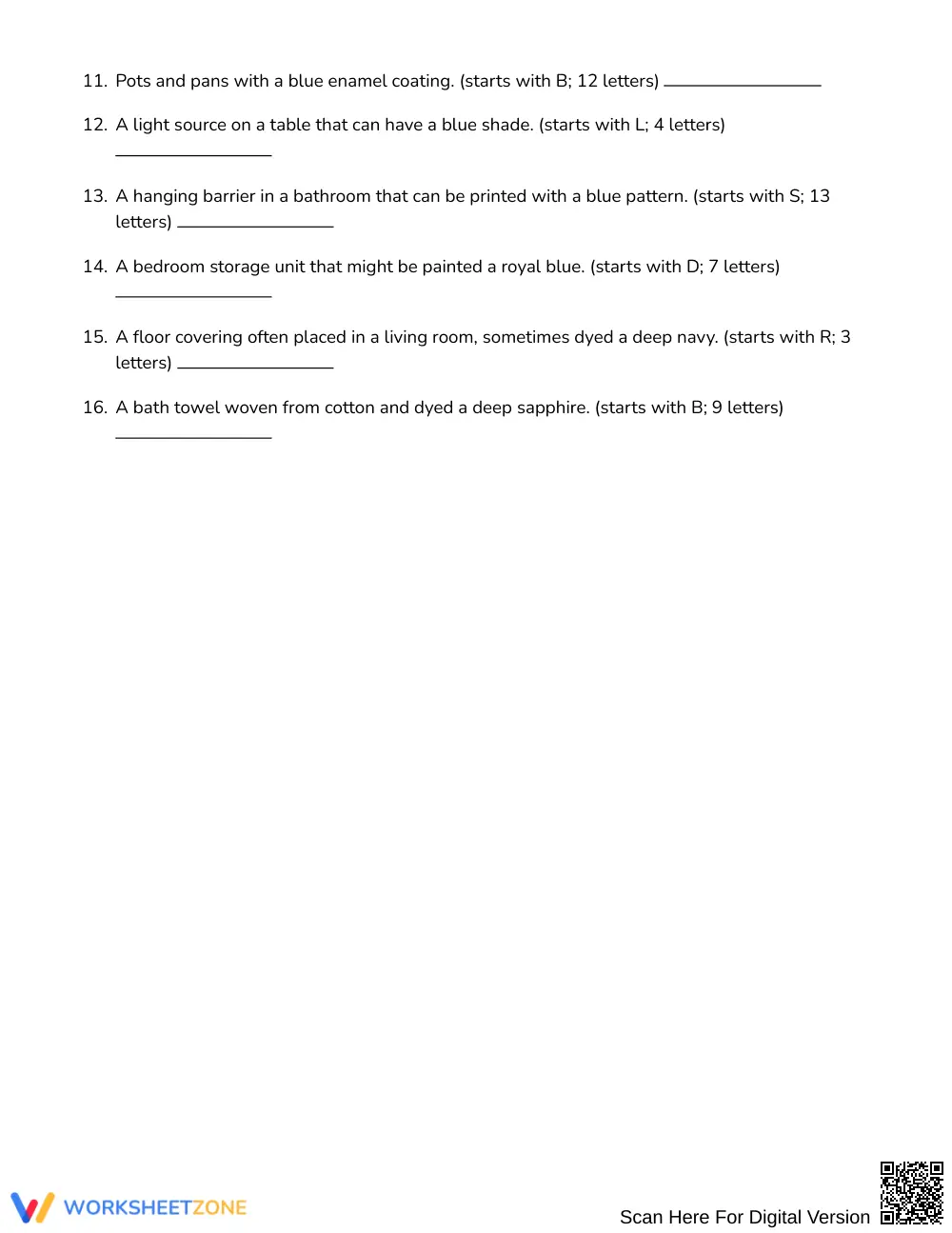
This Grades 6–7 vocabulary enrichment word search challenges learners to identify and locate 16 blue household objects across a large letter grid. Students read descriptive context clues for each domestic item, deduce or match the target term, and track down the hidden words, strengthening spelling recognition, domestic vocabulary, and visual scanning skills.
At a Glance
- Grade: Grades 6–7 · Subject: English Language Arts
- Standard: Not standards-assessed — vocabulary enrichment
- Skill Focus: Domestic vocabulary and color association
- Format: 3 pages · 16 words · Answer key included · PDF
- Best For: Fast finishers, bell ringers, sub plans
- Time: 20–30 minutes
What's Inside
This 3-page printable activity features an 18 × 18 puzzle grid paired with 16 descriptive clues detailing blue interior furnishings and appliances. Rather than scanning from a standard list, students utilize clue definitions to reinforce contextual understanding. A comprehensive 3-page solution key shows exact letter coordinates and word orientations for seamless, independent verification.
Puzzle Mechanics
The activity operates on an 18 × 18 letter matrix designed to provide an engaging cognitive challenge without an overt word bank. The 16 hidden terms run in all eight possible compass directions: north, northeast, east, southeast, south, southwest, west, and northwest. Learners read clues describing common household items—such as cobalt vases, sky-blue couches, and sapphire bath towels—before tracing the letters diagonally, vertically, or backwards through the grid.
Standards Alignment
This activity is designed purely for vocabulary enrichment and spatial word study, so it is not aligned to a formal state or Common Core standard. It serves as an engaging supplemental resource that builds word consciousness, associative schema, and reading stamina in upper-elementary and middle-grade classrooms.
How to Use It
Deploy this puzzle as an independent sponge activity for early finishers or as an engaging hook during a descriptive writing unit on domestic settings. During independent work, observe whether students read the context clues first or scan for repetitive letter clusters like compound words. Most middle-grade learners will finish the complete 16-word challenge within 20 to 30 minutes.
Who It's For
This resource is tailored for Grades 6–7 English Language Arts students, English learners developing household lexicon, and intervention groups practicing orthographic processing. It pairs naturally with descriptive descriptive-writing prompts, home living design tasks, or informational texts exploring interior decorating and color symbolism.
Contextual vocabulary puzzles reinforce orthographic mapping, lexical retrieval, and structural decoding by requiring students to match descriptive semantic features with spatial letter patterns. According to Fisher & Frey (2014), intentional word study activities that activate associative knowledge and domain-specific terminology promote authentic word consciousness and expand working vocabulary. While this enrichment resource is not standards-assessed, navigating the 18 × 18 letter grid across 8 directional planes demands focused sustained attention and rigorous visual tracking. As middle-grade learners solve all 16 clue-based targets, they consolidate practical spelling sequences and semantic connections without passive rote memorization. The self-directed puzzle structure encourages autonomous problem-solving while providing teachers with an immediate, low-maintenance enrichment tool that fits smoothly into language arts blocks, literacy centers, or emergency substitute folders.


