





























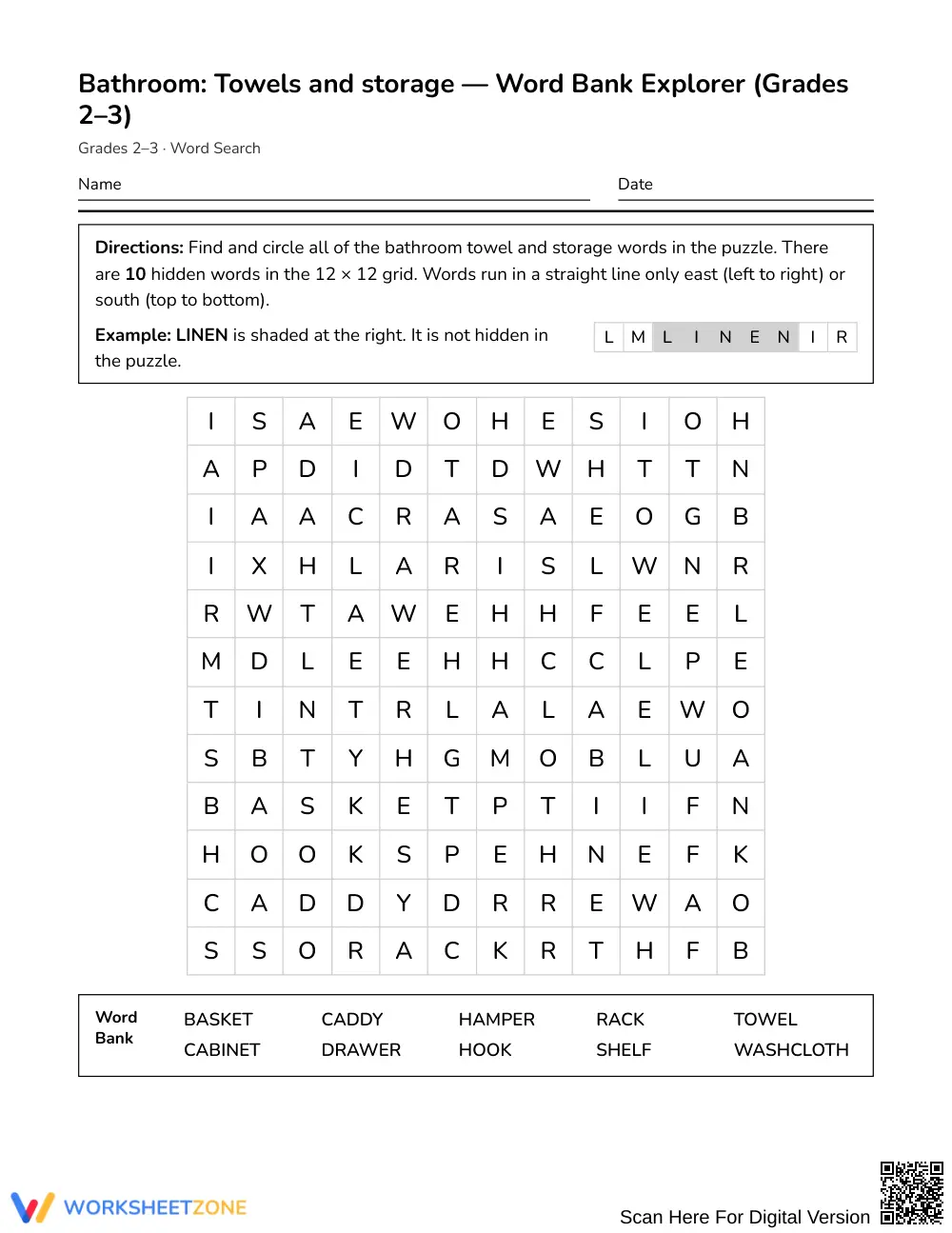


Printable Bathroom Storage Word Search | Grades 2–3 ELA

Paste this activity's link or code into your existing LMS (Google Classroom, Canvas, Teams, Schoology, Moodle, etc.).
Students can open and work on the activity right away, with no student login required.
You'll still be able to track student progress and results from your teacher account.
This bathroom towels and storage word search reinforces practical home vocabulary and letter-pattern recognition for early elementary learners. Students search for 10 thematic vocabulary terms while building foundational spelling skills, visual scanning stamina, and domain-specific language comprehension. The engaging puzzle format encourages active word discovery and independent print engagement across early literacy contexts.
At a Glance
- Grade: Grades 2–3 · Subject: English Language Arts (ELA)
- Standard: Not standards-assessed — vocabulary enrichment
- Skill Focus: Towels and storage vocabulary
- Format: 1 page · 10 words · Answer key included · PDF
- Best For: Vocabulary centers, morning work, fast finishers
- Time: 10–15 minutes
This single-page vocabulary printable features a clean 10-word puzzle focused entirely on everyday bathroom linens and organization essentials. The resource provides an alphabetical word bank highlighting household terms such as basket, cabinet, hamper, and washcloth. A comprehensive two-page teacher answer key clearly marks the location of all hidden terms for rapid verification and grading.
Puzzle Mechanics
The puzzle is constructed on a 12 by 12 letter grid calibrated specifically for early elementary spellers. To maintain an age-appropriate challenge level without causing visual fatigue, words run in only two directions: horizontally from left to right (East) and vertically from top to bottom (South). Learners scan across rows and down columns to match terms from the alphabetical word list, reinforcing directional reading habits and tracking skills.
Standards Alignment
This activity provides targeted vocabulary enrichment and is not aligned to a formal academic standard. Rather than assessing specific standardized benchmarks, it supports foundational lexical acquisition and print awareness by acquainting primary students with functional domestic terminology in an accessible format.
How to Use It
Incorporate this activity during independent literacy rotations or as calm morning work following direct vocabulary instruction. Teachers can observe scanning techniques to identify students who struggle with directional tracking or orthographic chunking. The activity typically takes between 10 and 15 minutes to complete, serving as an effective low-stress bridge between phonics lessons and independent reading practice.
Who It's For
Designed primarily for Grade 2 and Grade 3 students expanding their real-world vocabulary, this resource also supports English language learners acquiring functional household words. Pair this puzzle with an illustrated bathroom item anchor chart or a practical sorting activity where students categorize objects by their storage functions.
Word search activities support foundational literacy by promoting orthographic mapping, letter-sequence recognition, and domain-specific vocabulary retention in early elementary classrooms. According to Fisher & Frey (2014), intentional word exposure and deliberate orthographic practice play a critical role in establishing robust mental lexicons for developing readers. Engaging with themed vocabulary lists allows students in Grades 2–3 to consolidate visual memory of complex consonant blends and multisyllabic spellings within low-stakes learning environments. As learners scan across letter grids to locate practical household terms like cabinet and washcloth, they repeatedly rehearse left-to-right and top-to-bottom visual processing pathways essential for fluent reading. Although designed purely for vocabulary enrichment rather than standardized assessment, targeted word puzzles offer meaningful supplementary print engagement that reinforces lexical familiarity, spelling accuracy, and independent task completion across elementary English language arts instruction.


