


























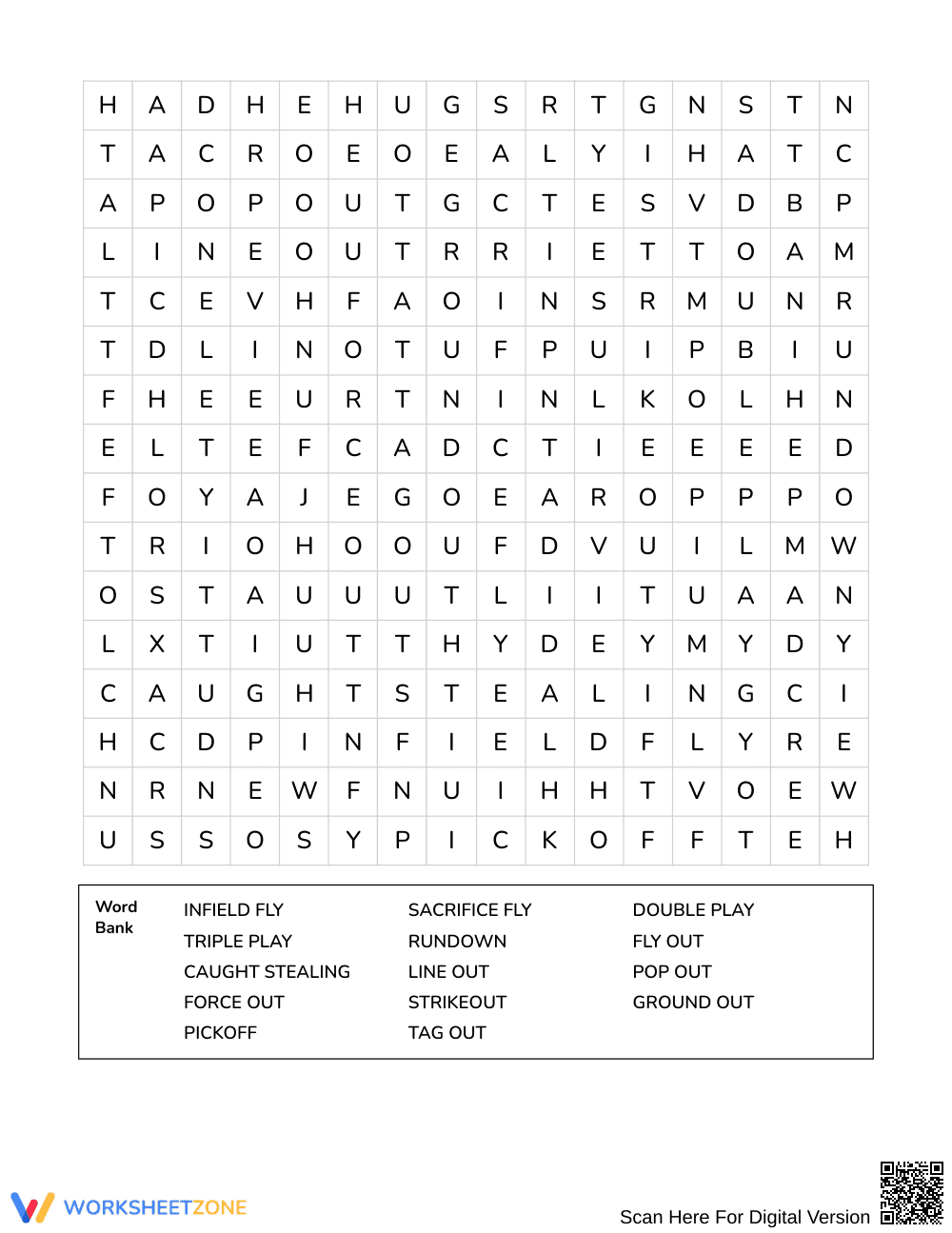

Printable Baseball Fielding Word Search | Grades 4–5 ELA
Paste this activity's link or code into your existing LMS (Google Classroom, Canvas, Teams, Schoology, Moodle, etc.).
Students can open and work on the activity right away, with no student login required.
You'll still be able to track student progress and results from your teacher account.
This baseball vocabulary word search builds sports literacy and domain-specific terminology for upper elementary students. Learners analyze 14 descriptive definitions of defensive fielding plays and outs before locating each hidden term inside the grid. The activity reinforces reading comprehension, context evaluation, and critical vocabulary retention through an engaging puzzle format.
At a Glance
- Grade: Grades 4–5 · Subject: English Language Arts (ELA)
- Standard: Not standards-assessed — vocabulary enrichment
- Skill Focus: Outs and fielding plays
- Format: 3 pages · 14 words · Answer key included · PDF
- Best For: Vocabulary enrichment and early finishers
- Time: 20–30 minutes
What's Inside
This 3-page printable set includes a clue-driven puzzle sheet alongside full solution keys. Students read 14 baseball scenarios describing plays such as sacrifice flies, double plays, rundowns, and infield flies. Rather than relying on a simple word list, learners decode the clues to determine each target term before finding it in the letter array. A complete 3-page answer key provides clear grid overlays for effortless verification.
Puzzle Mechanics and Structure
- Clue Detective Format: Students read detailed definitions for all 14 fielding terms, matching descriptions to accurate sports terminology before hunting for words.
- 16 × 16 Letter Grid: The puzzle features a balanced 16-by-16 grid that provides adequate search complexity for upper elementary learners without causing visual fatigue.
- Multidirectional Word Placement: Hidden terms run in four distinct paths: northeast (NE), east (E), southeast (SE), and south (S), encouraging close scanning.
Standards Alignment
This resource serves as targeted vocabulary enrichment and is not aligned to a formal state standard. It provides valuable domain-specific language development that enhances student comprehension of informational texts, athletic terminology, and context clues.
How to Use It
Integrate this word search during independent reading rotations, literacy centers, or after direct instruction on context clues and sports-themed informational texts. Teachers can use it as a formative assessment check by reviewing whether students correctly pair terminology with the written clues before beginning their search. Completion typically takes 20 to 30 minutes, making it ideal for morning work, sub plans, or purposeful early finisher tasks.
Who It's For
This activity is designed for Grades 4–5 learners expanding their general and technical vocabulary. It works well for general education classrooms, English language learners developing cultural and sports idioms, and speech-language enrichment groups. Pair this puzzle with high-interest baseball non-fiction articles or informational anchor charts on domain-specific vocabulary strategies.
Vocabulary acquisition research demonstrates that combining contextual definitions with active word-retrieval exercises strengthens long-term semantic storage. According to Fisher & Frey (2014), intentional word study paired with engaging, multi-step tasks significantly increases student confidence when encountering domain-specific text structures. This word search activity provides 14 rigorous clue-based tasks across a 16 × 16 grid, ensuring students engage in meaningful cognitive decoding rather than passive letter scanning. By requiring learners to interpret complex baseball actions such as force outs, pickoffs, and infield fly rules, the resource bridges high-interest recreational knowledge with academic reading stamina. The structured clue detective model promotes collaborative problem-solving, context clue utilization, and systematic visual scanning. As students verify each term, they reinforce essential orthographic patterns and lexical associations that support broader fourth and fifth grade reading comprehension growth across diverse classroom learning environments.


