



























Printable Baseball Equipment Word Search | Grades 2–3 ELA
Paste this activity's link or code into your existing LMS (Google Classroom, Canvas, Teams, Schoology, Moodle, etc.).
Students can open and work on the activity right away, with no student login required.
You'll still be able to track student progress and results from your teacher account.
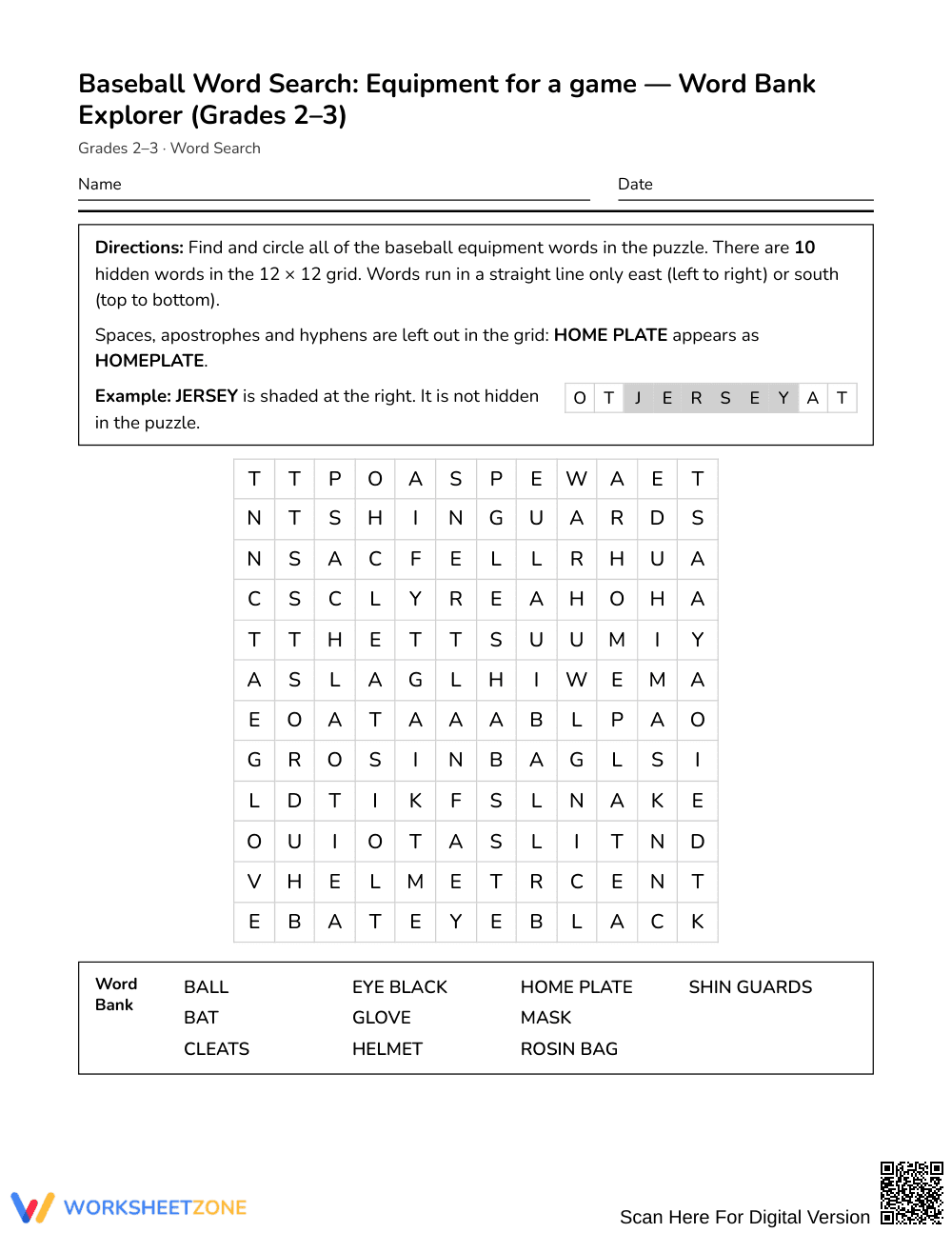
This printable word search helps Grades 2–3 ELA learners reinforce baseball equipment vocabulary while developing spelling and pattern recognition. Students locate ten key terms hidden in a 12 × 12 grid, then check their answers with the provided answer key, supporting quick, engaging vocabulary enrichment.
At a Glance
- Grade: Grades 2–3 · Subject: ELA
- Standard:
Not standards-assessed — vocabulary enrichment— students will enrich baseball equipment vocabulary- Skill Focus: equipment for a game (baseball)
- Format: 1 page · 10 words · comprehensive answer key included · PDF
- Best For: quick, engaging, interactive, fun vocabulary review activity during literacy centers
- Time: 5–10 minutes
The activity consists of a single 12 × 12 letter grid printed on one PDF page, accompanied by a word bank of ten baseball equipment terms listed alphabetically. An answer key on a second page shows each hidden word highlighted. No clues are provided, encouraging students to rely on spelling knowledge.
Zero-Prep Workflow
- Print: Download the PDF and print the one-page puzzle plus answer key (under 30 seconds).
- Distribute: Hand out the sheets during a short vocabulary station (1–2 minutes).
- Review: Quickly check answers together, reinforcing correct spellings (2–3 minutes).
Standards Alignment
This word search is designed for vocabulary enrichment and is not aligned to any specific state or Common Core standard. It supports general language development by exposing learners to domain-specific terminology.
How to Use It
Before a lesson: Introduce baseball equipment vocabulary with a short anchor chart, then have students complete the word search as a warm‑up to activate prior knowledge. Observe which terms students miss to inform immediate instruction.
During a literacy center: Set the puzzle as an independent activity while the teacher circulates. Use the answer key to provide immediate feedback, noting spelling accuracy as a formative assessment. Completion typically takes 5–10 minutes.
Who It's For
Designed for Grades 2–3 ELA learners, especially those building sports‑related vocabulary. The alphabetical word bank supports emerging readers, and the clear grid aids visual learners. Pair this activity with a baseball equipment anchor chart or a short video demonstration for multimodal reinforcement.
Research shows that focused, low‑stakes word activities boost vocabulary retention for early elementary learners (Fisher & Frey, 2014). This baseball equipment word search offers ten target words, reinforcing spelling and meaning through pattern recognition. By integrating a familiar sports context, the activity taps into students’ existing interests, promoting deeper processing of the terms. The inclusion of an answer key enables immediate feedback, a key component of effective formative assessment. Educators can smoothly embed this resource into daily literacy routines, supporting the broader goal of expanding domain‑specific language without the pressure of formal testing. The design aligns with evidence‑based practices that emphasize brief, engaging tasks to strengthen word knowledge in grades 2–3. Studies indicate that word searches also improve visual scanning skills and can serve as a low‑anxiety entry point for students who struggle with traditional worksheets. Incorporating this activity regularly contributes to cumulative vocabulary growth across the elementary curriculum.


