



























Printable Animation Timing Word Search | Grades 3–4 ELA
Paste this activity's link or code into your existing LMS (Google Classroom, Canvas, Teams, Schoology, Moodle, etc.).
Students can open and work on the activity right away, with no student login required.
You'll still be able to track student progress and results from your teacher account.
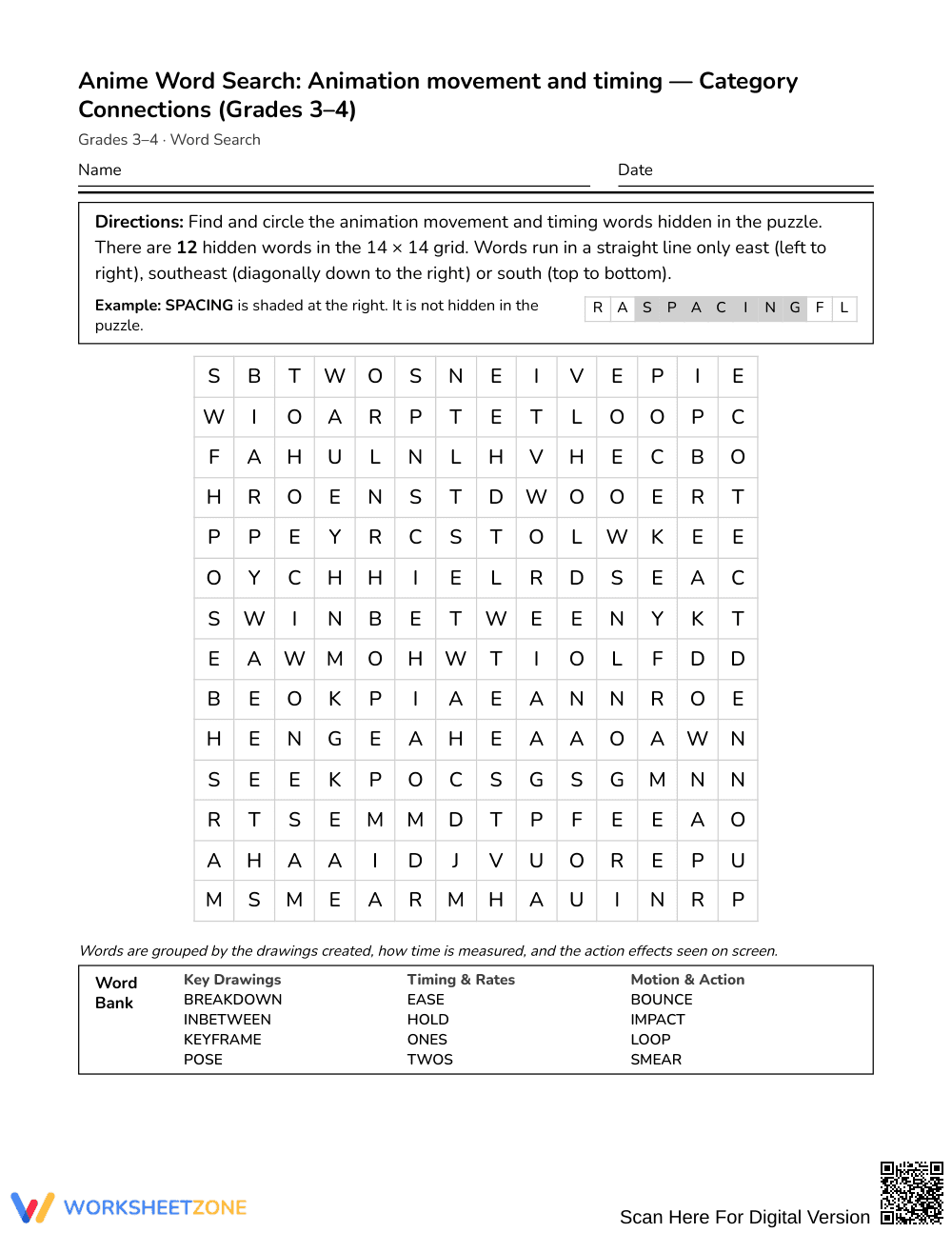
This animation movement and timing word search introduces Grades 3–4 students to essential media production vocabulary through targeted word recognition. Learners identify 12 specialized terms related to keyframes, playback pacing, and visual dynamics across an engaging puzzle grid, reinforcing domain-specific spelling and conceptual understanding before applying these concepts in creative storytelling or art projects.
At a Glance
- Grade: Grades 3–4 · Subject: English Language Arts (ELA)
- Standard: Not standards-assessed — vocabulary enrichment
- Skill Focus: Animation movement and timing
- Format: 1 page · 12 words · Answer key included · PDF
- Best For: Early finishers, unit warm-ups, and sub plans
- Time: 15–25 minutes
This 1-page word search features a clean 14-by-14 letter grid containing 12 hidden animation terms organized into three thematic categories: Key Drawings, Timing & Rates, and Motion & Action. The categorized word bank assists student navigation by grouping related concepts together. A comprehensive 3-page answer key provides clear solution overlays for quick verification and effortless grading.
The puzzle is structured to provide an accessible yet challenging word-finding experience:
- Grid Dimensions: The activity uses a compact 14-by-14 letter grid that keeps letter scanning manageable for elementary students without causing visual fatigue.
- Search Directions: Words are hidden across three reading directions: horizontally forward (East), vertically downward (South), and diagonally downward (South-East), eliminating backwards reading to match developmental reading patterns.
- Categorized Organization: The word bank groups all 12 terms into meaningful clusters, helping students build conceptual associations between drawings, timing methods, and physical screen motions.
This learning resource is designed specifically for vocabulary enrichment and is not aligned to a formal academic standard. It focuses on expanding domain-specific terminology related to visual media, arts, and creative technology. Educators can integrate these terms into cross-curricular units connecting English language arts with visual arts and digital media literacy.
Use this activity after direct instruction on multimedia elements or as an independent extension during creative writing and animation units. For an effective formative-assessment routine, observe which directional patterns give students difficulty and ask learners to orally define one category term upon locating it. The puzzle typically requires 15 to 25 minutes to complete independently or in pairs.
This word search is suited for Grades 3–4 elementary students exploring introductory media arts, animation concepts, or narrative pacing. It provides natural differentiation for visual learners and early finishers who benefit from tactile pattern-finding tasks. Pair this puzzle with an introductory mentor text on filmmaking or a storyboard planning template to bridge vocabulary acquisition with hands-on creative expression.
Domain-specific vocabulary acquisition functions as a crucial cornerstone for reading comprehension and content-area literacy in upper elementary classrooms. According to research on intentional word study by Fisher & Frey (2014), structured exposure to technical terminology across categorical groupings helps learners anchor conceptual definitions into long-term memory. This Grades 3–4 word search provides students with repeated visual exposure to 12 vital animation and timing concepts, including keyframes, frame rates, and transitional ease. By organizing target vocabulary into coherent conceptual categories, the resource supports associative schema development while strengthening orthographic recognition and spatial scanning skills. The accompanying 3-page answer key provides educators with immediate verification tools to facilitate timely corrective feedback. These print-ready materials offer an engaging entry point into media literacy, ensuring students build functional familiarity with specialized creative language before engaging in multimedia analysis or digital production tasks.


