
































Printable Animation Techniques Word Search | Grades 7–8

Paste this activity's link or code into your existing LMS (Google Classroom, Canvas, Teams, Schoology, Moodle, etc.).
Students can open and work on the activity right away, with no student login required.
You'll still be able to track student progress and results from your teacher account.
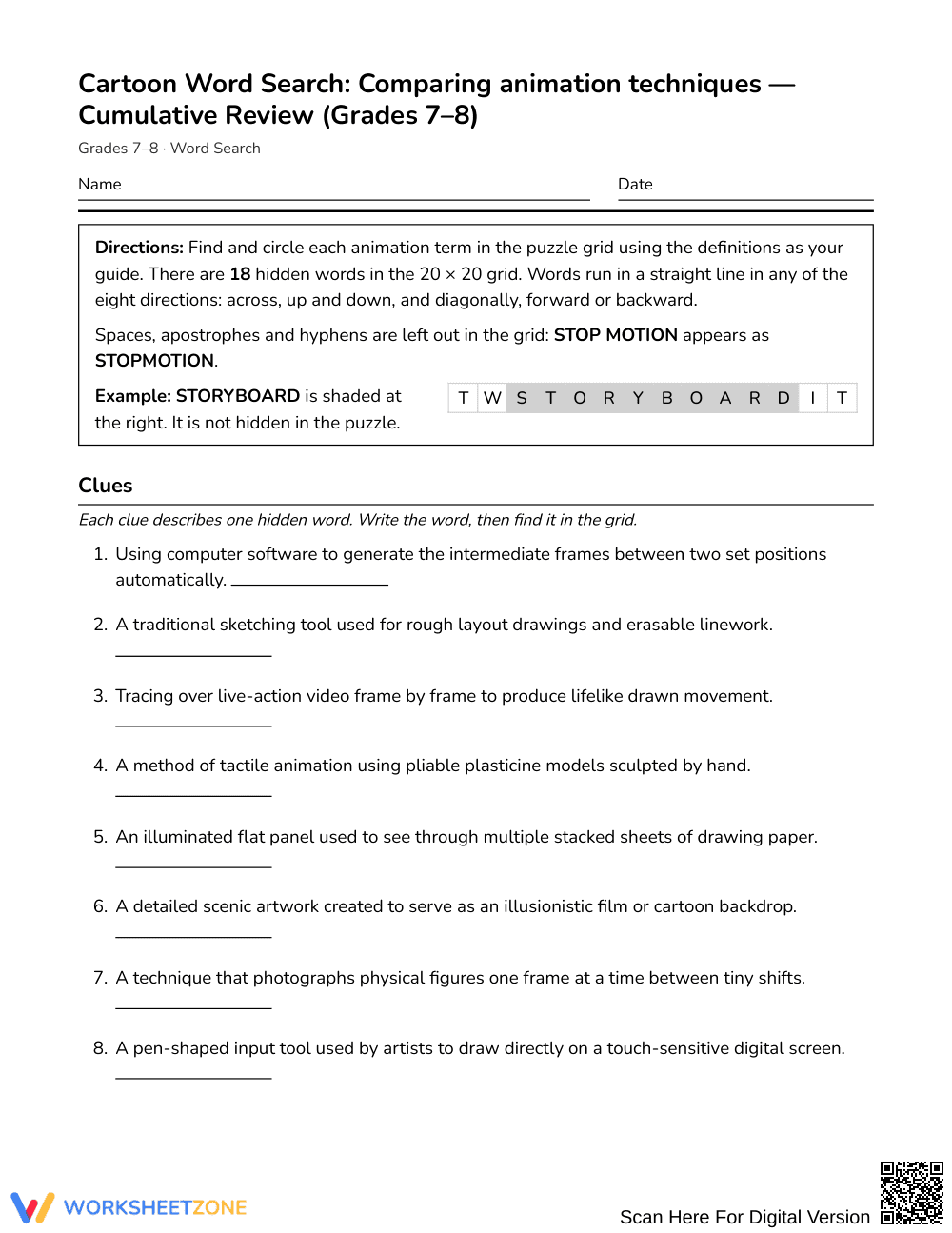
Boost learners’ animation‑vocabulary mastery with this engaging word‑search that targets key techniques used in cartoon production. Students locate 18 hidden terms, reinforcing definitions while sharpening visual scanning skills. The activity can be completed individually or in small groups, making it ideal for quick review or enrichment.
At a Glance
- Grade: Grades 7–8 • Subject: English Language Arts (ELA)
- Standard:
Not standards-assessed — vocabulary enrichment— students expand animation‑related vocabulary through contextual clues.- Skill Focus: Comparing animation techniques such as rigging, keyframing, and stop‑motion.
- Format: 3 printable pages • 18 hidden words • Answer key included • PDF file ready for instant use.
- Best For: Quick vocabulary enrichment review, homework practice, or classroom warm‑up activity.
- Time: Approximately 10–15 minutes for most learners to complete.
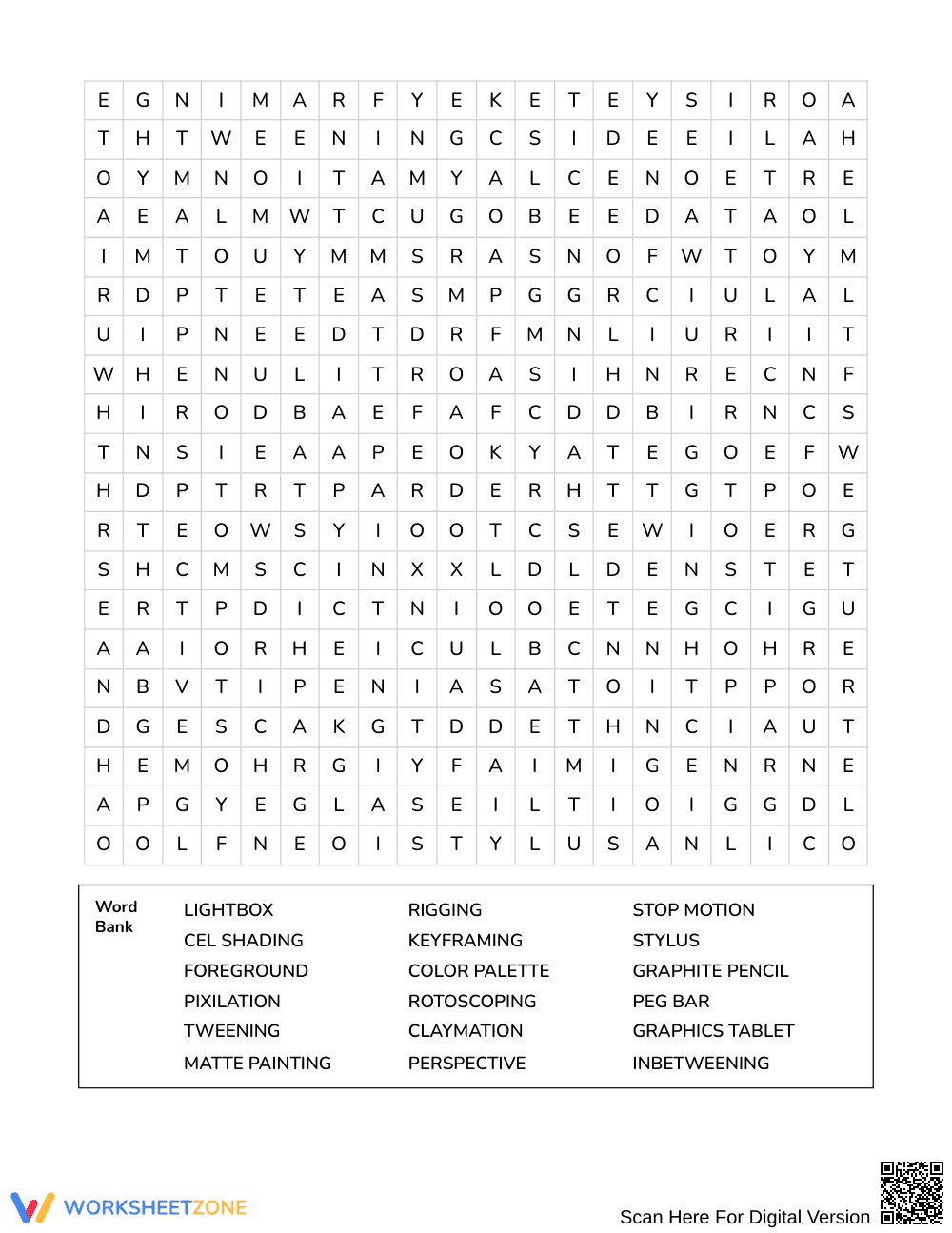
The search grid measures 20 × 20 squares and allows words to run in all eight directions—north, northeast, east, southeast, south, southwest, west, and northwest. A shuffled word bank and detailed clues support independent discovery.
Students work alone to scan the grid, locate each of the 18 animation‑related terms, and circle them. The puzzle uses the provided clues and the full word bank, which is presented in a random order to encourage recall rather than pattern‑matching.
This activity is designed for vocabulary enrichment and is not aligned to any specific state or Common Core standard. It simply reinforces key terminology related to animation techniques, making it a flexible supplement for any ELA or media‑arts curriculum.
Use the word search as a pre‑lesson warm‑up to activate prior knowledge of animation vocabulary, then transition to a deeper analysis of technique differences. Alternatively, assign it as a low‑stakes homework task; quickly scan completed grids to gauge individual retention and note any missing terms for targeted reteaching.
Designed for Grades 7–8 ELA learners, the puzzle supports visual and linguistic learners alike. No differentiation levels are required, but teachers can pair it with an animation‑technique anchor chart or a short video clip to deepen context.
Vocabulary‑building games like word searches have been shown to improve retention of subject‑specific terminology. Fisher & Frey (2014) report that low‑stakes, engaging activities increase student motivation and facilitate deeper processing of key concepts, especially when paired with clear definitions. In the context of animation studies, reinforcing terms such as rigging, keyframing, and stop‑motion through repeated visual exposure supports both oral and written articulation of the concepts. This 20 × 20 grid offers 18 targeted words, providing ample practice without overwhelming learners. Educators can confidently incorporate the puzzle into vocabulary units, knowing that research links such interactive tasks to measurable gains in recall and application. The activity also aligns with cognitive‑load theory, allowing students to focus on one lexical item at a time while the surrounding grid provides a familiar, low‑pressure environment. When used regularly, such searches contribute to a richer academic vocabulary, which research ties to higher reading comprehension scores across middle‑school curricula.


