































Printable Africa Word Search | Grades 7–8 Social Studies

Paste this activity's link or code into your existing LMS (Google Classroom, Canvas, Teams, Schoology, Moodle, etc.).
Students can open and work on the activity right away, with no student login required.
You'll still be able to track student progress and results from your teacher account.
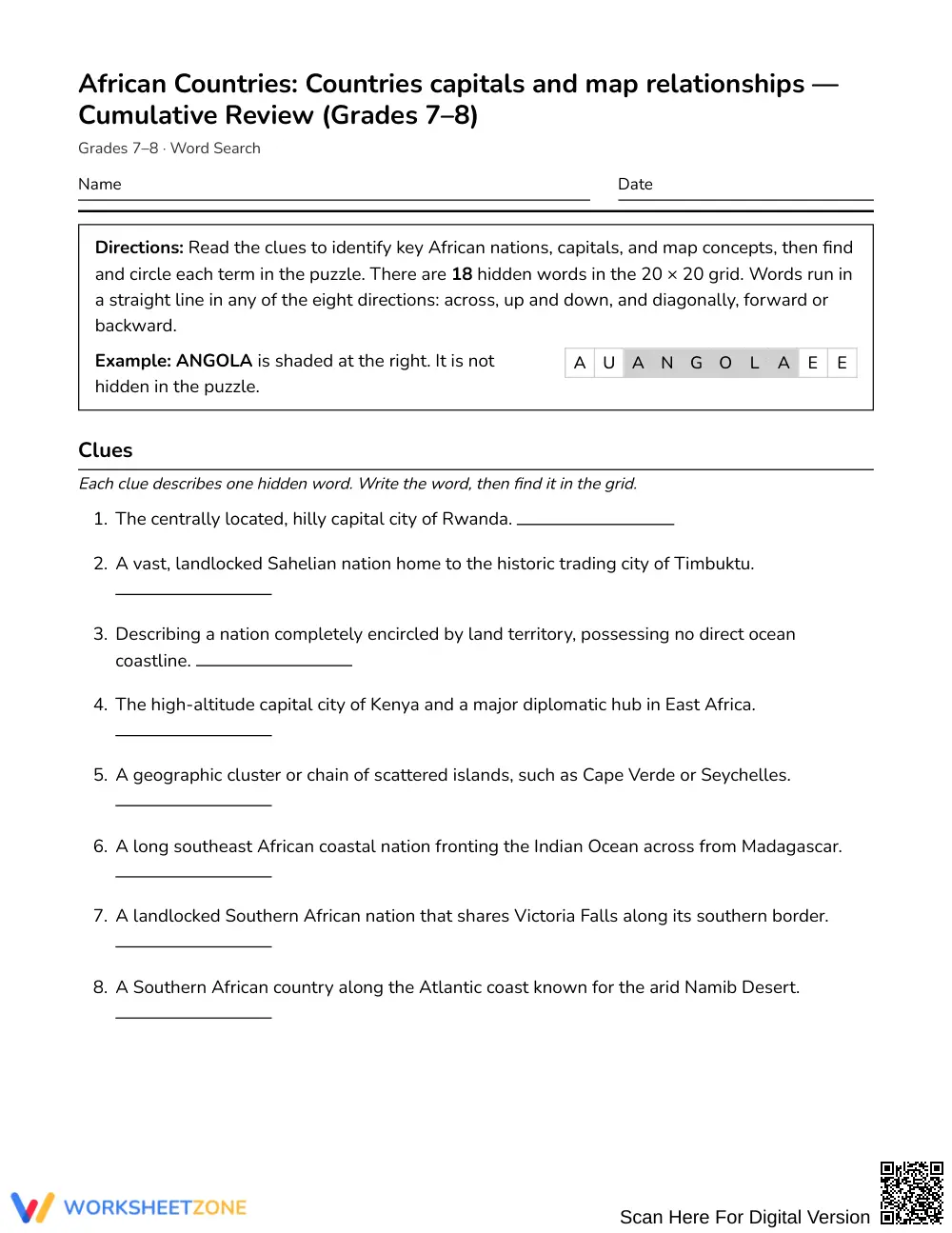
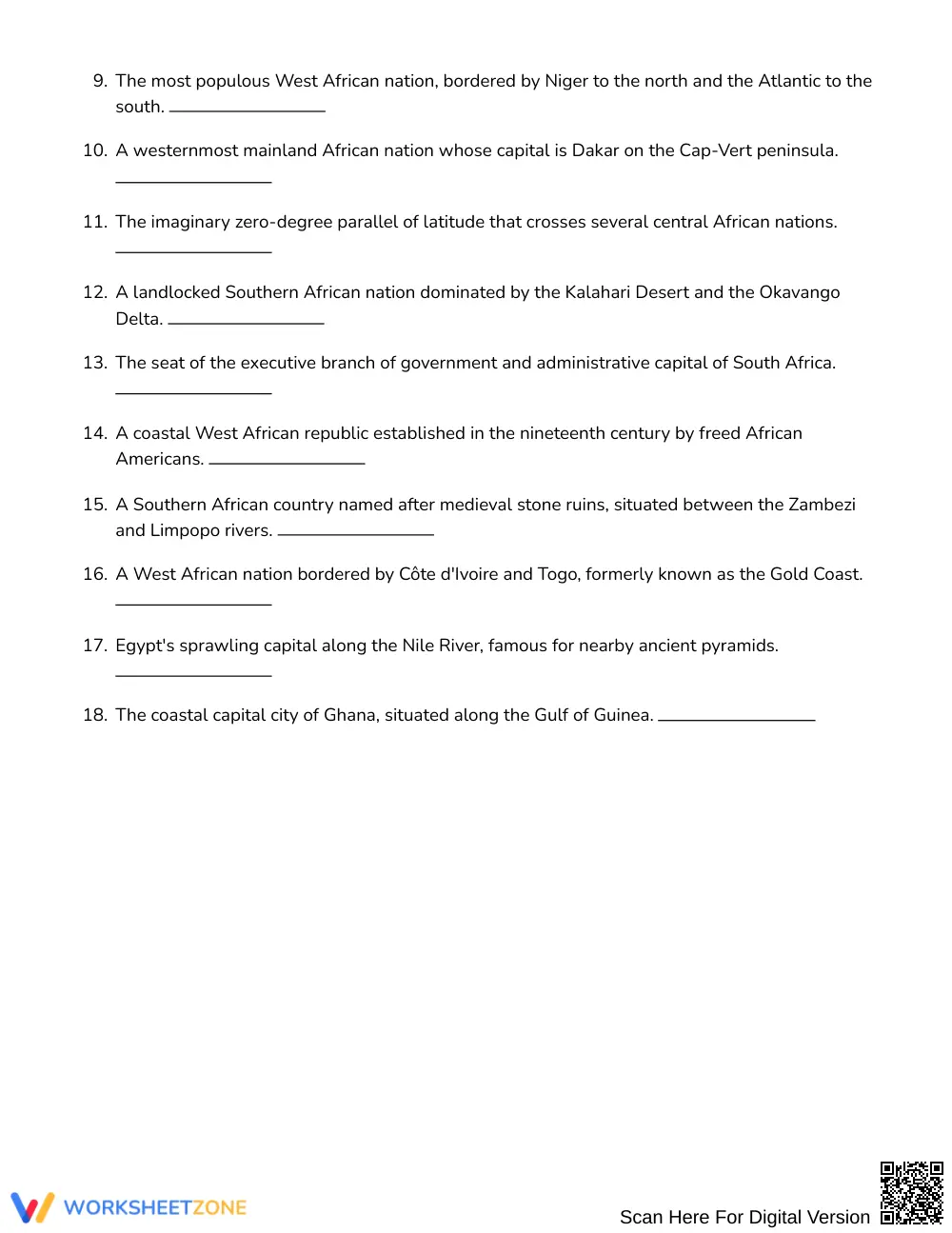
This African geography word search reinforces spatial awareness, country recognition, and regional terminology for middle school learners. Students examine descriptive geographical clues to identify eighteen nations, capitals, and map concepts before locating them within the letter grid. The activity consolidates regional knowledge across West, East, and Southern Africa through engaging vocabulary retrieval.
At a Glance
- Grade: Grades 7–8 · Subject: Social Studies
- Standard: Not standards-assessed — vocabulary enrichment and regional terminology reinforcement
- Skill Focus: African countries, capital cities, and regional map relationships
- Format: 3 pages · 18 words · Full answer key included · Printable PDF
- Best For: Middle school cumulative review and regional geography vocabulary reinforcement
- Time: 25–35 minutes
What's Inside
The activity includes a three-page student puzzle packet accompanied by a comprehensive four-page answer key. Students work with a shuffled word bank paired with eighteen substantive clues that describe geographical boundaries, cultural landmarks, physical terrain, and political capitals. The layout provides ample space for circling terms while maintaining clear readability across all pages.
Word Search Mechanics
Students navigate a 20 by 20 letter grid containing eighteen hidden geography terms. Words run in all eight possible directions: north, northeast, east, southeast, south, southwest, west, and northwest. To complete the activity, learners read clue descriptions—such as identifying Kenya's high-altitude diplomatic capital or a landlocked nation bordering the Zambezi River—to deduce the correct target term before scanning the letter matrix.
Standards Alignment
This cumulative review activity serves as vocabulary enrichment and is not aligned to an assessed state standard. It provides supplementary regional reinforcement designed to deepen student familiarity with African geopolitics, physical boundaries, and cardinal relationships without formal standard testing constraints.
How to Use It
Introduce this word search after completing direct instruction on African regional geography. Use it as an independent station task during review rotations, where teachers can observe whether students deduce terms from contextual clues or rely on word-length patterns. Alternatively, assign the activity as a quiet, focused partner challenge during unit wrap-up. The puzzle requires approximately 25 to 35 minutes to solve.
Who It's For
This resource is designed for middle school students in Grades 7–8 studying world geography or regional social studies. For emerging learners, teachers can highlight first letters directly on the grid or review the clue sheet together. Pair this activity naturally with a political wall map of Africa or a regional atlas to facilitate spatial reference.
Vocabulary acquisition in secondary social studies relies on repeated, contextual exposure to academic language and domain-specific terminology. Research by Fisher & Frey (2014) demonstrates that structured retrieval practices, when combined with semantic context clues, significantly improve long-term retention of specialized informational terms. By requiring middle school learners to read detailed geographic descriptions before locating terms within an 18-word search grid, this resource actively engages prior knowledge of African nations, capital cities, and spatial map relationships. Students do not simply perform passive letter-matching; they interpret physical geography concepts such as landlocked territories, archipelagos, and equatorial coordinates while reinforcing correct orthography for regional proper nouns. This dual-processing mechanism strengthens conceptual geography schemas, supporting both independent inquiry and collaborative discussion across middle school world cultures curricula. Consequently, learners build foundational spatial literacy and geographic vocabulary that enhance general reading comprehension and cross-regional comparative analysis.


