





























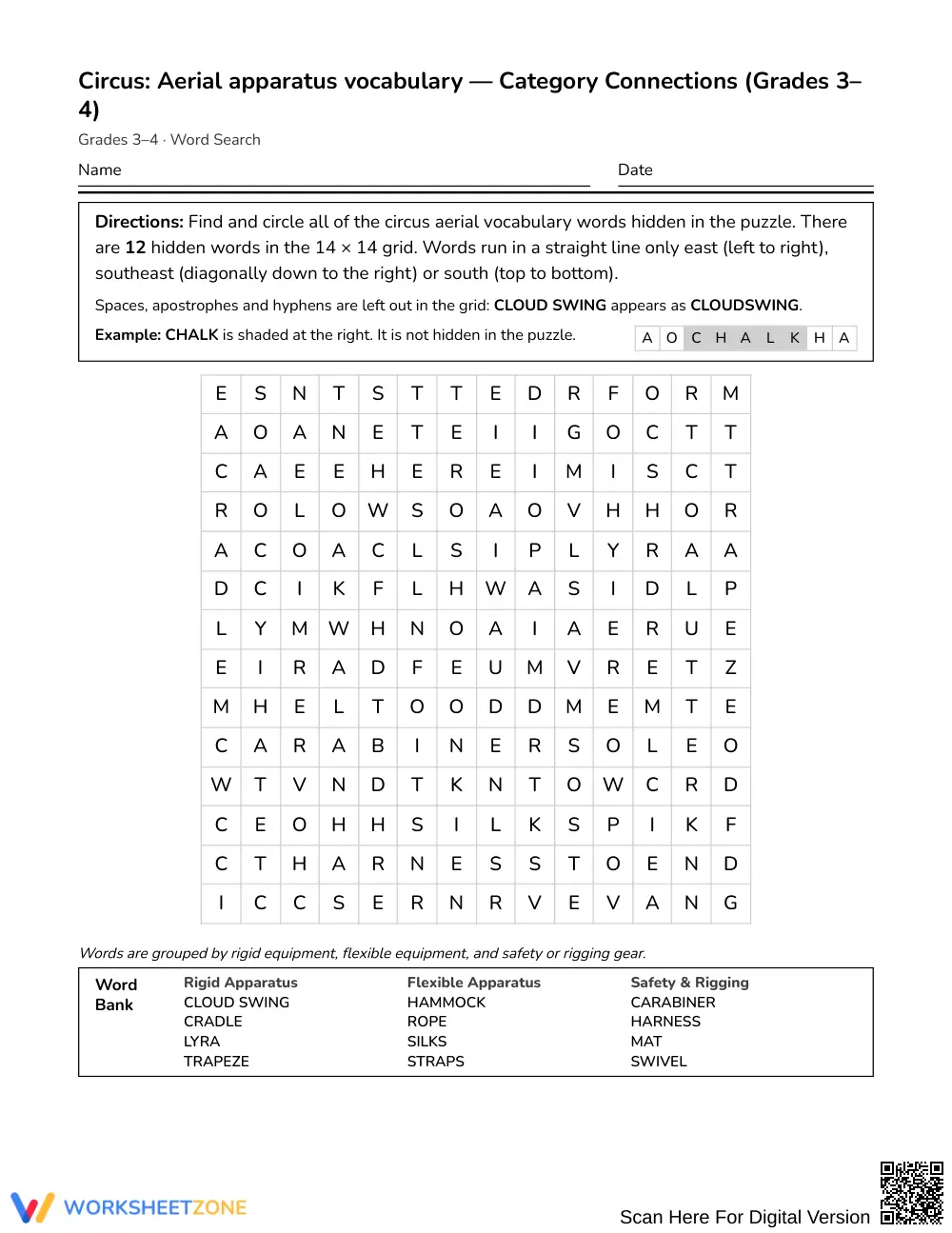


Printable Aerial Apparatus Word Search | Grades 3–4 ELA

Paste this activity's link or code into your existing LMS (Google Classroom, Canvas, Teams, Schoology, Moodle, etc.).
Students can open and work on the activity right away, with no student login required.
You'll still be able to track student progress and results from your teacher account.
This Grades 3–4 aerial apparatus vocabulary word search introduces learners to the specialized equipment of circus acrobatics. Students locate 12 technical terms grouped into rigid gear, flexible apparatus, and safety rigging. The puzzle reinforces spelling, word recognition, and categorization through an engaging, low-stakes vocabulary challenge.
At a Glance
- Grade: Grades 3–4 · Subject: English Language Arts (ELA)
- Standard: Not standards-assessed — circus arts vocabulary enrichment and spelling reinforcement
- Skill Focus: Aerial apparatus vocabulary and category identification
- Format: 1 printable page · 12 hidden words · 3-page answer key included · PDF
- Best For: Fast finishers, thematic units, and vocabulary enrichment
- Time: 15–25 minutes of focused independent work
This 1-page activity features a clear puzzle layout with a word bank organized into three technical domains: rigid apparatus, flexible apparatus, and safety rigging. Students locate 12 specialized terms while connecting each word to its functional category. A complete 3-page answer key provides solved grid coordinates for effortless checking.
The word search features a 14 x 14 letter grid tailored for intermediate readers. Hidden vocabulary words run in three forward directions: horizontal (East), vertical (South), and diagonal (Southeast). Restricting paths to East, South, and Southeast prevents backward-reading confusion while encouraging focused letter-pattern analysis. The word bank groups the 12 words by technical categories rather than alphabetical order, prompting students to recognize conceptual relationships between circus apparatus as they search.
This puzzle is designed for vocabulary enrichment and is not aligned to an academic content standard. While it strengthens visual tracking, pattern scanning, and domain-specific lexicon development, it functions as a high-interest enrichment activity rather than an assessment tool.
Use this word search during independent literacy stations or as a quick activity for fast finishers following vocabulary instruction. It also serves as an engaging introduction to a circus arts unit to build background knowledge before reading informational texts. While students work, observe whether they scan rows systematically or hunt randomly to gauge visual tracking habits. Completion time averages 15 to 25 minutes.
This resource is designed for Grades 3–4 students building technical vocabulary and visual scanning stamina. It supports intermediate readers who benefit from categorized terms, English learners studying specialized vocabulary, and students interested in performing arts. Pair this activity with an informational reading passage or diagram illustrating circus aerial equipment.
Domain-specific vocabulary acquisition relies on repeated, contextual exposure to specialized terminology. According to Fisher & Frey (2014), intentional word exposure coupled with thematic categorization significantly accelerates lexical retention in upper-elementary learners. This Grades 3–4 aerial apparatus vocabulary activity introduces 12 targeted performance and safety terms across rigid, flexible, and rigging equipment groups. Rather than evaluating formal standards, the 14 x 14 letter puzzle reinforces orthographic awareness and letter-sequence recognition through purposeful East, Southeast, and South word searches. Research in vocabulary acquisition underscores that categorization helps intermediate students construct cognitive schemata, linking unfamiliar terms like lyra and carabiner to familiar concepts of swinging and climbing. By integrating structured word banks with visual search routines, this print-ready resource offers a high-interest entry point for developing technical vocabulary, fostering persistence, and building domain knowledge across diverse elementary reading environments.


