




























Views
Downloads



Printable Acid Naming Worksheet | Grades 9‑12 Science

Paste this activity's link or code into your existing LMS (Google Classroom, Canvas, Teams, Schoology, Moodle, etc.).
Students can open and work on the activity right away, with no student login required.
You'll still be able to track student progress and results from your teacher account.
Overview
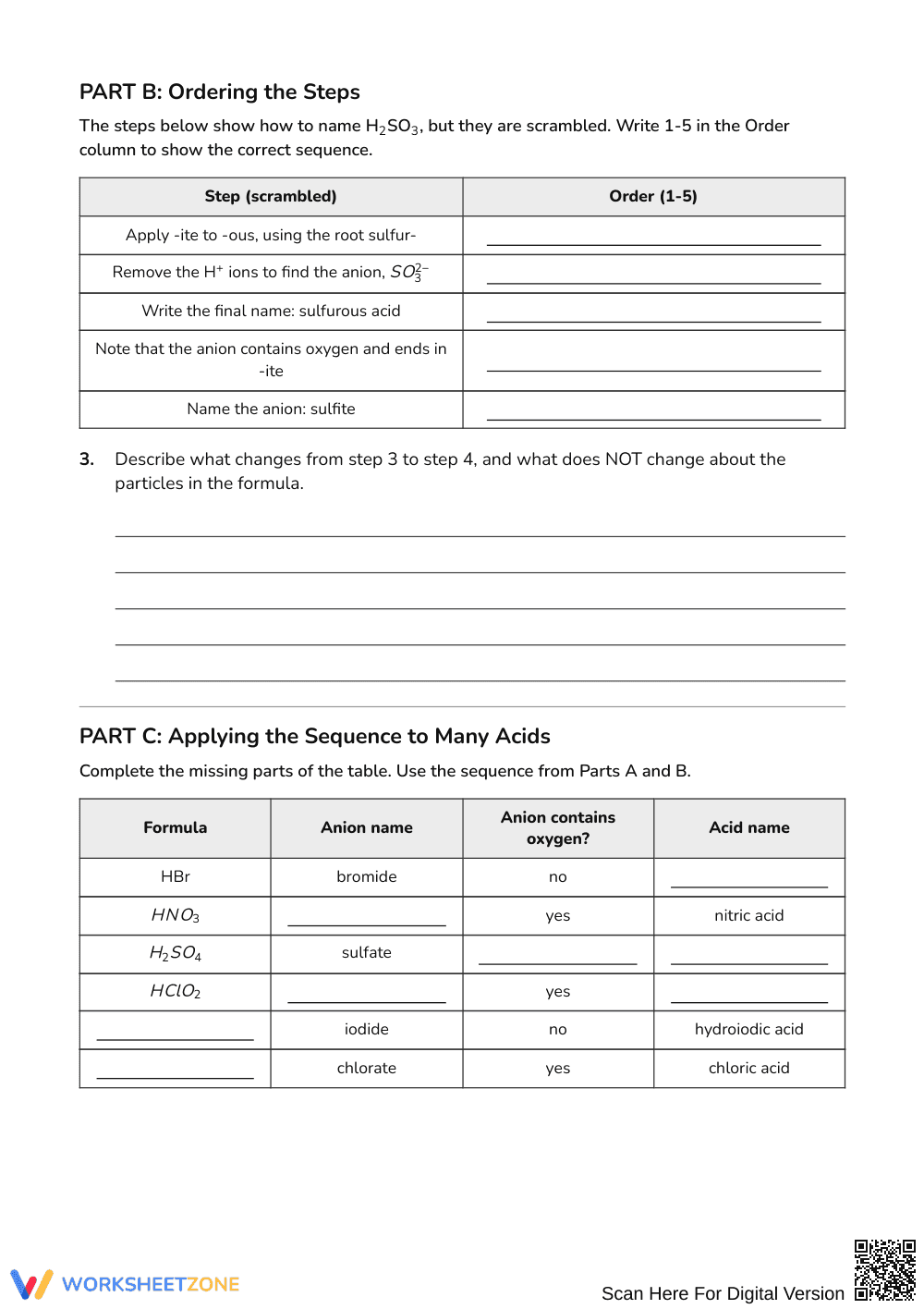
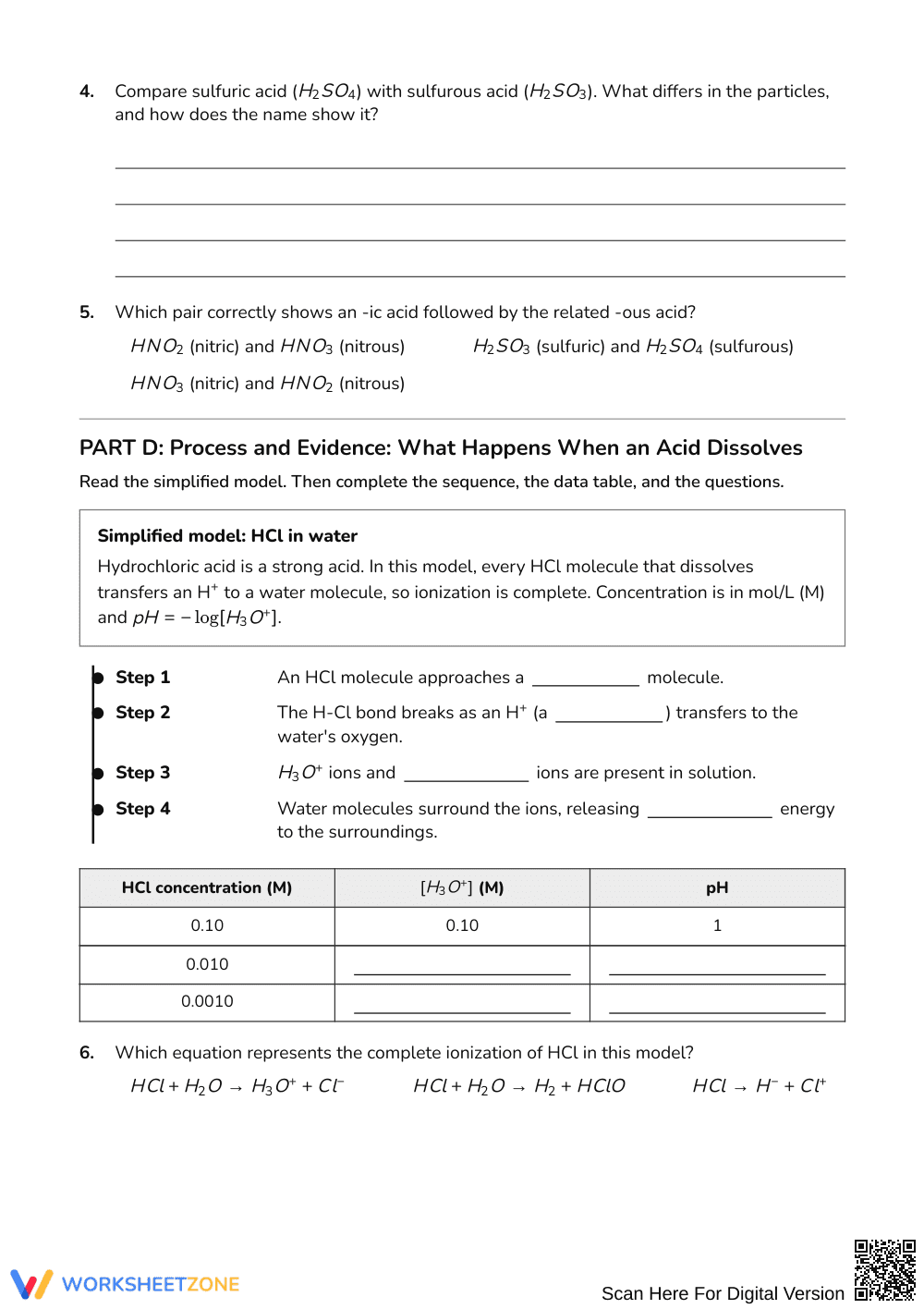
Students master the systematic process of naming acids by working through 31 guided problems that require them to follow a decision flowchart, order procedural steps, and articulate the chemical changes between each stage. They also compare -ic and -ous forms, interpret ionization data, and write balanced formulas.
At a Glance
At a Glance
- Grade: 9‑12 · Subject: Science
- Standard:
— name acids using a decision flowchart and clearly explain each procedural step- Skill Focus: Systematic Acid Naming Process
- Format: 4 printable pages · 31 varied problems · answer key included · PDF download
- Best For: reinforcing chemical nomenclature after a lecture or lab activity
- Time: 30–45 minutes of focused classroom work
What’s Inside
The worksheet spans four PDF pages and contains 31 problems divided into five parts (A‑E). Students begin with a flow‑chart analysis, move to ordering scrambled steps, complete a comparative table, interpret ionization data, and finish with open‑ended synthesis questions. Each section includes a worked example, sentence frames for explanations, and a word bank of common acid‑naming suffixes. An answer key on the final page provides model responses and a concise grading rubric for quick checking.
Skill Progression
- Guided practice (tasks 1‑10): students follow a step‑by‑step worked example, using the flowchart and sentence frames to name acids.
- Supported practice (tasks 11‑20): students complete the scrambled‑step ordering and comparative table, aided by a word bank of suffixes.
- Independent practice (tasks 21‑31): students answer open‑ended synthesis questions on ionization and reverse‑naming without scaffolds.
The sequence follows the classic I Do, We Do, You Do release model, ensuring confidence before independence.
Standards Alignment
Students follow the acid‑naming decision sequence, identify oxygen‑containing anions, apply the appropriate –ic/–ous suffixes, and explain particle changes between steps, directly addressing the curriculum expectation for chemical nomenclature. Both standard codes can be copied directly into lesson plans, IEP goals, or district curriculum mapping tools.
How to Use It
Use as a post‑lecture activity after introducing oxyanions; students work in pairs to complete Parts A‑C, allowing the teacher to observe use of the flowchart and note misconceptions in real time. Expected time: 20‑25 minutes.
Deploy as a formative quiz at the end of a unit; have students individually finish Parts D‑E while you circulate, collecting their written explanations as evidence of mastery. Expected time: 15‑20 minutes.
Who It’s For
Designed for high‑school science students in grades 9‑12, the worksheet meets the needs of mixed‑ability classes. Teachers can simplify the task by providing only the flowchart, or extend it with additional exotic acids for advanced learners. Pair it with an anchor chart of common acid suffixes for quick reference during instruction.
This worksheet aligns with the science curriculum expectation that students name acids by following a systematic decision sequence and explain the chemical changes at each stage. By engaging learners in guided, supported, and independent practice, the tasks embody the explicit instruction model championed by Fisher & Frey (2014), which links clear scaffolding to improved conceptual understanding. The inclusion of a flowchart, word bank, and sentence frames mirrors research‑based recommendations for visual and linguistic supports in high‑school chemistry. With 31 targeted problems across four pages, the resource offers rapid, evidence‑based practice that can be printed and assigned in minutes, helping educators meet rigorous standards while fostering student confidence in chemical nomenclature. Teachers can use the answer key to provide immediate feedback, and the open‑ended items supply data for formative assessment dashboards. The worksheet also supports IEP goals related to scientific communication and analytical reasoning.


