































Printable 6-Letter Food Word Search | Grades 3–4 ELA

Paste this activity's link or code into your existing LMS (Google Classroom, Canvas, Teams, Schoology, Moodle, etc.).
Students can open and work on the activity right away, with no student login required.
You'll still be able to track student progress and results from your teacher account.
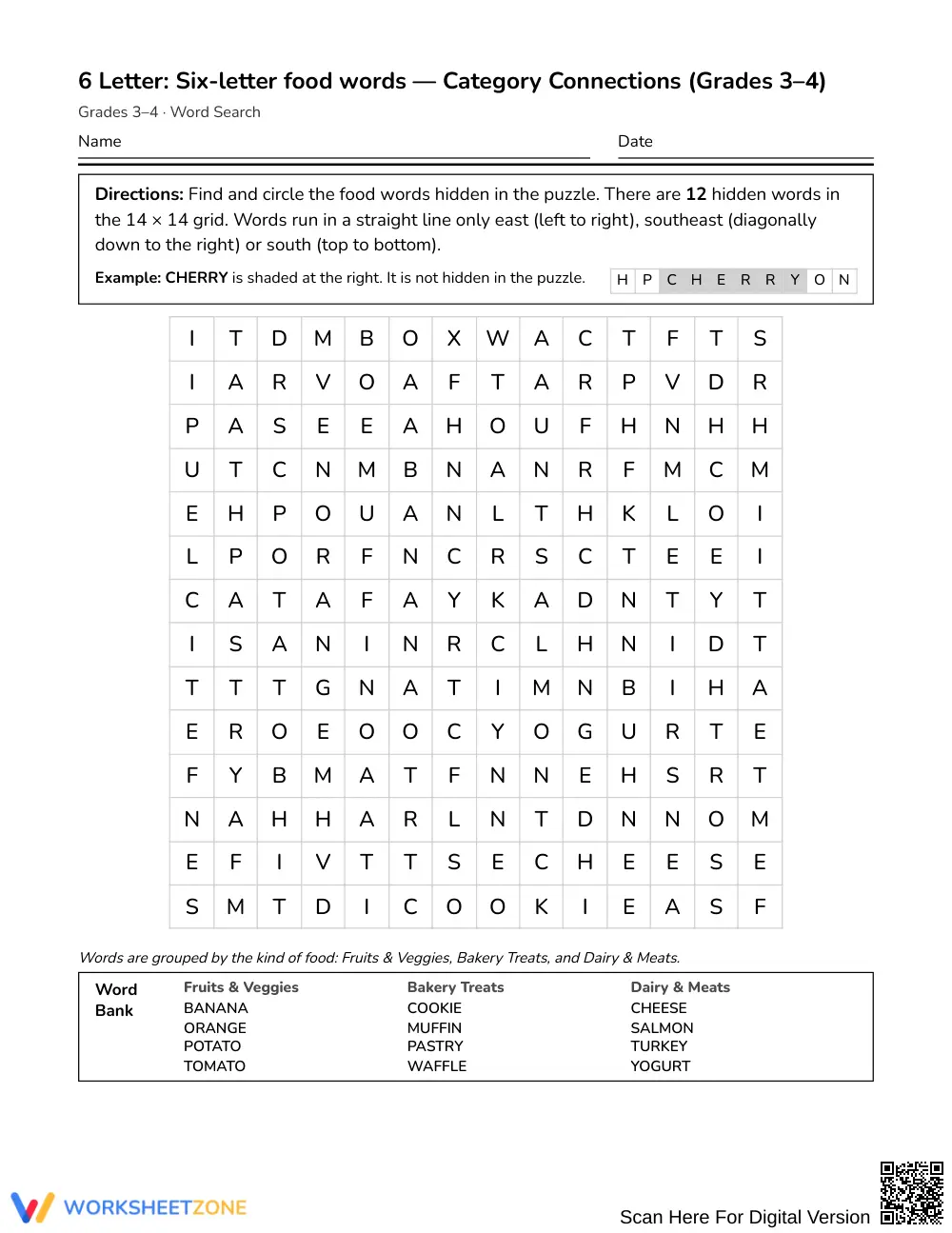
This printable word search strengthens spelling and recognition of six-letter culinary terms for elementary readers. Students locate 12 high-utility food words organized across three thematic nutritional categories. The activity reinforces orthographic memory, letter-pattern awareness, and category associations in an accessible, low-stress format suitable for independent seatwork or structured literacy blocks.
At a Glance
- Grade: Grades 3–4 · Subject: English Language Arts (ELA)
- Standard: Not standards-assessed — vocabulary enrichment
- Skill Focus: Six-letter food words
- Format: 1 page · 12 words · Answer key included · PDF
- Best For: Morning work, fast finishers, sub plans
- Time: 15–25 minutes
What's Inside
The one-page student sheet features a clear 14 by 14 letter grid and 12 target vocabulary words grouped into Fruits and Veggies, Bakery Treats, and Dairy and Meats. Accompanying student clues offer concise definitions for each culinary item to reinforce reading comprehension alongside visual search. A complete 3-page solution key shows exact letter coordinates for effortless grading and student self-checking.
Puzzle Structure and Mechanics
The word search uses an intentional 14 by 14 grid where all 12 target words run strictly East (left to right), Southeast (diagonally down), or South (vertically down). Words never read backward, keeping letter-sequencing accessible for developing decoders in Grades 3–4. Grouped word banks prompt students to make conceptual category connections as they scan for specific consonant-vowel combinations.
Standards Alignment
This activity is designed purely for vocabulary enrichment and spelling reinforcement rather than formal standards assessment. While not aligned to a specific state or national standard code, the task supports foundational decoding, orthographic mapping, and lexical categorization essential for elementary reading fluency.
How to Use It
Distribute this activity after direct spelling or nutrition lessons to reinforce letter order and content-area vocabulary. It functions smoothly as an independent warm-up, a quiet fast-finisher activity, or an emergency sub plan requiring no teacher setup. As a formative check, observe whether students scan systematically by initial letter blends or rely on category clues to confirm spelling before highlighting. Most learners finish within 15 to 25 minutes.
Who It's For
This puzzle serves students in Grades 3–4 who benefit from engaging visual word-study exercises. It offers accessible practice for English learners building conversational food nouns and provides calming, focused work for general education classrooms. Pair this puzzle with an informational text on balanced nutrition or a student-created culinary glossary.
Orthographic mapping and repeated visual exposure to structured word patterns play a foundational role in elementary vocabulary retention. Research highlighted in Fisher & Frey (2014) emphasizes that intentional word study across purposeful semantic categories supports lexical acquisition and automaticity in developing readers. By engaging with 12 six-letter food words within a defined 14 by 14 puzzle environment, students actively analyze letter sequences and practice spatial scanning without encountering cognitive overload. Grouping terms into distinct food groups promotes schema activation, allowing intermediate elementary learners to connect graphic word forms with concrete real-world meanings. The predictable directional pathways ensure that emerging readers consolidate spelling patterns systematically, bridging visual puzzle exploration with functional reading fluency.


