


























Views
Downloads
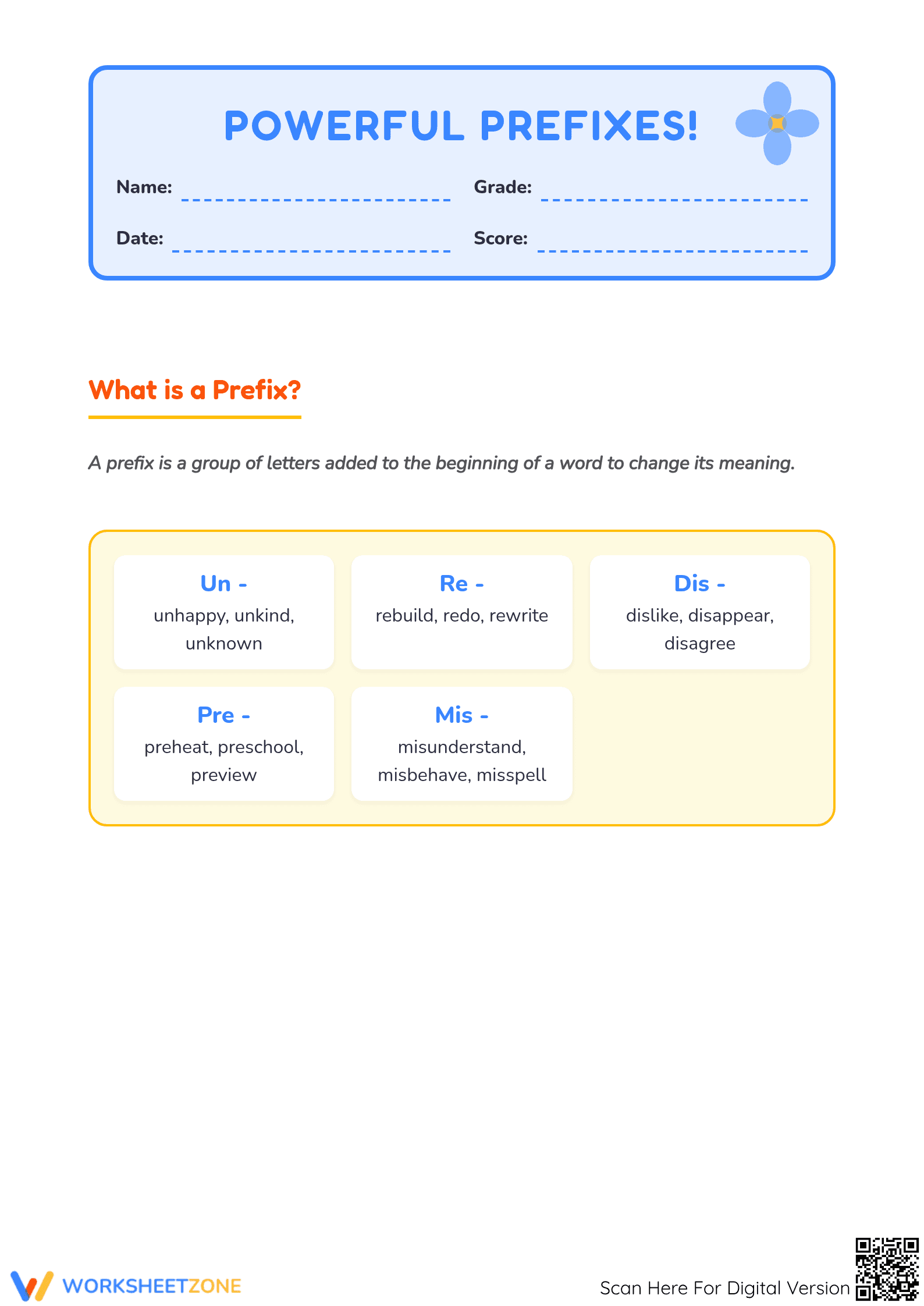



Printable Prefixes Worksheet | Grade 2 ELA
Paste this activity's link or code into your existing LMS (Google Classroom, Canvas, Teams, Schoology, Moodle, etc.).
Students can open and work on the activity right away, with no student login required.
You'll still be able to track student progress and results from your teacher account.
This printable Grade 2 prefixes worksheet helps students decode and build new words by mastering common prefixes like un-, re-, dis-, pre-, and mis-. By completing these targeted exercises, young readers will expand their vocabulary and improve reading comprehension, setting a strong foundation for future language arts success.
At a Glance
- Grade: 2 · Subject: English
- Standard:
CCSS.ELA-LITERACY.L.2.4.B— Determine the meaning of a new word formed when a prefix is added.- Skill Focus: Prefixes (un-, re-, dis-, pre-, mis-)
- Format: 4 pages · 16 problems · Answer key included · PDF
- Best For: Independent practice and vocabulary building
- Time: 20–30 minutes
What's Inside
This comprehensive resource includes four pages of student activities and a complete four-page answer key. The worksheet begins with a clear reference guide defining what a prefix is, alongside helpful examples. Students then work through four distinct task types: a meaning match, fill-in-the-blank sentences, multiple-choice word selection, and a creative sentence-writing prompt.
Skill Progression
- Guided practice: The first page serves as an anchor chart, introducing the five target prefixes with clear definitions and familiar examples to build confidence.
- Supported practice: Parts 1 and 2 offer 10 structured matching and fill-in-the-blank problems where students apply prefix meanings to highly contextualized sentences.
- Independent practice: Parts 3 and 4 challenge students with 6 advanced tasks, requiring them to select the correct prefixed word based on a definition and independently construct a new sentence.
This gradual-release model ensures students move smoothly through the I Do, We Do, You Do instructional framework.
Standards Alignment
Aligned to CCSS.ELA-LITERACY.L.2.4.B: Determine the meaning of the new word formed when a known prefix is added to a known word (e.g., happy/unhappy, tell/retell). It also supports broader vocabulary acquisition standards by encouraging students to use context clues to confirm word meanings. Both standard codes can be copied directly into lesson plans, IEP goals, or district curriculum mapping tools.
How to Use It
This worksheet is highly versatile for second-grade classrooms. Use it during literacy centers after a direct instruction mini-lesson on word parts, allowing students to practice independently. Alternatively, assign it as meaningful homework to reinforce vocabulary skills. As a formative assessment tip, review the final sentence-writing task to quickly gauge if a student truly grasps how the prefix alters the root word's meaning in context. Expected completion time is 20 to 30 minutes.
Who It's For
Designed primarily for second-grade students, this resource is also excellent for first graders needing enrichment or third graders requiring foundational review. The clear layout and built-in reference guide make it highly accessible for English Language Learners (ELLs) and students needing extra scaffolding. Pair this worksheet with a shared reading text where students can go on a prefix hunt to find these word parts in published books.
Mastering prefixes is a critical component of early literacy and vocabulary development for elementary students. By aligning with CCSS.ELA-LITERACY.L.2.4.B, this resource ensures students can accurately determine the meaning of a new word formed when a prefix is added. According to Fisher & Frey (2014), explicit instruction in morphology and word parts significantly enhances reading comprehension and decoding fluency in young readers. When students understand how prefixes like un- and re- change a base word, they gain the ability to independently decipher thousands of new vocabulary words across all subject areas. This foundational morphological awareness not only improves spelling accuracy but also builds the critical thinking skills necessary for tackling complex, grade-level texts with confidence and independence throughout their educational journey.


