


























Views
Downloads

Preschool Reading Game: Who's Who? | Essential Printable
Paste this activity's link or code into your existing LMS (Google Classroom, Canvas, Teams, Schoology, Moodle, etc.).
Students can open and work on the activity right away, with no student login required.
You'll still be able to track student progress and results from your teacher account.
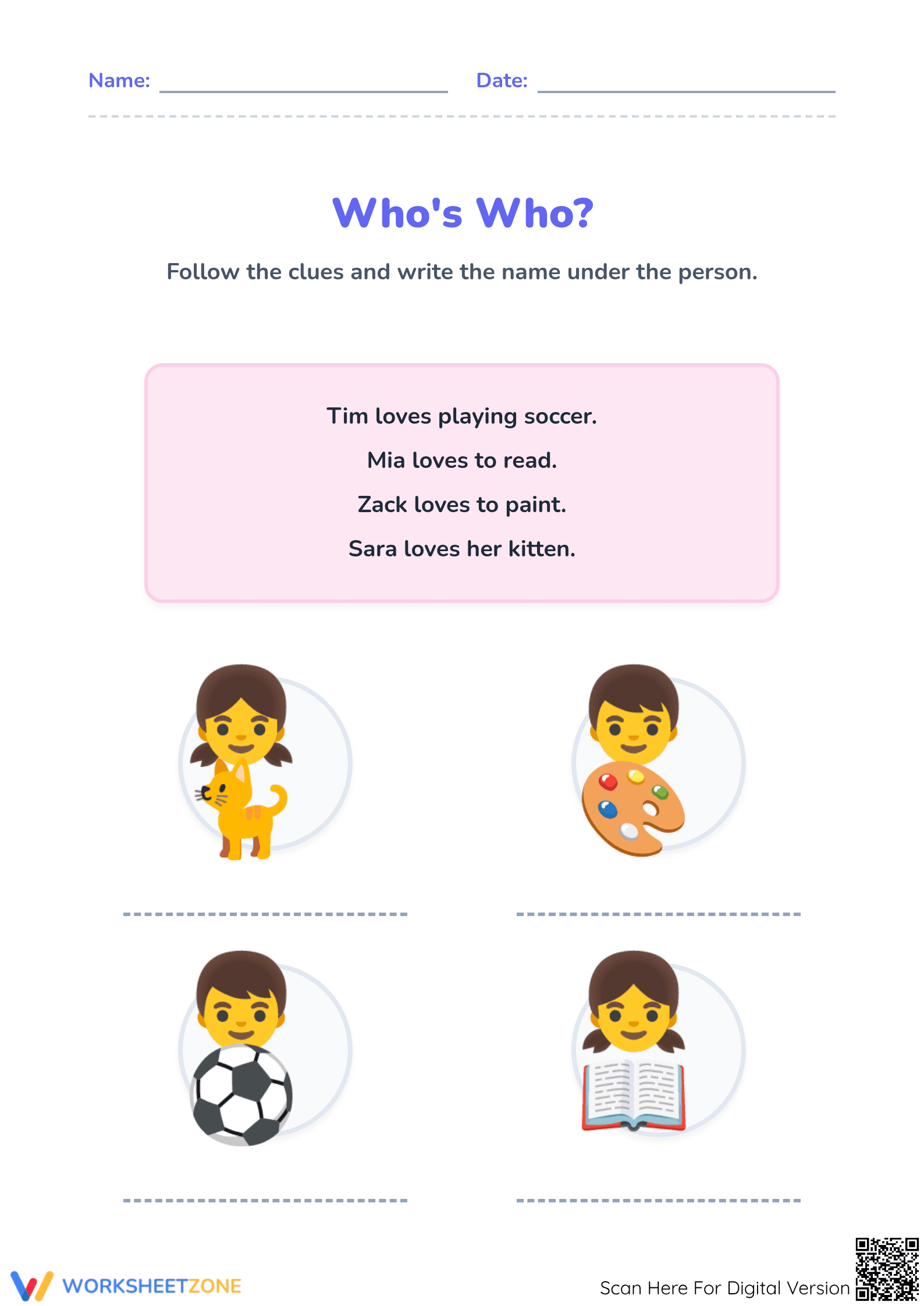
This preschool reading comprehension worksheet helps early learners connect simple text clues to visual representations. By identifying key details about characters like Tim and Mia, students develop foundational literacy skills and logical reasoning. It transforms basic sentence reading into an engaging "Who's Who" game that builds confidence in young readers through successful picture matching.
At a Glance
- Grade: Preschool · Subject: ELA
- Standard:
CCSS.ELA-LITERACY.RL.K.1— Answer questions about key details in a text with prompting and support- Skill Focus: Text-to-picture matching
- Format: 1 page · 4 problems · Answer key included · PDF
- Best For: Early literacy centers and morning work
- Time: 10–15 minutes
The worksheet features a clean, distraction-free layout with a central clue box containing four simple sentences. Below the text, four high-quality illustrations depict children engaged in specific activities like painting, reading, and playing soccer. Students use the provided name bank within the sentences to label each character, supported by a clear answer key for teacher or parent review.
The zero-prep workflow is designed for busy educators. First, print the single-page PDF (30 seconds). Next, distribute the sheets to students and read the clues aloud for pre-readers or let emerging readers tackle the text independently (1 minute). Finally, review the matches as a group to reinforce vocabulary and comprehension (5 minutes). Total teacher preparation time is under 2 minutes, making it an ideal sub-plan resource.
This resource aligns with `CCSS.ELA-LITERACY.RL.K.1`, focusing on identifying key details within a short text. While designed for Preschool, it serves as an excellent bridge to Kindergarten expectations by requiring students to extract specific information (names and hobbies) to solve a problem. Both standard codes can be copied directly into lesson plans, IEP goals, or district curriculum mapping tools.
Use this as a formative assessment during small group instruction to observe how students track text from left to right. It also works well as a quiet-time activity after a read-aloud session. Teachers should look for students who can verbally explain why they chose a specific name, such as pointing to the soccer ball as evidence for Tim. Completion typically takes 10 to 15 minutes depending on the student's reading level.
This activity is ideal for preschoolers and early kindergarteners who are beginning to recognize sight words and simple sentence structures. It provides excellent support for English Language Learners (ELLs) by pairing descriptive text with clear visual cues. Pair this worksheet with a character-based picture book or an anchor chart about "Wh- questions" to extend the learning session.
According to the RAND AIRS 2024 report, early exposure to text-to-picture association is a critical predictor of later reading fluency and comprehension success. This worksheet utilizes the "Who's Who" format to engage the brain's pattern-recognition centers, allowing students to practice `CCSS.ELA-LITERACY.RL.K.1` in a low-stakes, high-success environment. By requiring students to match 4 distinct clues to specific visual evidence, the activity reinforces the concept that text carries specific meaning. Research from Fisher & Frey (2014) suggests that these types of scaffolded tasks help bridge the gap between phonemic awareness and functional literacy. This printable resource provides the structured repetition necessary for cognitive development in early childhood settings, ensuring that students move beyond simple decoding to active information processing and logical deduction.


