


























Views
Downloads
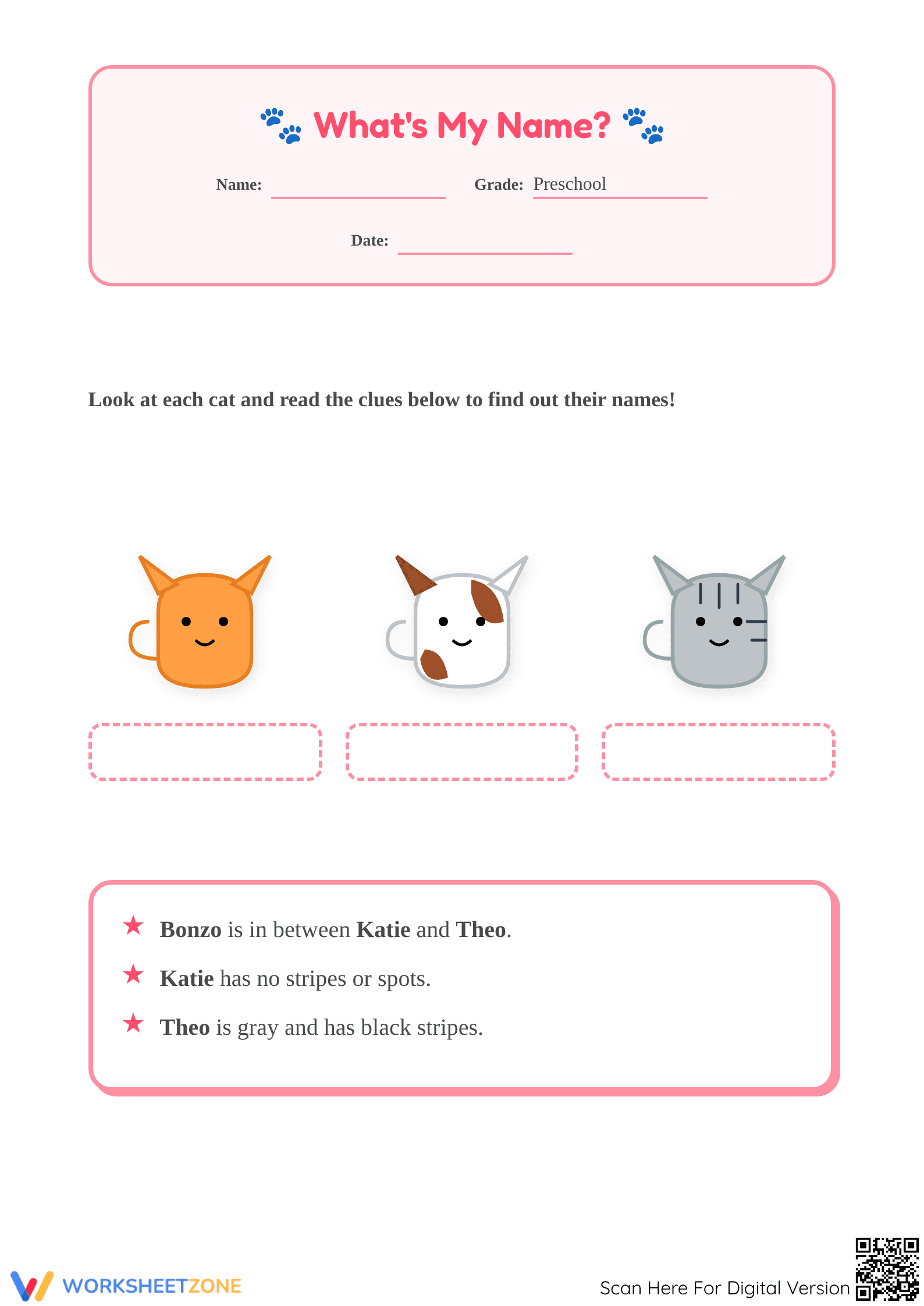


Printable Pre-Reading Cat Game Worksheet | Preschool ELA
Paste this activity's link or code into your existing LMS (Google Classroom, Canvas, Teams, Schoology, Moodle, etc.).
Students can open and work on the activity right away, with no student login required.
You'll still be able to track student progress and results from your teacher account.
This Pre-Reading Cat Game worksheet introduces early learners to the essential skill of identifying characters through descriptive text clues. By matching adorable cat illustrations to specific physical traits and names, preschoolers develop critical thinking. This interactive activity ensures students learn to pay close attention to details while building confidence for reading success.
At a Glance
- Grade: Preschool · Subject: English Language Arts
- Standard:
CCSS.ELA-LITERACY.RL.K.1— Answer questions about key details in a text with support- Skill Focus: Descriptive clue matching
- Format: 2 pages · 6 problems · Answer key included · PDF
- Best For: Early literacy centers and guided reading
- Time: 10–15 minutes
This two-page PDF includes a structured identification task and a reinforcement matching game. The first page presents three distinct cat illustrations—orange, spotted, and striped—alongside a "Clue Box" that challenges students to solve a name mystery. The second page features a matching section where learners connect names like Bonzo, Katie, and Theo to descriptions. A full answer key is provided.
Skill Progression
- Guided practice: Students listen to clues to determine Bonzo's position between other characters.
- Supported practice: Learners identify Katie and Theo by matching physical attributes like color to images.
- Independent practice: The matching activity connects text descriptions to names to verify mastery.
This follows a gradual-release model, moving from visual identification to abstract text-to-name matching.
Standards Alignment
This resource is primarily aligned to CCSS.ELA-LITERACY.RL.K.1, which requires students to answer questions about key details in a text with support. By requiring students to extract meaning from clues to solve a puzzle, the worksheet also supports early reasoning. Both standard codes can be copied directly into lesson plans, IEP goals, or district curriculum mapping tools.
How to Use It
Use this worksheet during small-group sessions to model how to look for "clue words" like colors. As a formative-assessment tip, watch if students can differentiate between "stripes" and "spots" without assistance. This activity is designed for 10-15 minutes of engagement, making it ideal for a quick literacy center rotation.
Who It's For
This activity is suited for preschool students beginning to associate written text with visual information. It provides excellent differentiation for English Language Learners through visual supports. Pair this worksheet with a short fiction passage about pets or an anchor chart featuring common descriptive adjectives to reinforce the learning objective.
The Pre-Reading Cat Game targets the foundational requirements of CCSS.ELA-LITERACY.RL.K.1 by scaffolding the process of answering questions about key details. Research from Fisher & Frey (2014) emphasizes the importance of guided practice and visual cues in developing the mental models necessary for reading comprehension. By using a 6-task structure that bridges visual observation with descriptive text, this resource helps preschool students transition from oral language to text-based evidence effectively. The inclusion of an answer key allows for immediate corrective feedback, a practice shown by RAND AIRS 2024 to significantly improve retention in early literacy environments. This worksheet serves as a high-quality bridge between simple identification and the analytical demands of elementary-grade texts, ensuring students possess the prerequisite skills for evidence-based reading.


