


























Views
Downloads
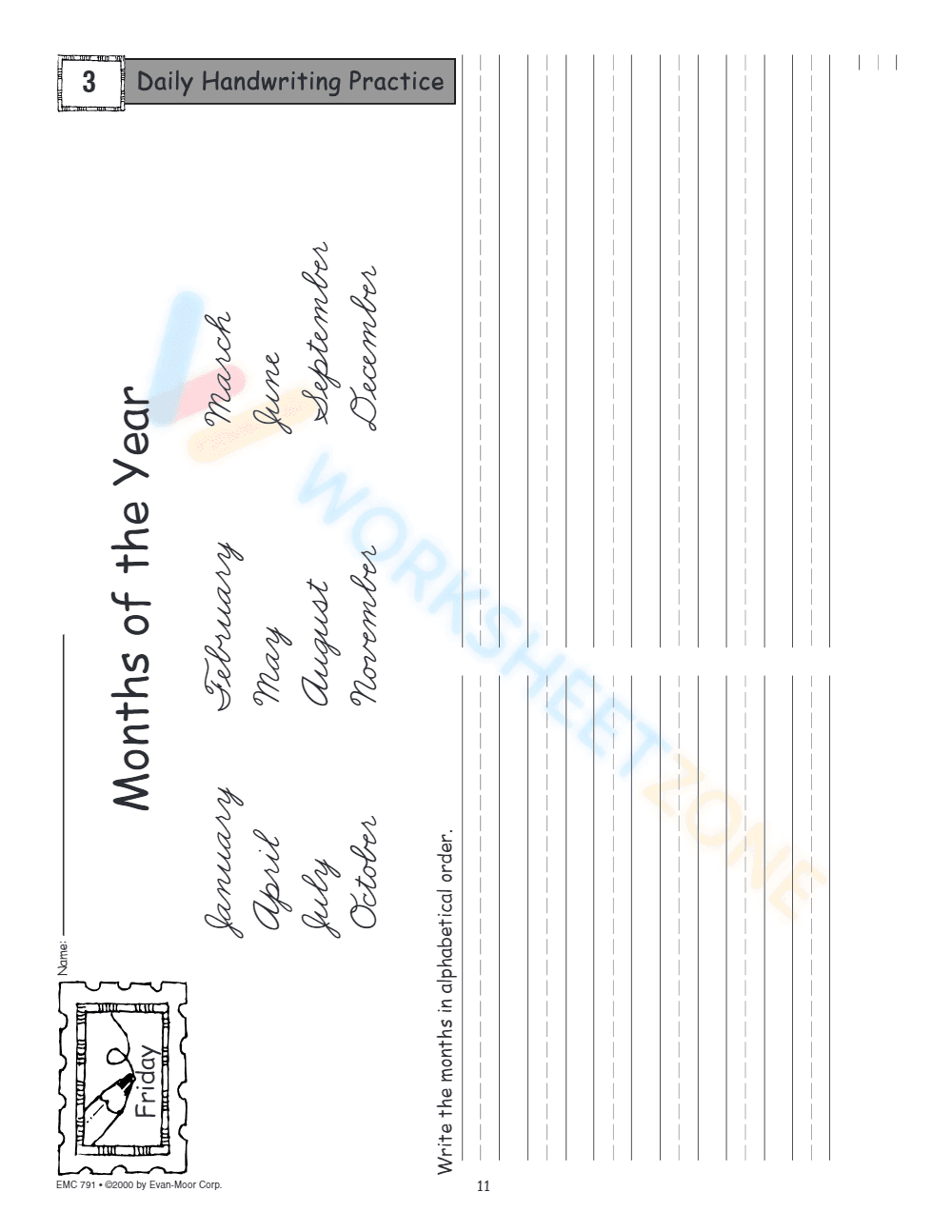

Cursive Months of the Year — Printable Grade 3 Worksheet
Paste this activity's link or code into your existing LMS (Google Classroom, Canvas, Teams, Schoology, Moodle, etc.).
Students can open and work on the activity right away, with no student login required.
You'll still be able to track student progress and results from your teacher account.
Overview
This Grade 3 cursive handwriting worksheet provides students with a structured opportunity to master the months of the year while refining their penmanship. By combining vocabulary with motor skill development, learners practice letter connections and spacing. This resource ensures students can write legibly and fluently in a cursive style, meeting essential literacy milestones.
At a Glance
- Grade: 3 · Subject: Handwriting
- Standard:
CCSS.ELA-LITERACY.L.3.1— Write legibly in cursive and demonstrate command of standard English conventions- Skill Focus: Cursive Penmanship
- Format: 1 page · 12 problems · Answer key included · PDF
- Best For: Daily morning work or bell ringers
- Time: 10–15 minutes
What's Inside
This single-page PDF features a clear list of all 12 months of the year written in a standard cursive font. Below the reference list, students find ample lined space with traditional mid-line dashes to guide letter height and slant. The task requires students to rewrite the months in alphabetical order, adding a cognitive layer to the mechanical writing exercise.
Zero-Prep Workflow
- Print: Select the single-page PDF and print copies for your entire class in approximately 30 seconds.
- Distribute: Hand out the sheets as students enter the room for a quiet morning transition or Friday review (1 minute).
- Review: Check for alphabetical accuracy and proper letter connections during individual desk rounds or as a group (30 seconds).
This workflow minimizes teacher preparation, making it an ideal component for emergency sub-plans or daily bell-ringer routines.
Standards Alignment
The primary standard for this resource is `CCSS.ELA-LITERACY.L.3.1`, which requires students to demonstrate command of the conventions of standard English. While cursive requirements vary by state, this worksheet supports the foundational legibility needed for all written communication. This standard code can be copied directly into lesson plans, IEP goals, or district curriculum mapping tools.
How to Use It
Use this worksheet during the independent practice phase of a handwriting lesson. It serves as an excellent formative assessment tool; observe students' grip, posture, and paper orientation as they work. The expected completion time is 10 to 15 minutes, making it perfect for a quick transition activity between ELA blocks or as a focused homework assignment.
Who It's For
This resource is designed for third and fourth-grade students transitioning from manuscript to cursive. It is particularly helpful for students needing extra fine-motor support or English Language Learners practicing calendar vocabulary. Pair this with a cursive alphabet anchor chart or a direct instruction lesson on uppercase letter connections to maximize student success.
According to the Fisher & Frey (2014) framework for gradual release of responsibility, structured practice is vital for motor skill automaticity. This worksheet aligns with `CCSS.ELA-LITERACY.L.3.1` by focusing on the mechanical conventions of writing. Research from the NAEP indicates that students who develop fluent handwriting can devote more cognitive resources to higher-level composition tasks. By practicing the 12 months of the year in alphabetical order, students engage in a dual-task exercise that reinforces both linguistic sequencing and penmanship. This specific resource provides the necessary scaffolding for Grade 3 learners to move from letter-level tracing to word-level fluency. Educators can utilize this tool to track progress in legibility and letter formation over time. The 15-minute instructional window fits within standard daily literacy blocks, ensuring that handwriting remains a consistent part of the elementary curriculum without overwhelming the schedule.


