


























Views
Downloads
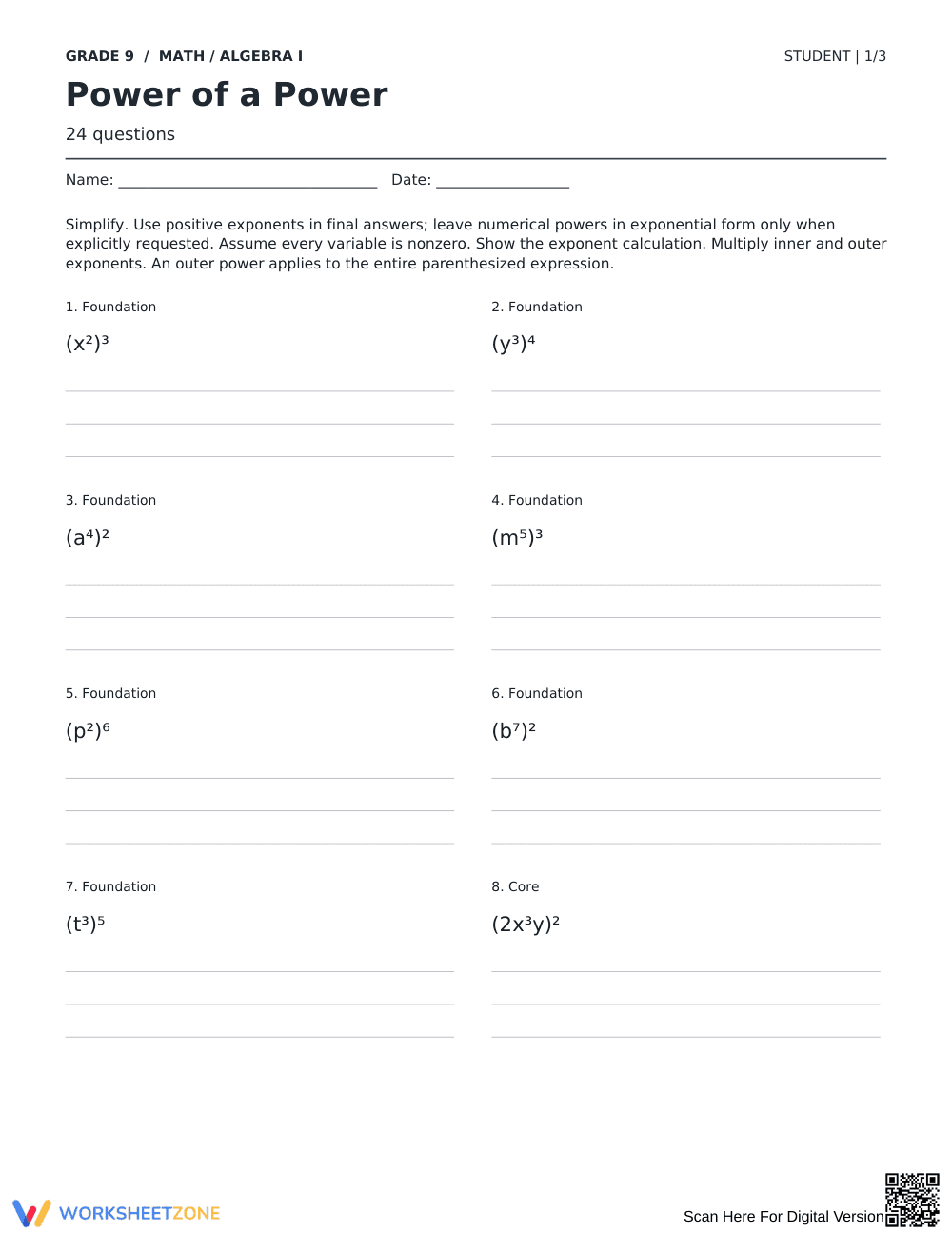
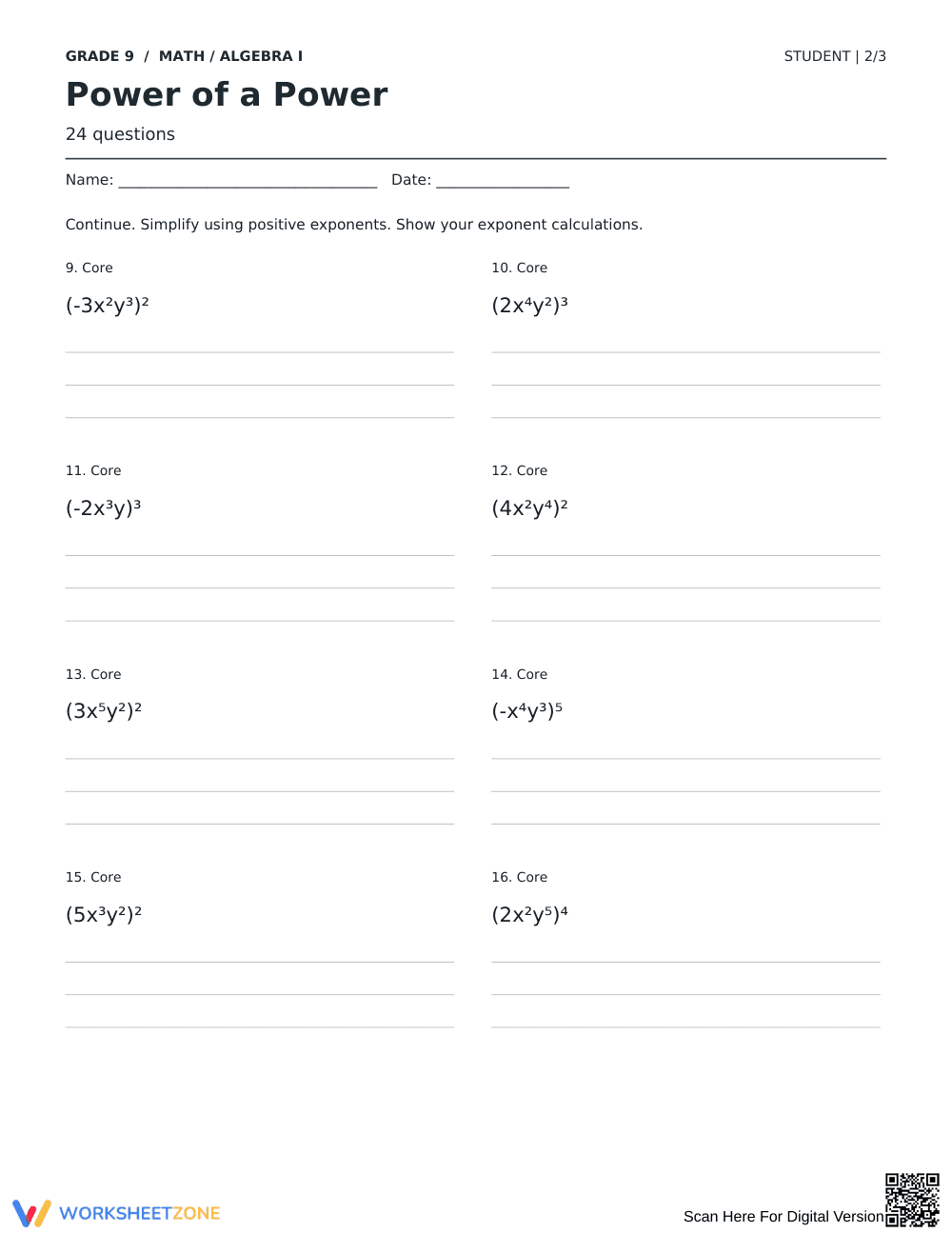
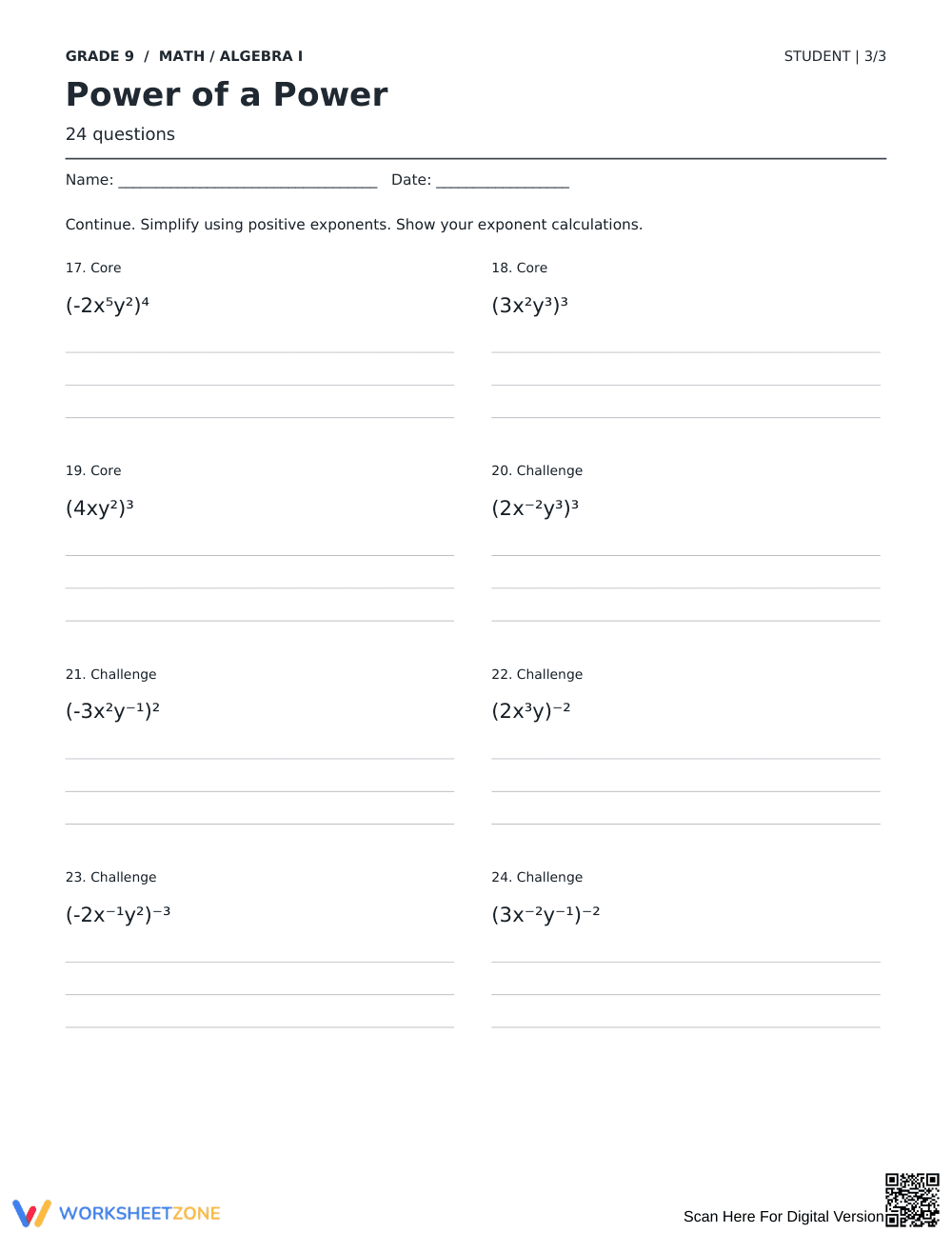

Power of a Power Printable Worksheet | Grade 9 Algebra
Paste this activity's link or code into your existing LMS (Google Classroom, Canvas, Teams, Schoology, Moodle, etc.).
Students can open and work on the activity right away, with no student login required.
You'll still be able to track student progress and results from your teacher account.
This Grade 9 algebra worksheet builds fluency with the power of a power exponent rule, guiding students through 24 structured problems that progress from single-variable expressions to multi-variable and negative-exponent challenges. Students leave with a reliable, transferable procedure for simplifying exponential expressions.
At a Glance
- Grade: 9 · Subject: Math / Algebra
- Standard:
CCSS.MATH.CONTENT.HSA-SSE.B.3— Choose and produce an equivalent form of an expression to reveal its properties- Skill Focus: Applying the power of a power rule to simplify exponential expressions
- Format: 2 pages · 24 problems · Answer key included · PDF
- Best For: Guided practice after direct instruction
- Time: 20–30 minutes
The worksheet spans two student-facing pages and one complete answer key. Problems are organized in clearly numbered sets, moving from straightforward integer-exponent expressions such as (x²)³ to more complex forms involving coefficients, multiple variables, and negative exponents. No word bank or worked example is printed on the student page, keeping the focus on procedural recall and application.
- Guided practice (Problems 1–8): Single-variable expressions with positive integer exponents. Students apply (aᵐ)ⁿ = aᵐⁿ in its most direct form, building confidence before complexity increases.
- Supported practice (Problems 9–16): Expressions introduce coefficients and two-variable bases, requiring students to distribute the outer exponent across each factor. Moderate scaffold through consistent problem structure.
- Independent practice (Problems 17–24): Negative exponents, fractional bases, and mixed multi-step expressions demand full procedural independence. Students must combine the power of a power rule with other exponent laws.
This gradual-release sequence mirrors the I Do, We Do, You Do framework, making it easy to assign sections selectively based on where students are in the lesson cycle.
Standards Alignment
The primary standard is CCSS.MATH.CONTENT.HSA-SSE.B.3: Choose and produce an equivalent form of an expression to explain the properties of the quantity represented by the expression. Supporting work also connects to CCSS.MATH.CONTENT.HSA-APR.A.1, which addresses operations on polynomial expressions. Both standard codes can be copied directly into lesson plans, IEP goals, or district curriculum mapping tools.
How to Use It
Assign Problems 1–8 immediately after direct instruction on the power of a power rule as a quick formative check; watch for students who multiply exponents rather than add them — a common error that signals the need for re-teaching. Use the full 24-problem set as independent practice or homework the following day. Expected completion time is 20–30 minutes for most ninth-grade students.
Who It's For
Designed for Grade 9 Algebra 1 students encountering exponent rules for the first time, this worksheet also works well as a review tool for Algebra 2 students who need to consolidate foundational skills before tackling rational exponents. Pair it with an exponent-rules anchor chart or a brief worked-example lesson for maximum impact.
Research supports the value of structured procedural practice in algebra readiness. According to Fisher & Frey (2014), the gradual-release model — in which responsibility shifts incrementally from teacher to student — produces measurably stronger retention of procedural skills than massed practice alone. This worksheet's three-phase problem sequence directly reflects that model. Aligned to CCSS.MATH.CONTENT.HSA-SSE.B.3, it targets the high-leverage skill of rewriting exponential expressions in equivalent forms — a competency that NAEP data consistently identifies as a gap area for entering high school students. With 24 problems and a full answer key, teachers can use this resource for instruction, formative assessment, or targeted intervention without additional preparation.


