


























Views
Plays
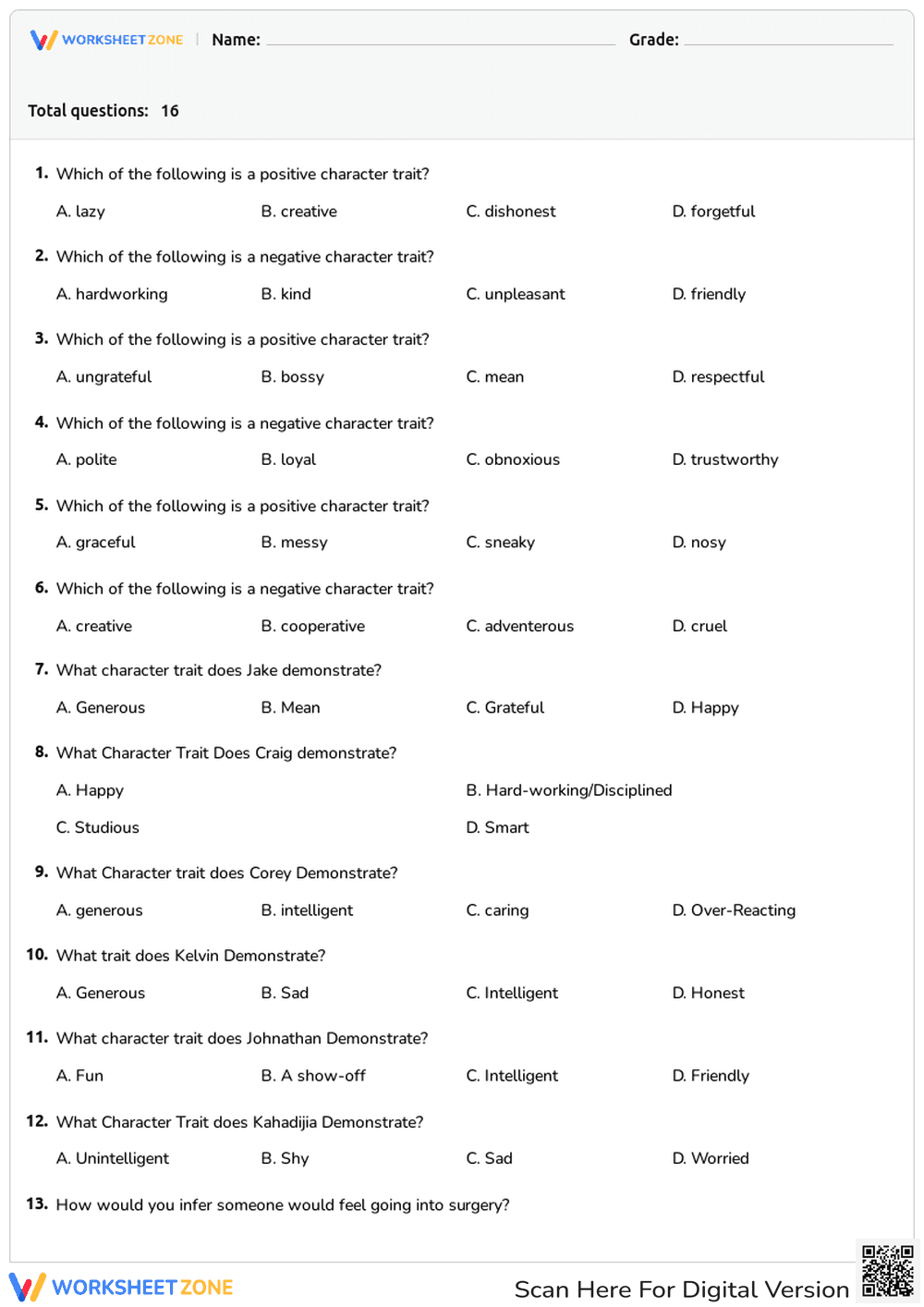


Character Traits Practice Worksheet | Grade 4-5 Essential
Paste this activity's link or code into your existing LMS (Google Classroom, Canvas, Teams, Schoology, Moodle, etc.).
Students can open and work on the activity right away, with no student login required.
You'll still be able to track student progress and results from your teacher account.
This Grade 4 and Grade 5 character traits worksheet helps students distinguish between positive and negative personality attributes while practicing critical inference skills. By analyzing 16 specific questions, learners move beyond simple definitions to understand how actions and feelings manifest as identifiable traits. This resource ensures students can accurately categorize behavior and apply vocabulary to character analysis.
At a Glance
- Grade: 4-5 · Subject: Character Traits
- Standard:
CCSS.ELA-LITERACY.RL.4.3— Describe characters in depth using specific details and traits from the text.- Skill Focus: Positive vs. Negative Trait Classification
- Format: 2 pages · 16 problems · Answer key included · PDF
- Best For: Independent practice or quick formative assessment
- Time: 15–20 minutes
What's Inside
The worksheet consists of two clearly organized pages containing 16 multiple-choice questions. The first section focuses on direct classification, asking students to identify which traits (such as creative, dishonest, or respectful) fall into positive or negative categories. The second section challenges students to infer traits from short character scenarios and definitions. A full answer key is provided to facilitate rapid grading or student self-correction.
Zero-Prep Workflow
- Print (1 minute): Select the two-page PDF and print enough copies for your roster. No collation or stapling is required for the single-sided layout.
- Distribute (30 seconds): Hand out the sheets as a bell-ringer or a transition activity between reading blocks.
- Review (30 seconds): Use the included answer key to check for understanding. Total teacher preparation time is under two minutes, making this an ideal choice for emergency sub plans.
Standards Alignment
This resource aligns primarily with `CCSS.ELA-LITERACY.RL.4.3`, which requires students to describe characters in depth, drawing on specific details such as their actions or spoken words. It also supports `CCSS.ELA-LITERACY.L.4.6` by expanding academic vocabulary related to personality and behavior. Both standard codes can be copied directly into lesson plans, IEP goals, or district curriculum mapping tools.
How to Use It
Assign this worksheet during the "You Do" phase of a gradual release lesson on characterization. It serves as an excellent formative assessment tool; observe if students struggle with the inference-based questions (13-16) versus the classification questions (1-6) to determine if they need more support with context clues. Most students will complete the 16 tasks within a 15 to 20-minute window.
Who It's For
This practice is designed for upper elementary students in general education or special education settings focusing on Social-Emotional Learning (SEL). It is particularly effective for students who need concrete examples of abstract personality concepts. Pair this worksheet with a character anchor chart or a short story passage to provide a comprehensive literacy experience.
According to research by Fisher & Frey (2014), the ability to categorize and label character traits is a foundational step in complex literary analysis and reading comprehension. This worksheet addresses that need by providing 16 structured opportunities for students to engage with trait vocabulary. By isolating the skill of trait identification, the resource allows educators to measure student mastery of `CCSS.ELA-LITERACY.RL.4.3` without the cognitive load of a full-length novel. The inclusion of both positive and negative attributes encourages students to develop a nuanced understanding of character motivation and conflict. This systematic approach to vocabulary acquisition is supported by the NAEP framework, which emphasizes the importance of word knowledge in overall literacy achievement. Educators can use the results of this 16-task assessment to identify specific gaps in student inference skills or vocabulary breadth, ensuring that future instruction is targeted and effective for every learner in the classroom.


