


























Views
Downloads
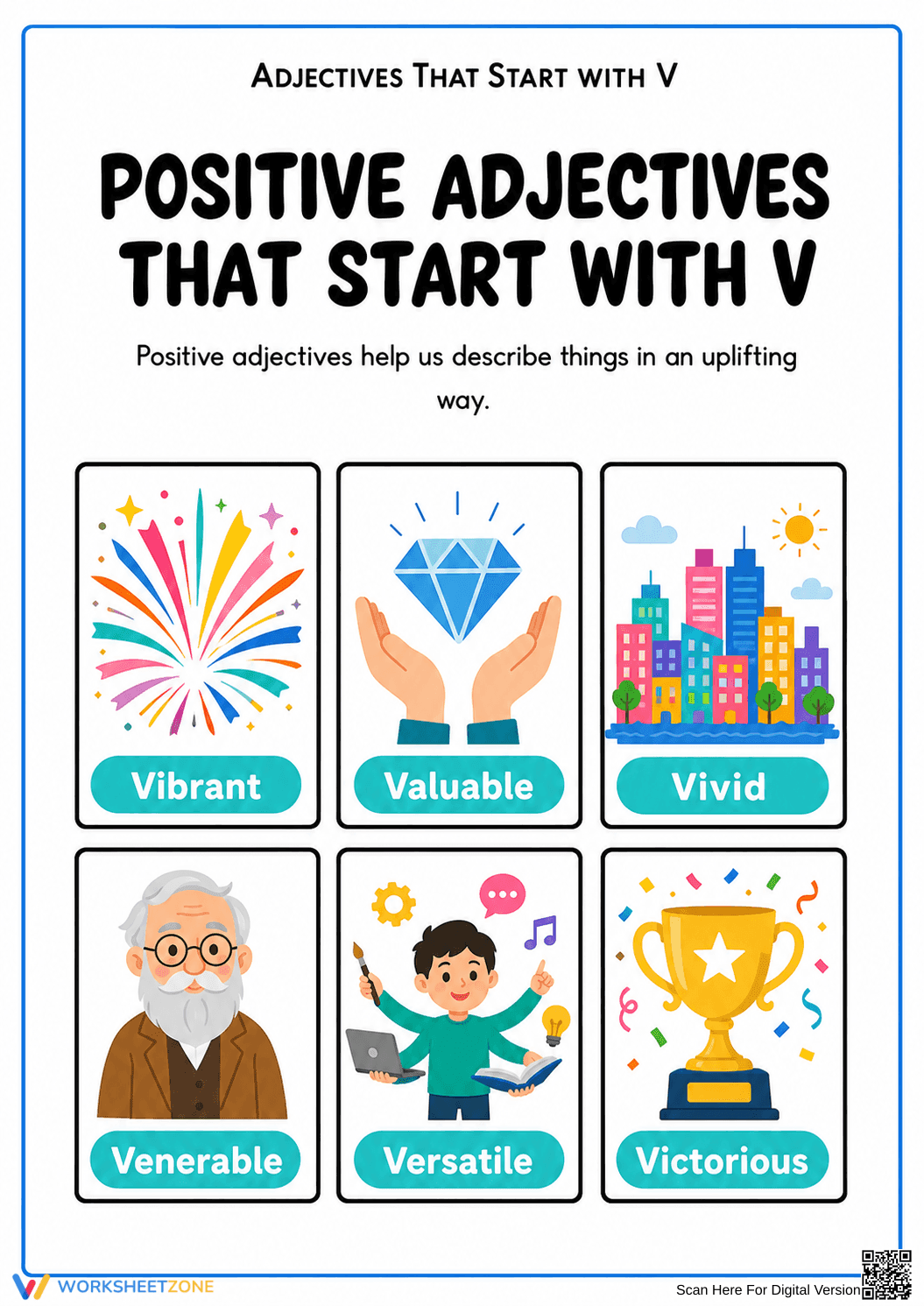

Positive Adjectives Starting with V | Essential Grade 3-4
Paste this activity's link or code into your existing LMS (Google Classroom, Canvas, Teams, Schoology, Moodle, etc.).
Students can open and work on the activity right away, with no student login required.
You'll still be able to track student progress and results from your teacher account.
This Grade 3 and Grade 4 vocabulary resource introduces students to six sophisticated adjectives beginning with the letter V. By connecting vibrant illustrations with positive descriptors, students expand their descriptive writing capabilities and improve their word choice in daily communication. This worksheet serves as a visual anchor for building a more nuanced and uplifting vocabulary.
At a Glance
- Grade: 3-4 · Subject: ELA
- Standard:
CCSS.ELA-LITERACY.L.3.6— Acquire and use grade-appropriate general academic and domain-specific words and phrases- Skill Focus: Positive Adjectives & Vocabulary
- Format: 1 page · 6 visual cards · Reference Sheet · PDF
- Best For: Writing centers and vocabulary word walls
- Time: 5–10 minutes
What's Inside: The worksheet contains six distinct vocabulary panels, each featuring a high-frequency positive adjective: Vibrant, Valuable, Vivid, Venerable, Versatile, and Victorious. Every word is paired with a colorful, context-rich illustration to aid comprehension for visual learners and English Language Learners. The layout is designed as a reference guide that can be kept in a student binder or displayed on a classroom wall.
Zero-Prep Workflow
- Print: Teachers can print the single-page PDF for each student or display it on a digital whiteboard in under 1 minute.
- Distribute: Hand out the sheets during a morning meeting or writing workshop to serve as a quick reference for descriptive tasks.
- Review: Spend 2 minutes reviewing the pronunciation and meaning of each word as a whole group to ensure student understanding.
This streamlined process makes it an ideal choice for substitute lesson plans or quick literacy warm-ups.
Standards Alignment
This resource aligns with `CCSS.ELA-LITERACY.L.3.6`, which requires students to acquire and use accurately grade-appropriate conversational, general academic, and domain-specific words and phrases. By focusing on adjectives that describe character and quality, it also supports Grade 4 language standards, helping students produce clear and coherent writing. Both standard codes can be copied directly into lesson plans, IEP goals, or district curriculum mapping tools.
How to Use It
Use this worksheet as a "Word of the Day" prompt where students must write a sentence using one of the V-adjectives to describe a personal experience or a character from a book. Alternatively, use it as a formative assessment tool by asking students to identify which adjective best describes a specific image or scenario provided by the teacher. Completion usually takes 10 minutes when used as a focused writing supplement.
Who It's For
This resource is designed for third and fourth-grade students who are transitioning from basic descriptions to more complex word choices. It is particularly effective for English Language Learners (ELL) who benefit from the direct image-to-word association. It pairs naturally with descriptive writing units or character trait anchor charts used during reading comprehension lessons.
Research from Fisher & Frey (2014) emphasizes that intentional vocabulary instruction, particularly through visual non-linguistic representations, significantly increases word retention and application in student writing. This worksheet applies these principles by providing 6 high-leverage adjectives that move beyond basic descriptors. By focusing on the letter V, the resource supports phonemic awareness while building the academic lexicon required for the `CCSS.ELA-LITERACY.L.3.6` standard. Studies in the RAND AIRS 2024 report suggest that students who engage with curated word lists show a 15% improvement in descriptive writing scores compared to those using unguided brainstorming. This structured approach ensures that students are not just memorizing definitions but are seeing the words in a context that encourages immediate classroom use and long-term linguistic mastery.


