


























Views
Plays

Grade 7 Poetry Elements — Printable No-Prep Worksheet
Paste this activity's link or code into your existing LMS (Google Classroom, Canvas, Teams, Schoology, Moodle, etc.).
Students can open and work on the activity right away, with no student login required.
You'll still be able to track student progress and results from your teacher account.
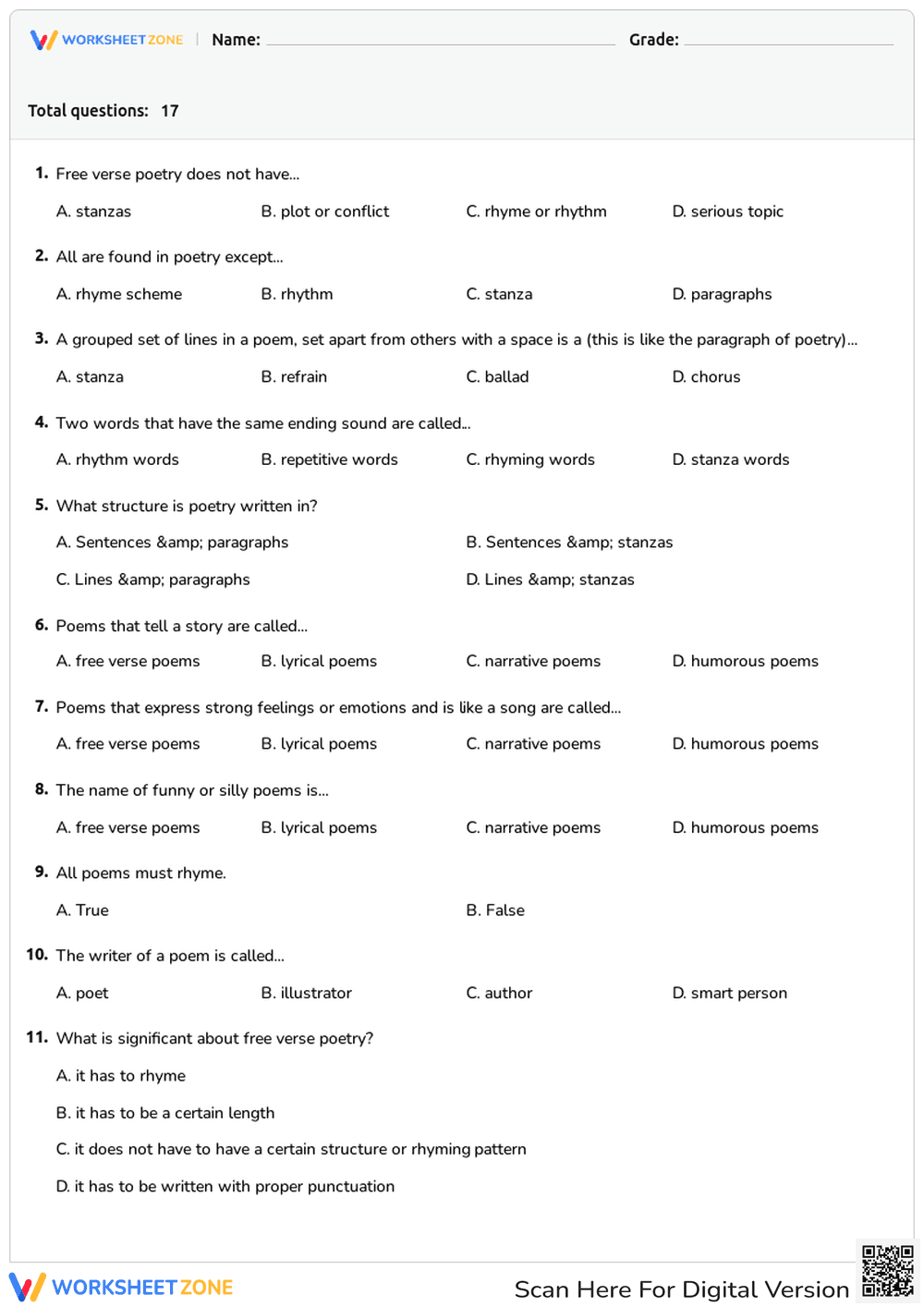
This Grade 7 and 8 poetry elements worksheet gives students focused practice identifying the structural characteristics and literary devices used in poems. By completing this straightforward quiz, learners will demonstrate their understanding of stanzas, rhyme schemes, free verse, and imagery, building a strong foundation for deeper literary analysis.
At a Glance
- Grade: 7 · Subject: ELA
- Standard:
CCSS.ELA-LITERACY.RL.7.5— Analyze how a poem's form or structure contributes to its meaning.- Skill Focus: Poetry elements and structural terms
- Format: 2 pages · 17 problems · Answer key included · PDF
- Best For: Formative assessment or review
- Time: 15–20 minutes
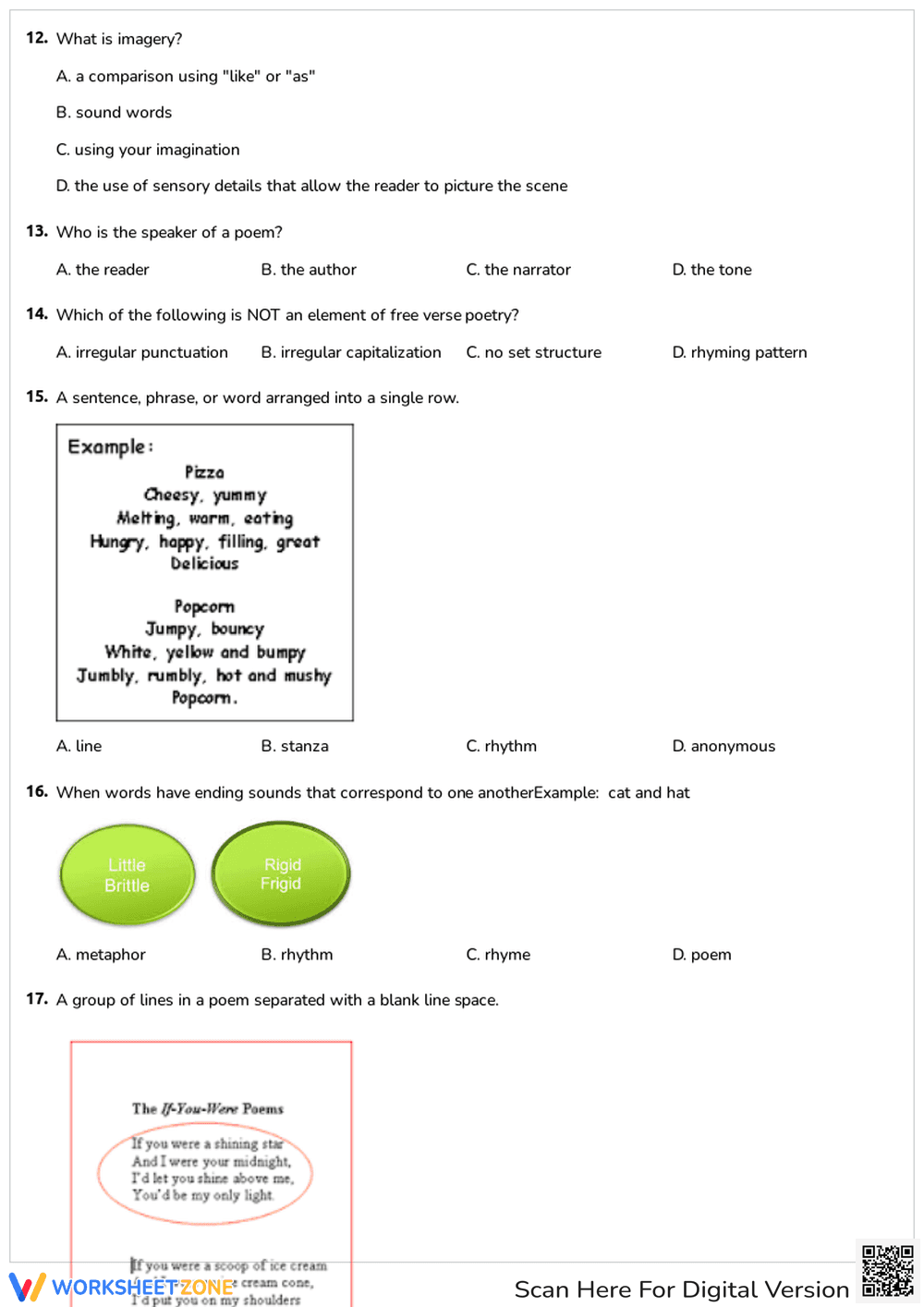
Inside this resource, educators will find a comprehensive two-page multiple-choice quiz featuring 17 targeted questions. The tasks cover a wide range of essential poetry vocabulary, including narrative poems, lyrical poetry, stanzas, lines, and sensory details. Several questions incorporate visual examples and short text snippets to help students contextualize the terms. A complete answer key is provided to ensure quick and accurate grading.
Enjoy a streamlined zero-prep workflow:
- Print (1 minute): Print the two-page assessment and answer key.
- Distribute (1 minute): Hand out the quiz; no additional setup or materials needed.
- Review (3 minutes): Use the provided key to rapidly score the 17 multiple-choice questions or conduct a whole-class review session.
With a total teacher prep time of under two minutes, this resource is highly suitable for emergency sub plans, quick knowledge checks, or independent practice stations.
This activity is directly aligned to CCSS.ELA-LITERACY.RL.7.5, requiring students to analyze how a drama's or poem's form or structure (e.g., soliloquy, sonnet) contributes to its meaning. By mastering the foundational vocabulary of poetic structure, students are prepared to tackle more complex analytical tasks. Both standard codes can be copied directly into lesson plans, IEP goals, or district curriculum mapping tools.
Use this quiz after direct instruction as a summative knowledge check to ensure students retain key definitions before analyzing full-length poems. Alternatively, assign it as an independent review activity during a poetry unit. For a formative assessment observation tip, monitor which specific terms (such as "imagery" versus "metaphor") students struggle with most, and use that data to plan targeted mini-lessons. The expected completion time is 15 to 20 minutes.
This resource is primarily designed for 7th and 8th-grade ELA students who are building their academic vocabulary in literature. The straightforward multiple-choice format provides built-in differentiation for students who benefit from structured options rather than open-ended recall. It serves as an excellent natural pairing resource alongside an introductory anchor chart on poetry terms or a direct instruction lesson on literary devices.
Mastering domain-specific vocabulary is a critical stepping stone for advanced reading comprehension and literary analysis. This resource targets CCSS.ELA-LITERACY.RL.7.5, helping students analyze how a poem's form or structure contributes to its meaning by first ensuring they can accurately identify those structural elements. According to Fisher & Frey (2014), explicit vocabulary instruction combined with multiple exposures to academic terms significantly improves students' ability to engage with complex texts. By providing 17 focused questions on poetry elements, this worksheet offers the repeated practice necessary for vocabulary retention. When students can confidently define terms like stanza, free verse, and imagery, they free up cognitive resources to focus on deeper thematic analysis and critical thinking. This targeted approach ensures learners are fully equipped to interpret and appreciate the nuances of poetic literature.


