




























Views
Plays


Poetic Terms Worksheet | Grade 4 Essential Practice

Paste this activity's link or code into your existing LMS (Google Classroom, Canvas, Teams, Schoology, Moodle, etc.).
Students can open and work on the activity right away, with no student login required.
You'll still be able to track student progress and results from your teacher account.
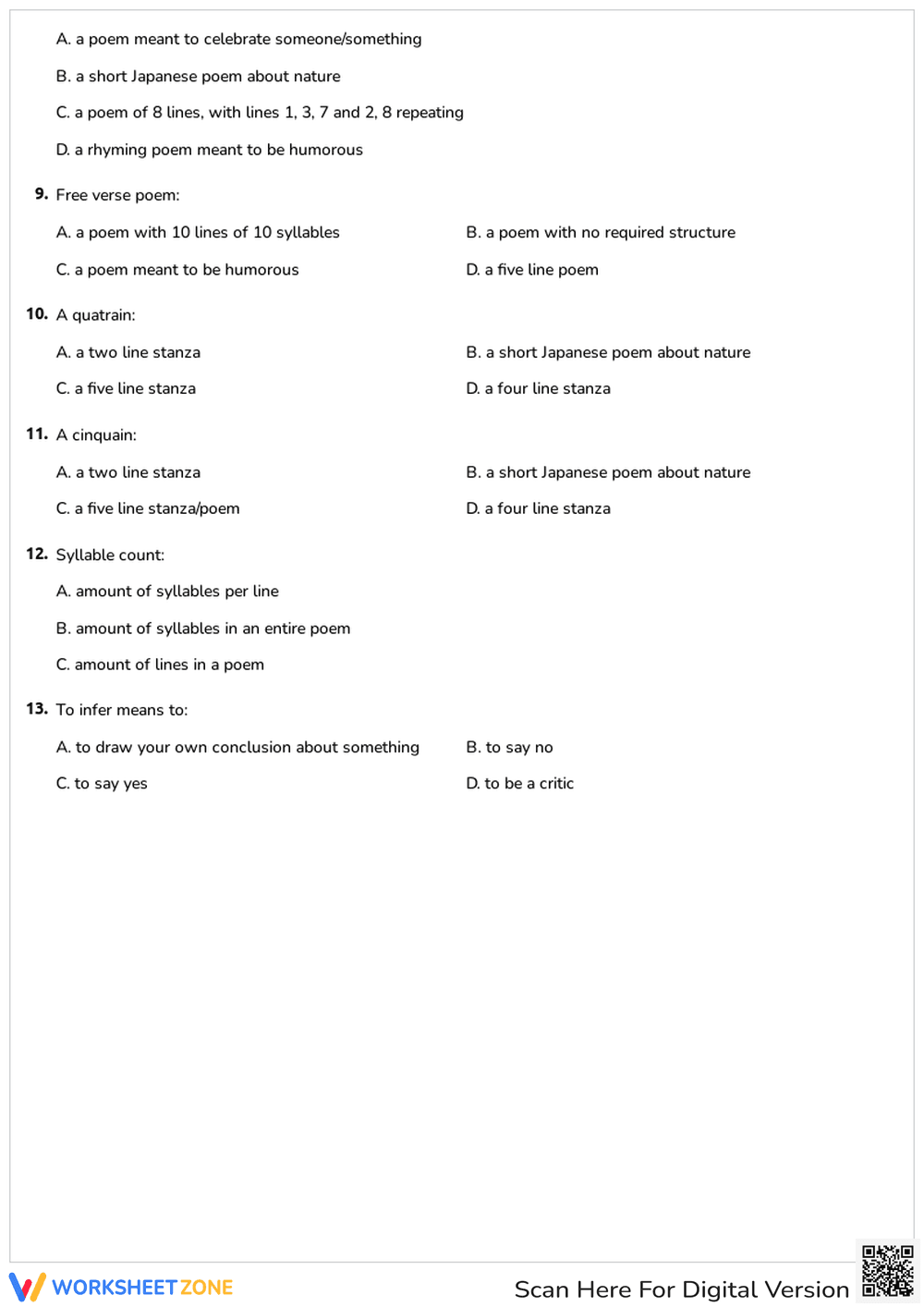
This Grade 4 poetic terms worksheet provides students with 13 structured multiple-choice questions to master the vocabulary of verse. By identifying the correct definitions for structural elements and specific poem types, learners build the foundational knowledge required to analyze complex literature. It ensures students can distinguish between various poetic forms and sound devices.
At a Glance
- Grade: 4 · Subject: ELA
- Standard:
CCSS.ELA-LITERACY.RL.4.5— Explain structural elements of poems like verse, rhythm, and meter- Skill Focus: Poetic Terminology
- Format: 2 pages · 13 problems · Answer key included · PDF
- Best For: Literary term review and assessment
- Time: 15–20 minutes
This two-page PDF features 13 targeted multiple-choice questions. Each question presents a key poetic term—ranging from structural components like stanzas and quatrains to sound devices like assonance and consonance—and asks students to select the most accurate definition from four options. The layout is clean and distraction-free, including a dedicated space for student names and grades.
The worksheet follows a logical progression of difficulty. It begins with guided practice on fundamental concepts like rhyme schemes and stanzas in the first three questions. It then moves into supported practice where students must differentiate between similar sound devices like assonance and consonance. Finally, it transitions to independent practice requiring the identification of specific poetic forms such as haikus, odes, and triolets. This gradual-release approach ensures students build confidence before tackling more nuanced literary definitions.
The primary focus is `CCSS.ELA-LITERACY.RL.4.5`, which requires students to explain major differences between poems, drama, and prose, specifically referring to the structural elements of poems. By defining terms like quatrain and free verse, students demonstrate an understanding of how poets organize their work. This standard code can be copied directly into lesson plans, IEP goals, or district curriculum mapping tools.
Use this worksheet as a formative assessment after a direct instruction lesson on poetry. It serves as an excellent check for understanding before students begin writing their own original poems. Teachers should observe if students struggle to distinguish between consonance and assonance, as this indicates a need for further phonemic awareness instruction. Expect a completion time of 15 to 20 minutes.
This resource is designed for 3rd, 4th, and 5th-grade students. It is particularly helpful for English Language Learners who need explicit vocabulary support for literary analysis. Pair this worksheet with a poetry anchor chart or a specific mentor text, such as a collection of haikus or free verse poems, to provide concrete examples of the terms defined.
According to the RAND AIRS 2024 report, explicit instruction in domain-specific vocabulary is a critical predictor of reading comprehension in the upper elementary grades. This worksheet addresses that need by isolating 13 essential poetic terms, allowing students to build the mental schema necessary for high-level literary analysis. By mastering the definitions of structural elements like stanzas and quatrains under the `CCSS.ELA-LITERACY.RL.4.5` framework, students are better equipped to navigate the complexities of figurative language and authorial intent. Research from Fisher & Frey (2014) emphasizes that such targeted practice helps bridge the gap between basic literacy and disciplinary expertise. This resource provides a structured environment for students to practice these skills, ensuring they can accurately identify and explain the mechanics of poetry in both academic and creative contexts.


