


























Views
Downloads
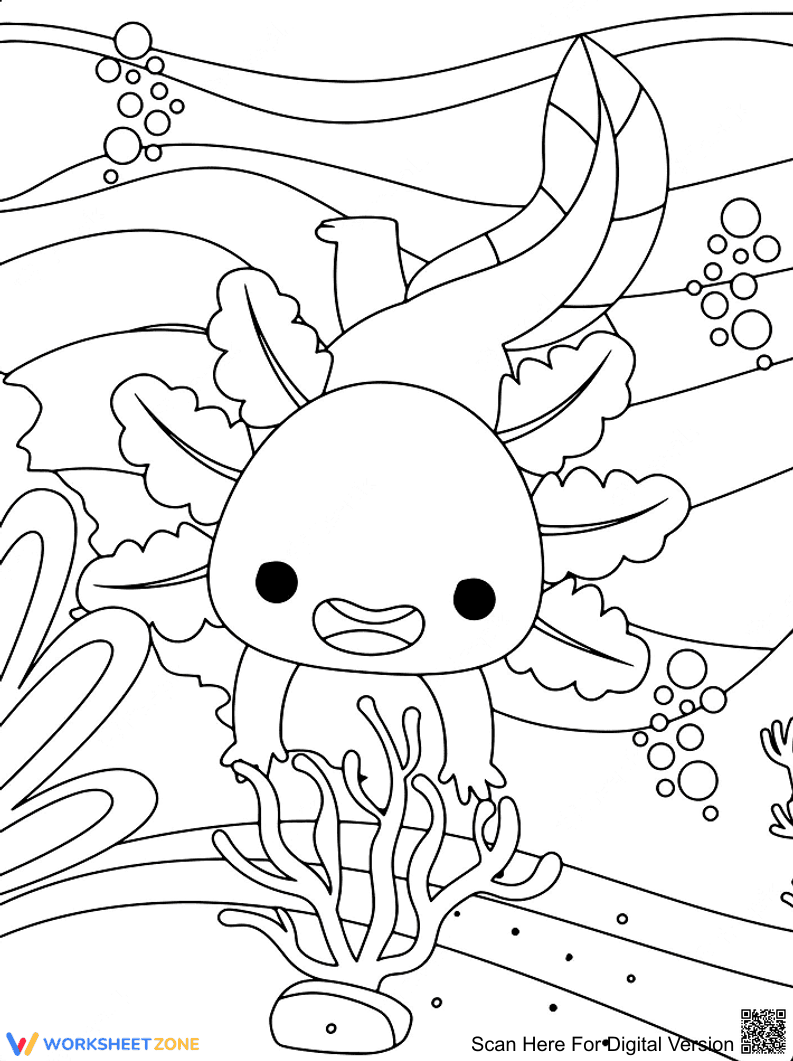

Playful Axolotl Coloring Page | Essential Grade 1-5
Paste this activity's link or code into your existing LMS (Google Classroom, Canvas, Teams, Schoology, Moodle, etc.).
Students can open and work on the activity right away, with no student login required.
You'll still be able to track student progress and results from your teacher account.
This playful axolotl coloring page provides elementary students with a high-interest creative activity that strengthens fine motor control and visual-spatial awareness. By engaging with the detailed underwater scene, learners practice precision and color selection while exploring animal anatomy. It serves as an excellent supplemental resource for biology units or creative writing prompts.
At a Glance
- Grade: 1-5 · Subject: Arts & English
- Standard:
CCSS.ELA-LITERACY.SL.1.5— Add visual displays to descriptions to clarify ideas and feelings- Skill Focus: Fine motor development
- Format: 1 page · 1 task · No answer key required · PDF
- Best For: Early finishers and morning work
- Time: 15–20 minutes
This single-page PDF features a high-resolution line drawing of a smiling axolotl. The illustration includes coral reefs and bubbles, providing varying levels of difficulty for coloring. There are no complex instructions, making it accessible for students to begin immediately. The clean borders ensure a professional look for classroom displays.
Zero-Prep Workflow
- Print: Select the PDF and print copies for your group in 30 seconds.
- Distribute: Hand out sheets during transitions; no extra materials needed beyond crayons.
- Review: Use the finished art as a springboard for verbal descriptions of aquatic life.
Total teacher preparation time is under 2 minutes, making this an ideal emergency sub plan component.
Standards Alignment
This activity aligns with `CCSS.ELA-LITERACY.SL.1.5`, which encourages students to add visual displays to descriptions to clarify ideas. Coloring helps students visualize descriptive text about habitats and animal characteristics. This standard code can be copied directly into lesson plans, IEP goals, or district curriculum mapping tools to justify creative arts in the ELA block.
How to Use It
Use this as a "calm-down" activity following high-energy transitions like recess. It provides a focused task that helps students reset their attention. Alternatively, assign it as a formative assessment for following oral directions (e.g., "Color the coral orange") to check listening comprehension. Expected completion time ranges from 15 to 20 minutes.
Who It's For
This resource is for Grades 1-5, especially students requiring occupational therapy for grip strength and stroke control. It pairs naturally with non-fiction passages about aquatic ecosystems or Mexican water monsters. It is also effective for English Language Learners to practice nature vocabulary in a low-stress environment.
Research from Fisher & Frey (2014) emphasizes that visual representation in the classroom bridges the gap between abstract concepts and concrete understanding. A RAND AIRS 2024 report highlights that fine motor activities support cognitive development and emotional regulation. By utilizing the CCSS.ELA-LITERACY.SL.1.5 standard, educators ensure that artistic expression remains grounded in academic frameworks. This axolotl-themed worksheet provides 1 specific task targeting the intersection of manual dexterity and visual literacy. Studies in ScienceDirect TpT Analysis suggest that high-interest animal subjects increase student engagement significantly compared to abstract patterns. This printable resource offers a structured way to incorporate these developmental benefits into any classroom schedule without increasing teacher workload. It is a proven tool for maintaining student focus during independent work blocks.


