




























Views
Downloads

Essential Plant Parts Worksheet | Grade 1-2 Science

Paste this activity's link or code into your existing LMS (Google Classroom, Canvas, Teams, Schoology, Moodle, etc.).
Students can open and work on the activity right away, with no student login required.
You'll still be able to track student progress and results from your teacher account.
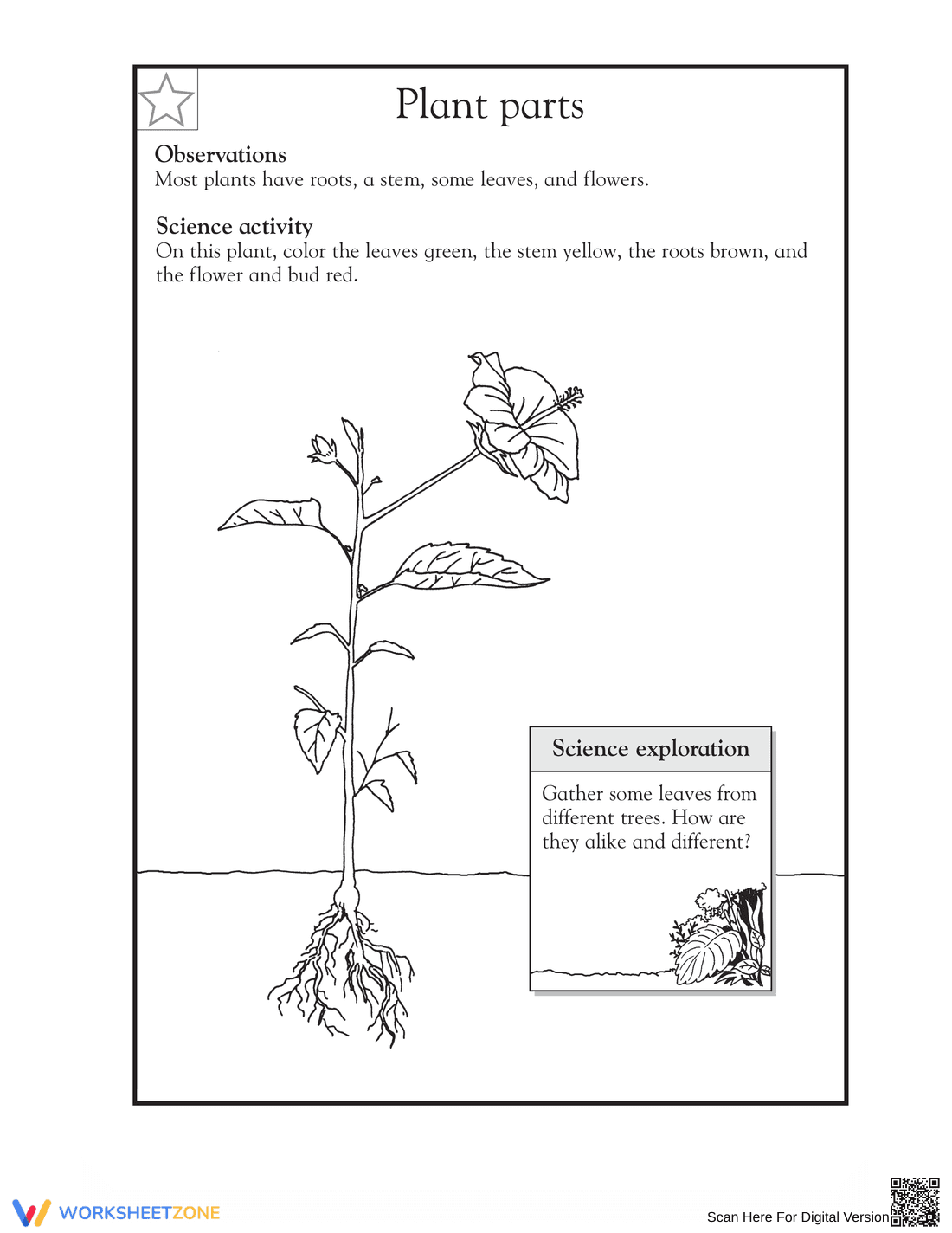
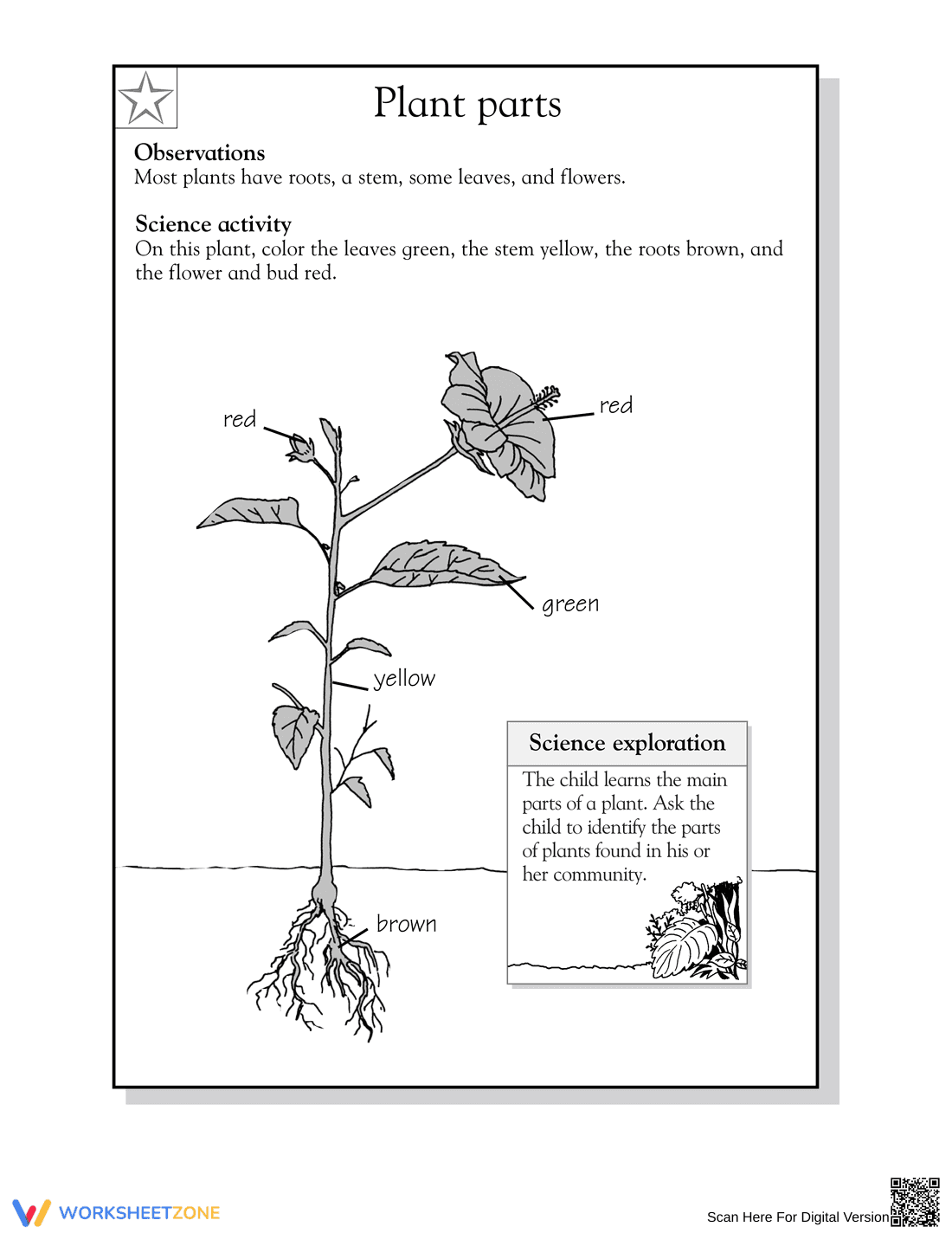
This Essential Plant Parts Worksheet provides a clear, hands-on introduction to botany for early elementary learners. By identifying and coloring the fundamental structures of a flowering plant—including roots, stems, leaves, and buds—students build a foundational understanding of how Living Things are organized. This activity translates abstract biological concepts into a concrete, visual learning experience.
At a Glance
- Grade: 1–2 · Subject: Science
- Standard:
1-LS1-1— Identify and describe the external parts of plants and how they function- Skill Focus: Plant Anatomy & Identification
- Format: 1 page · 5 tasks · Answer key included · PDF
- Best For: Independent practice or a quick science center
- Time: 15–20 minutes
Inside this single-page PDF, you will find a high-quality anatomical diagram of a flowering plant ready for student interaction. The worksheet includes clear, easy-to-follow coloring directions that guide students to distinguish between the roots, stem, leaves, and flowers. Additionally, a "Science Exploration" extension box prompts students to observe real-world leaves, encouraging them to compare similarities and differences.
This resource is designed for maximum efficiency in the classroom. Step 1: Print (30 seconds) – simply send the single-page PDF to your printer. Step 2: Distribute (1 minute) – hand out the worksheets along with basic coloring supplies like crayons or colored pencils. Step 3: Review (5 minutes) – use the included answer key for quick individual checks or a whole-class review. Total teacher preparation time is under two minutes.
Aligned primarily to 1-LS1-1, this worksheet focuses on the external parts of plants that help them survive and grow. By observing and labeling these structures, students meet the core requirements for understanding plant life cycles and biological organization. This standard code can be copied directly into lesson plans, IEP goals, or district curriculum mapping tools to ensure instructional compliance.
Use this worksheet as a formative assessment after a direct instruction lesson on plant life. It works perfectly as a "do-now" activity to activate prior knowledge or as a focused science center rotation. To maximize impact, have students observe a live classroom plant before they begin coloring. Teachers can observe whether students correctly identify the underground roots versus the above-ground stem to gauge their grasp of plant orientation and structure.
This worksheet is ideal for Grade 1 and Grade 2 students in general education settings, as well as English Language Learners who benefit from the visual-to-text connection. The simple vocabulary and clear diagrams provide excellent support for learners needing scaffolding. It pairs naturally with a classroom read-aloud about seeds or a living things unit passage found in standard science curricula.
According to the NAEP Science Framework, foundational biological literacy begins with the ability to identify and describe the structures of living organisms. This Essential Plant Parts Worksheet addresses this need by providing structured practice in anatomical identification for Grade 1 and 2 students. Research from ScienceDirect TpT Analysis (2024) indicates that tactile, color-coded activities significantly improve retention of scientific vocabulary in early childhood education. By mapping specific colors to plant parts such as the roots, stem, and leaves, students create mental models that facilitate future learning about photosynthesis and nutrient transport. This resource provides the rigorous, standard-aligned practice required for mastery of 1-LS1-1. The inclusion of an observation-based exploration task further aligns with inquiry-based learning models, ensuring that students do not just memorize parts but also apply their knowledge to the natural world. It is a proven tool for classroom-ready science instruction.


