


























Views
Downloads
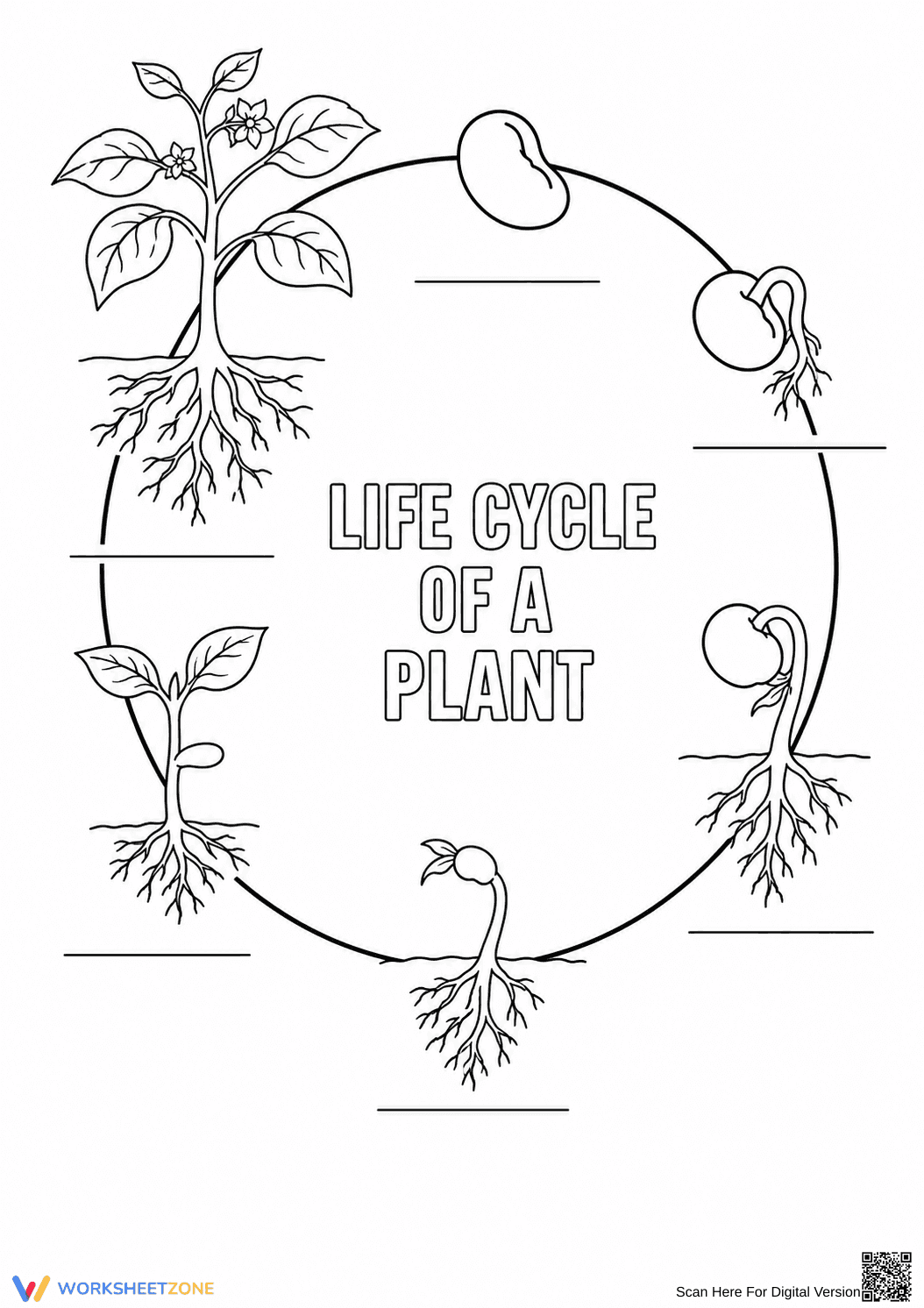

Grade 3 Plant Life Cycle — Printable No-Prep Worksheet
Paste this activity's link or code into your existing LMS (Google Classroom, Canvas, Teams, Schoology, Moodle, etc.).
Students can open and work on the activity right away, with no student login required.
You'll still be able to track student progress and results from your teacher account.
This Grade 3 science worksheet helps students visualize and identify the continuous stages of plant growth. By labeling and coloring a circular diagram, learners actively connect vocabulary to biological processes, reinforcing their understanding of how a simple seed develops into a mature, flowering plant.
At a Glance
- Grade: 3 · Subject: Science
- Standard:
3-LS1-1— Develop models to describe organism life cycles- Skill Focus: Labeling plant life cycle stages
- Format: 1 page · 6 problems · PDF
- Best For: Independent practice and visual learning
- Time: 15–20 minutes
Inside this single-page resource, educators will find a clear, black-and-white circular diagram illustrating six distinct phases of plant development. The visual progression starts with a dormant seed, moves through germination, and culminates in a mature plant. Six blank lines prompt students to write the correct terminology. The line-art style doubles as a coloring activity, keeping learners engaged.
This resource is designed for immediate classroom implementation with a streamlined workflow:
- Print (1 minute): The PDF prints cleanly without draining color ink.
- Distribute (1 minute): Hand out the sheets with colored pencils.
- Review (3 minutes): Quickly check student labels as a class.
Total teacher preparation takes under two minutes, making this an excellent option for emergency sub plans or morning work.
This activity aligns directly with the Next Generation Science Standards, specifically focusing on 3-LS1-1: Develop models to describe that organisms have unique and diverse life cycles but all have in common birth, growth, reproduction, and death. By completing the diagram, students are effectively interacting with a scientific model of growth and reproduction. Both standard codes can be copied directly into lesson plans, IEP goals, or district curriculum mapping tools.
Deploy this worksheet during the core instructional phase of a botany unit. After direct instruction about how seeds grow, assign this page to solidify vocabulary. Alternatively, use it as a pre-assessment to gauge prior knowledge. While students work, observe whether learners correctly sequence the germination phase before the seedling phase. Expect students to complete the labeling within 15 to 20 minutes.
This resource is designed for third-grade science students, though adaptable for second graders. The visual diagram provides built-in scaffolding for English Language Learners who benefit from seeing physical changes alongside vocabulary. Pair this worksheet with a hands-on seed planting activity or an anchor chart to maximize comprehension.
Integrating visual models into elementary science instruction significantly enhances student retention of biological processes. This worksheet supports 3-LS1-1 by requiring students to develop models to describe organism life cycles. According to a ScienceDirect TpT Analysis, activities that combine visual sequencing with active labeling improve cognitive mapping of cyclical concepts in young learners. When students physically write the terms while observing the corresponding structural changes in the plant, they build stronger neural connections regarding growth and reproduction. This dual-coding approach ensures that foundational life science concepts are anchored in both linguistic and visual memory, preparing students for more complex ecological studies in upper elementary grades. Utilizing this straightforward, model-based practice provides educators with a reliable tool to measure standard mastery efficiently.


