




























Views
Downloads

Grade 3 Plant Life Cycle — Printable No-Prep Worksheet

Paste this activity's link or code into your existing LMS (Google Classroom, Canvas, Teams, Schoology, Moodle, etc.).
Students can open and work on the activity right away, with no student login required.
You'll still be able to track student progress and results from your teacher account.
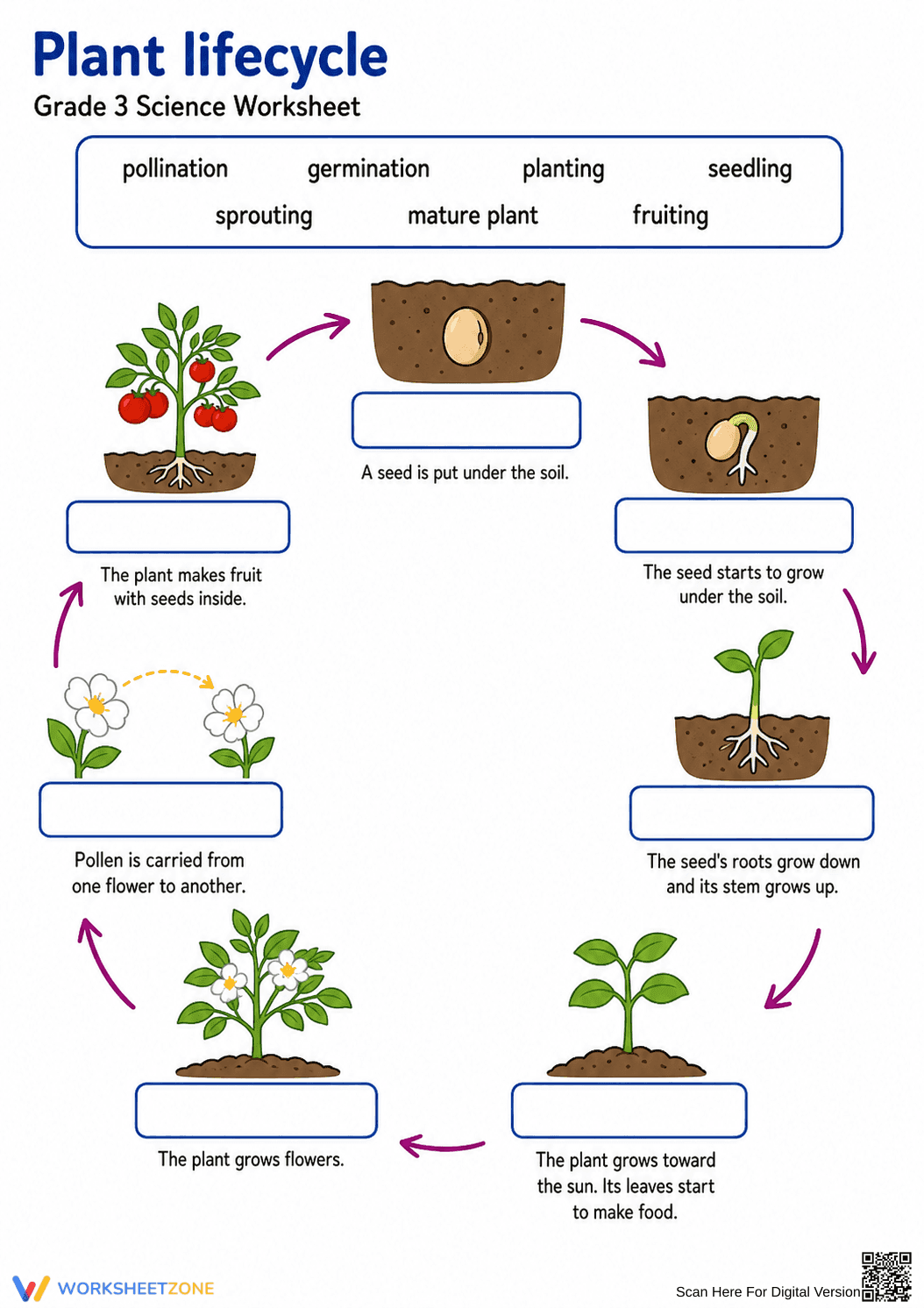
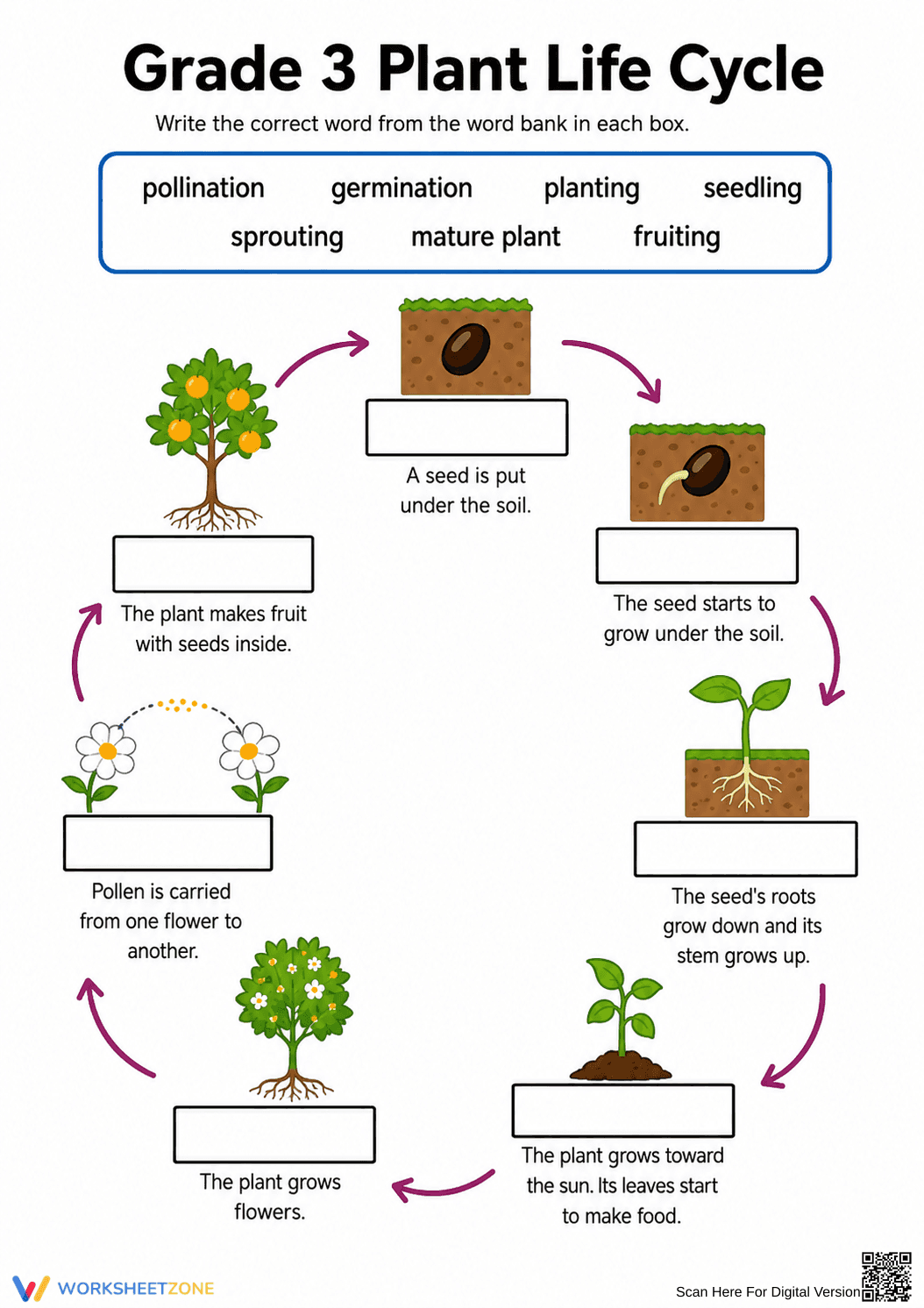
This printable plant life cycle worksheet helps third-grade students identify and sequence the stages of plant growth. By matching key vocabulary terms to a visual diagram, learners map the journey from a planted seed to a mature, fruit-bearing plant while reinforcing essential life science concepts and biological vocabulary. This resource ensures students understand the cyclical nature of living things.
At a Glance
- Grade: 3 · Subject: Science
- Standard:
3-LS1-1— Describe that organisms have unique and diverse life cycles- Skill Focus: Sequencing plant life cycle stages
- Format: 2 pages · 7 problems · Answer key included · PDF
- Best For: Independent practice or science centers
- Time: 10–15 minutes
This resource features a single-page visual diagram of a plant's life cycle with seven fill-in-the-blank boxes. Students use the provided word bank—including terms like germination, pollination, and seedling—to label each stage correctly based on descriptive text and illustrations. A complete answer key is included to make grading quick and efficient for busy educators, allowing for immediate feedback during the lesson.
Designed for immediate use, this resource requires no teacher setup to implement in the classroom:
- Print (1 minute): Simply print the PDF. The black-and-white friendly design ensures clear copies for every student while saving on ink costs.
- Distribute (1 minute): Hand out the worksheet during your science block. The clear instructions and word bank allow students to work independently.
- Review (3 minutes): Use the included answer key to quickly check student work or project it for whole-class self-correction.
With a total prep time under two minutes, this worksheet is an excellent addition to any emergency sub plan or last-minute science filler.
This activity aligns with the Next Generation Science Standards, specifically focusing on 3-LS1-1: Develop models to describe that organisms have unique and diverse life cycles but all have in common birth, growth, reproduction, and death. By labeling the diagram, students actively work with a scientific model to visualize these transitions. Standard codes can be copied directly into lesson plans or district curriculum mapping tools.
This worksheet fits easily into various instructional moments. Use it as independent practice after a direct instruction lesson on plant biology, allowing students to consolidate new vocabulary. Alternatively, it serves as an excellent formative assessment tool; observe whether students can distinguish between similar stages like sprouting and seedling. The activity takes 10 to 15 minutes, making it perfect for morning work or a dedicated science station.
Designed for third-grade science students, this resource can easily be adapted for second-grade enrichment or fourth-grade review. The word bank provides built-in scaffolding, making it accessible for English Language Learners and students needing vocabulary support. It pairs perfectly with a hands-on seed planting activity or a non-fiction read-aloud book about botany.
Understanding biological sequences is a foundational element of early elementary science education. This worksheet supports mastery of 3-LS1-1 by requiring students to describe that organisms have unique and diverse life cycles through a clear visual model. According to research, integrating visual diagrams with targeted vocabulary practice significantly improves student retention of complex scientific processes. By connecting terms like germination and pollination directly to sequential illustrations, young learners build stronger cognitive maps of essential biological concepts. This structured approach not only reinforces immediate lesson objectives but also prepares students for more advanced life science topics. Providing clear, scaffolded practice with immediate feedback via the included answer key ensures that all students can successfully navigate and comprehend the cyclical nature of plant life, fostering a deeper appreciation for the natural world.


