




























Views
Downloads
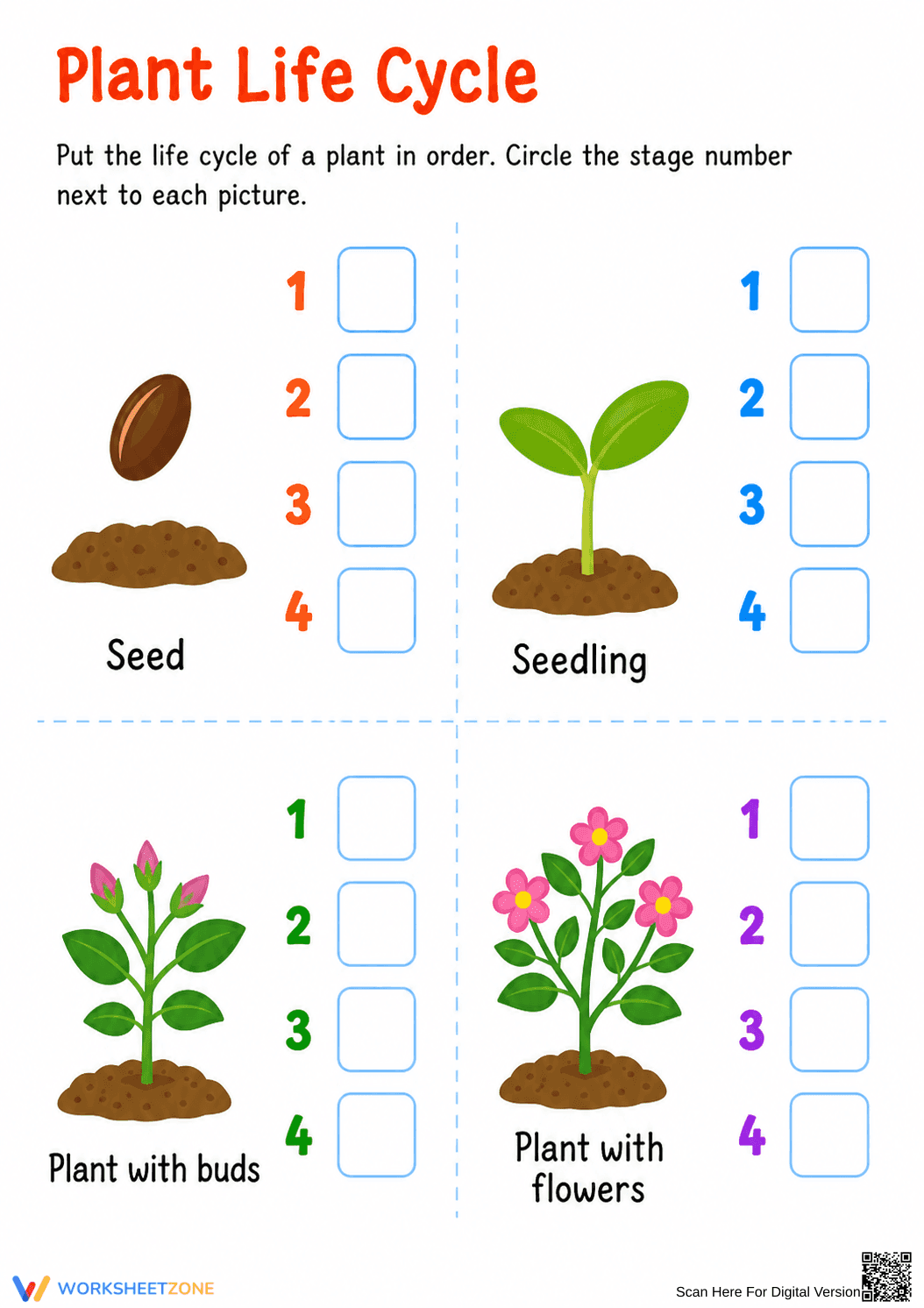

Grade 3 Plant Life Cycle — Printable Science Worksheet

Paste this activity's link or code into your existing LMS (Google Classroom, Canvas, Teams, Schoology, Moodle, etc.).
Students can open and work on the activity right away, with no student login required.
You'll still be able to track student progress and results from your teacher account.
This Grade 3 plant life cycle worksheet helps students master biological sequencing by identifying and ordering the four primary stages of growth. Students analyze visual representations of seeds, seedlings, and mature plants to determine chronological order. This resource ensures learners understand the cyclical nature of plant development through a clear, engaging format.
At a Glance
- Grade: 3 · Subject: Science
- Standard:
3-LS1-1— Develop models to describe that organisms have unique and diverse life cycles- Skill Focus: Sequencing growth stages
- Format: 1 page · 4 problems · Answer key included · PDF
- Best For: Quick formative assessment or science centers
- Time: 10–15 minutes
This single-page PDF features four distinct illustrations representing the life cycle of a flowering plant: the initial seed, the emerging seedling, the budding plant, and the final flowering stage. Each quadrant includes a numerical selection area where students circle the correct sequence number. The layout is clean and high-contrast, making it ideal for standard classroom printing or digital display.
The workflow for this resource is designed for maximum efficiency. Teachers can print the single-page document in approximately 30 seconds, distribute it to the class in under a minute, and review the four-stage sequence together in less than 5 minutes. This makes it an ideal "bell-ringer" activity or a reliable emergency sub plan component requiring zero prior teacher setup.
This worksheet aligns with 3-LS1-1: "Develop models to describe that organisms have unique and diverse life cycles but all have in common birth, growth, reproduction, and death." It specifically targets the growth and development phases of the life cycle. Both standard codes can be copied directly into lesson plans, IEP goals, or district curriculum mapping tools.
Use this worksheet during the "Explain" phase of a 5E science lesson to verify student understanding of plant development. It also serves as an effective formative assessment tool after a hands-on planting activity. Teachers should observe if students can distinguish between the "bud" and "flower" stages, which requires careful visual analysis. Completion typically takes 10 to 15 minutes.
This resource is designed for Grade 3 students but is appropriate for Grade 2 enrichment or Grade 4-5 review. It is particularly helpful for English Language Learners (ELLs) due to the heavy reliance on visual cues and minimal text. Pair this worksheet with a physical seed-planting project or a life cycle anchor chart for a comprehensive learning experience.
According to the RAND AIRS 2024 report on elementary science instruction, visual sequencing tasks are essential for developing mental models of biological processes in young learners. This worksheet addresses the 3-LS1-1 standard by requiring students to organize the chronological stages of a plant's life, from seed to flowering adult. By engaging with these 4 specific tasks, students build the foundational knowledge necessary for more complex ecological studies in later grades. Research from Fisher & Frey (2014) suggests that such scaffolded visual aids significantly improve retention of scientific vocabulary and conceptual frameworks. This printable resource provides a structured environment for students to demonstrate mastery of life cycle patterns, ensuring they can identify the commonalities in growth across different species. It is a high-utility tool for any primary science curriculum focused on life sciences and observable natural patterns.


