




























Views
Downloads

Essential Plant Anatomy Worksheet | Grade 2 Science

Paste this activity's link or code into your existing LMS (Google Classroom, Canvas, Teams, Schoology, Moodle, etc.).
Students can open and work on the activity right away, with no student login required.
You'll still be able to track student progress and results from your teacher account.
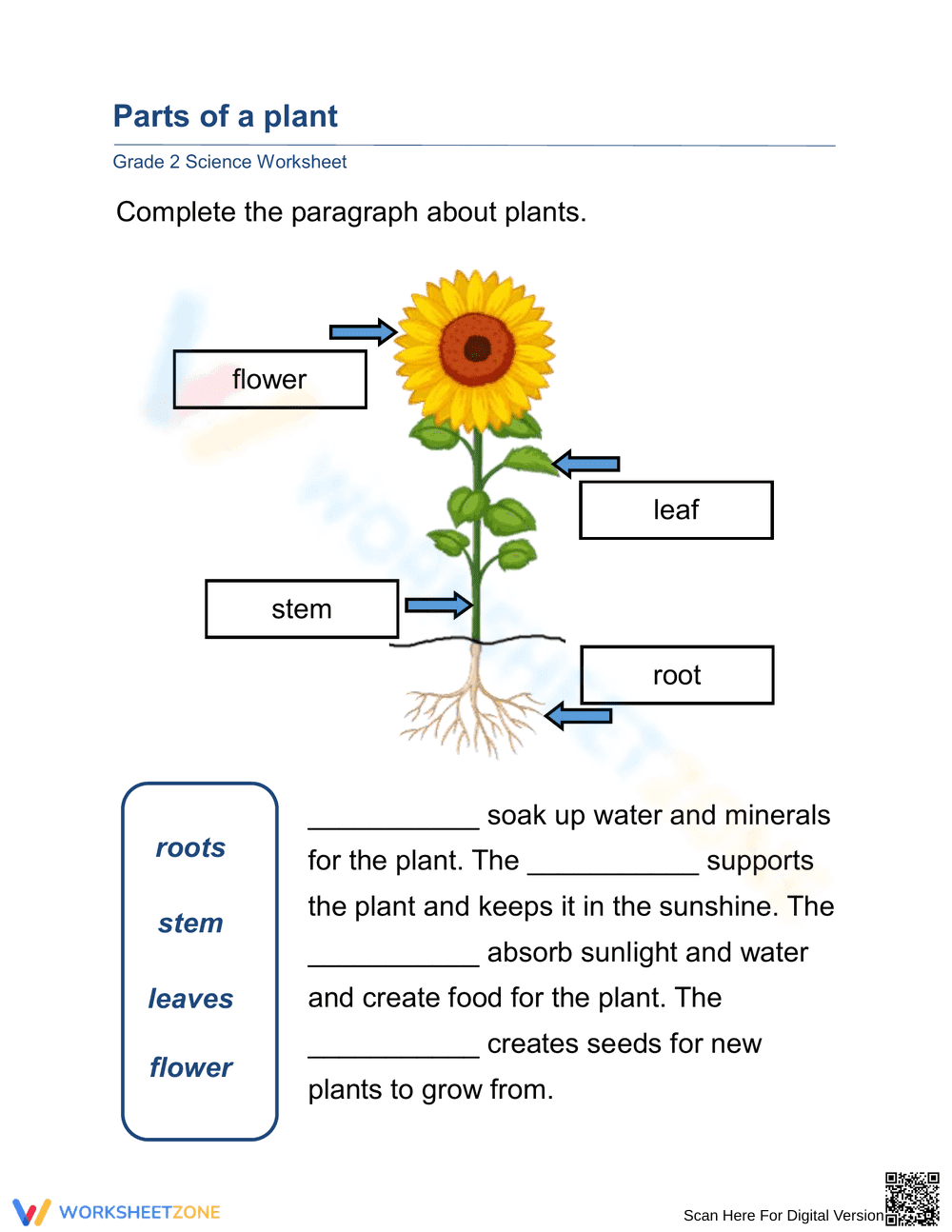
This Grade 2 Science worksheet helps students master plant anatomy by identifying key structures and their biological functions. By connecting visual diagrams with descriptive text, learners develop a concrete understanding of how roots, stems, leaves, and flowers support a plant's lifecycle. It is a vital tool for building early life science literacy.
At a Glance
- Grade: 2 · Subject: Living Things
- Standard:
2-LS2-1— Identify how plant structures like leaves and roots help plants grow- Skill Focus: Plant Anatomy and Function
- Format: 2 pages · 4 tasks · Answer key included · PDF
- Best For: Individual practice or science center activity
- Time: 15–20 minutes
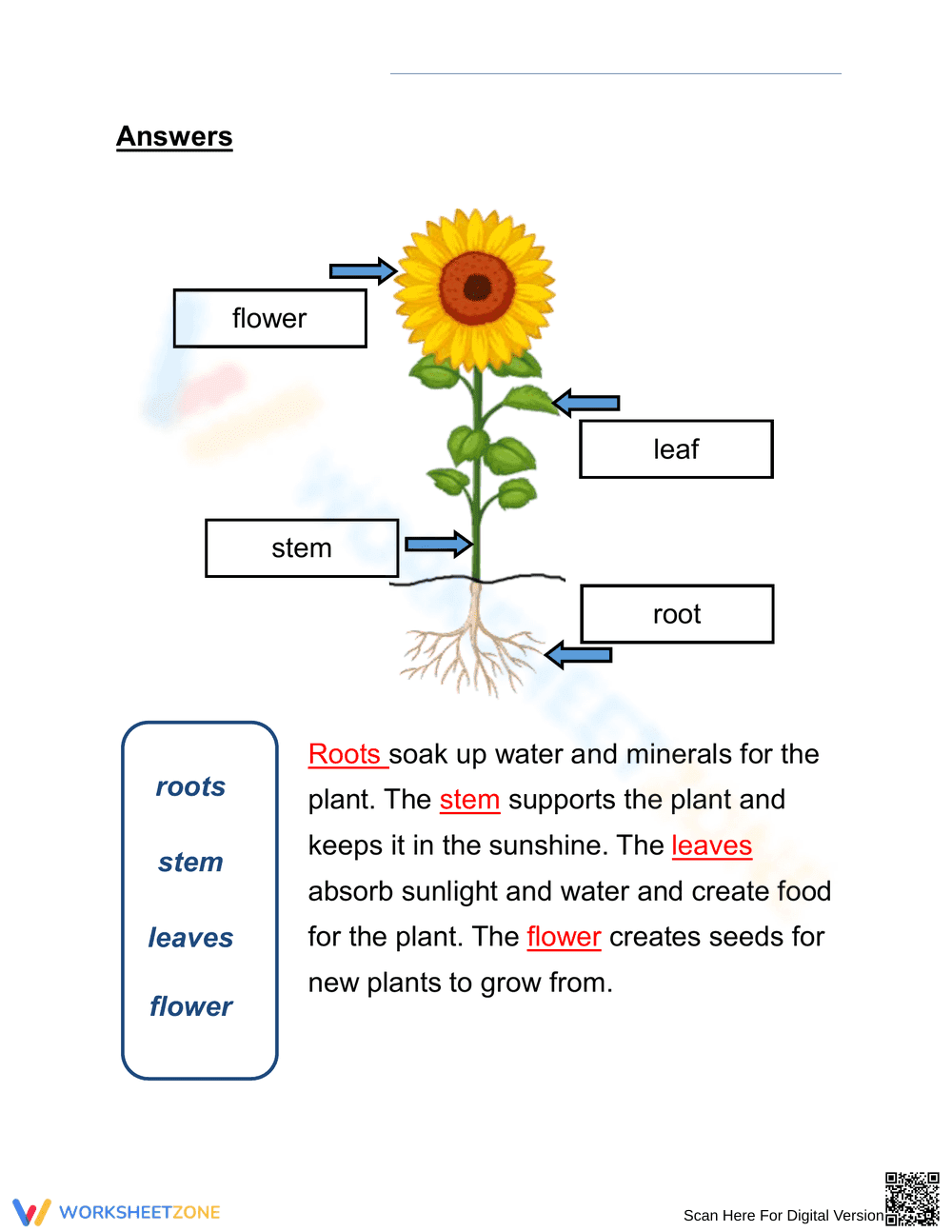
This two-page PDF resource features a high-quality botanical illustration of a sunflower, clearly labeled to guide student observation. Below the diagram, a fill-in-the-blank paragraph challenges students to match parts like roots and stems to their specific roles, such as mineral absorption or structural support. A comprehensive answer key is included for immediate student feedback or easy grading.
The print-and-go design of this worksheet ensures maximum instructional efficiency with minimal setup. First, print the worksheet page for your students and the answer key for your records, which takes roughly thirty seconds. Next, distribute the single-page task; students can begin immediately using the provided word bank. Finally, use the answer key for rapid whole-class correction or independent check, requiring less than two minutes of teacher time.
This resource is aligned to `2-LS2-1`, which focuses on the interdependence of plants and their environment. By identifying that leaves absorb sunlight and roots soak up water, students demonstrate mastery of structural functions necessary for survival. Both standard codes can be copied directly into lesson plans, IEP goals, or district curriculum mapping tools.
Assign this worksheet during the explain phase of a 5E lesson model to solidify vocabulary after a hands-on plant dissection or observation. It also serves as an excellent formative assessment tool; observe if students correctly associate the root's position with water absorption to gauge their understanding of plant systems. Expected completion time is usually under twenty minutes.
Designed for second-grade students in general education or ESL settings, this worksheet provides visual scaffolds through the diagram and word bank. It pairs naturally with a classroom seed-planting project or a non-fiction reading passage about local flora, allowing for cross-curricular integration between science and literacy.
Research by Fisher & Frey (2014) emphasizes that visual-verbal integration, such as matching labels in a diagram to functional descriptions in a paragraph, significantly improves long-term retention of scientific concepts in primary students. This Grade 2 plant anatomy resource applies these principles by requiring learners to translate visual data from the sunflower model into the technical language of the 2-LS2-1 standard. By identifying that roots, stems, and leaves perform discrete but interconnected tasks like mineral transport and food creation, students build a foundational mental model of biological systems. This structural approach ensures that second graders move beyond simple naming to a functional understanding of life sciences. The inclusion of a word bank and immediate visual cues makes this an effective evidence-based tool for diverse learners, satisfying the requirements for rigorous, standards-aligned science instruction in the early elementary classroom.


