


























Views
Downloads
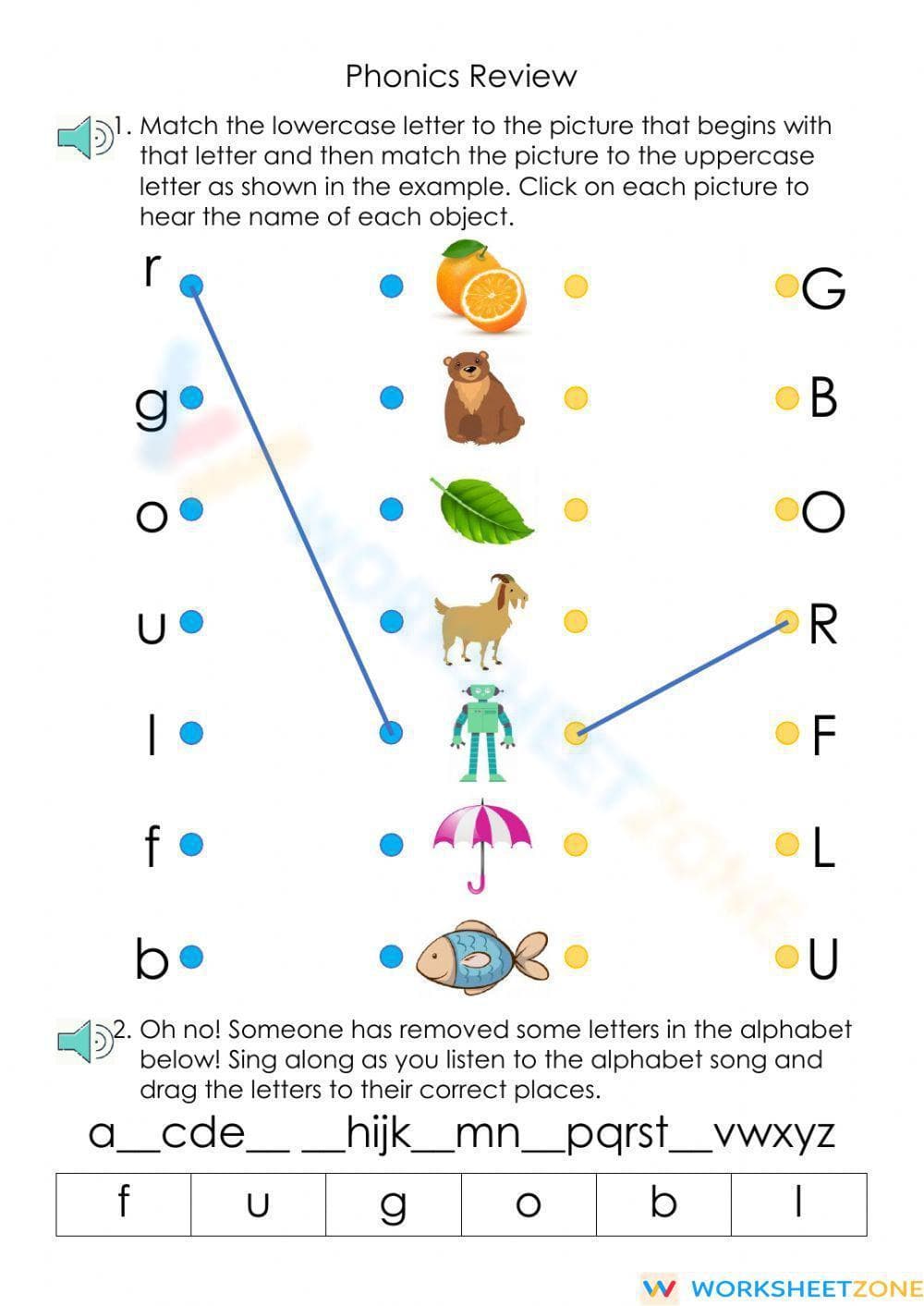

Essential Phonics Review 2 Worksheet | Kindergarten
Paste this activity's link or code into your existing LMS (Google Classroom, Canvas, Teams, Schoology, Moodle, etc.).
Students can open and work on the activity right away, with no student login required.
You'll still be able to track student progress and results from your teacher account.
This interactive Phonics Review 2 worksheet helps preschool and kindergarten students master letter-sound correspondence and alphabetical order. Students engage in matching lowercase letters to initial-sound images and uppercase counterparts, followed by an alphabet sequencing task. This dual-focus approach solidifies foundational literacy skills through visual and auditory cues during early childhood development.
At a Glance
- Grade: Kindergarten · Subject: English Language Arts (ELA)
- Standard:
CCSS.ELA-LITERACY.RF.K.1.D— Recognize and name all upper- and lowercase letters of the alphabet- Skill Focus: Letter matching and alphabet sequencing
- Format: 1 page · 13 problems · Answer key included · PDF
- Best For: Morning work or phonics centers
- Time: 10–15 minutes
This one-page PDF features two distinct instructional tasks designed for early literacy success. The first section contains seven matching exercises where students connect lowercase letters (r, g, o, u, l, f, b) to colorful illustrations like a bear, orange, and fish, and then to their corresponding uppercase forms. The second section provides an alphabet string with six missing letters for students to drag and drop or write into place.
This worksheet is designed for immediate classroom integration with a zero-prep workflow. Teachers can print the document in under 30 seconds, distribute it to students for a quick 12-minute review session, and use the included answer key for rapid grading. It is an ideal resource for substitute folders, rainy day activities, or as an independent task during small-group rotations to keep students focused on core skills.
The primary focus is `CCSS.ELA-LITERACY.RF.K.1.D`, which requires students to identify and name all uppercase and lowercase letters. Additionally, it supports `CCSS.ELA-LITERACY.RF.K.3.A` by reinforcing the relationship between written letters and their spoken sounds through visual association. Both standard codes can be copied directly into lesson plans, IEP goals, or district curriculum mapping tools for administrative compliance.
Use this worksheet as a formative assessment after introducing the letters g, o, u, l, f, and b to gauge student retention and mastery. During the activity, observe if students can name the objects aloud to check for phonemic awareness and correct pronunciation. This 15-minute task serves as a practical bridge between direct instruction and independent reading, ensuring students are ready for more complex decoding tasks.
Tailored for early learners in preschool and kindergarten, this resource is excellent for students developing fine motor skills through matching and tracing. It pairs naturally with an alphabet song or a letter-of-the-week anchor chart, providing the necessary repetition for letter mastery. The clear layout ensures that students can navigate the page without constant teacher intervention, promoting early learner independence.
According to Fisher & Frey (2014), the gradual release of responsibility begins with focused tasks that allow students to practice foundational skills like letter recognition within a supported framework. This Phonics Review 2 worksheet addresses the CCSS.ELA-LITERACY.RF.K.1.D standard by providing a structured environment for students to recognize and name both uppercase and lowercase letters. Research from the NAEP highlights that early mastery of the alphabet and its associated sounds is a primary predictor of later reading success. By combining visual matching with sequencing, this tool ensures that students build the mental pathways required for fluent decoding. Educational frameworks such as RAND AIRS 2024 emphasize that interactive, multi-sensory approaches to phonics significantly improve engagement and retention in early childhood settings. This resource provides a practical, research-backed method for reinforcing these essential literacy pillars without requiring extensive teacher preparation or complex materials.


