


























Views
Downloads


Grade 2 Phonics & Vocabulary Test: CCSS.ELA-LITERACY.RF.2.3 Aligned
Paste this activity's link or code into your existing LMS (Google Classroom, Canvas, Teams, Schoology, Moodle, etc.).
Students can open and work on the activity right away, with no student login required.
You'll still be able to track student progress and results from your teacher account.
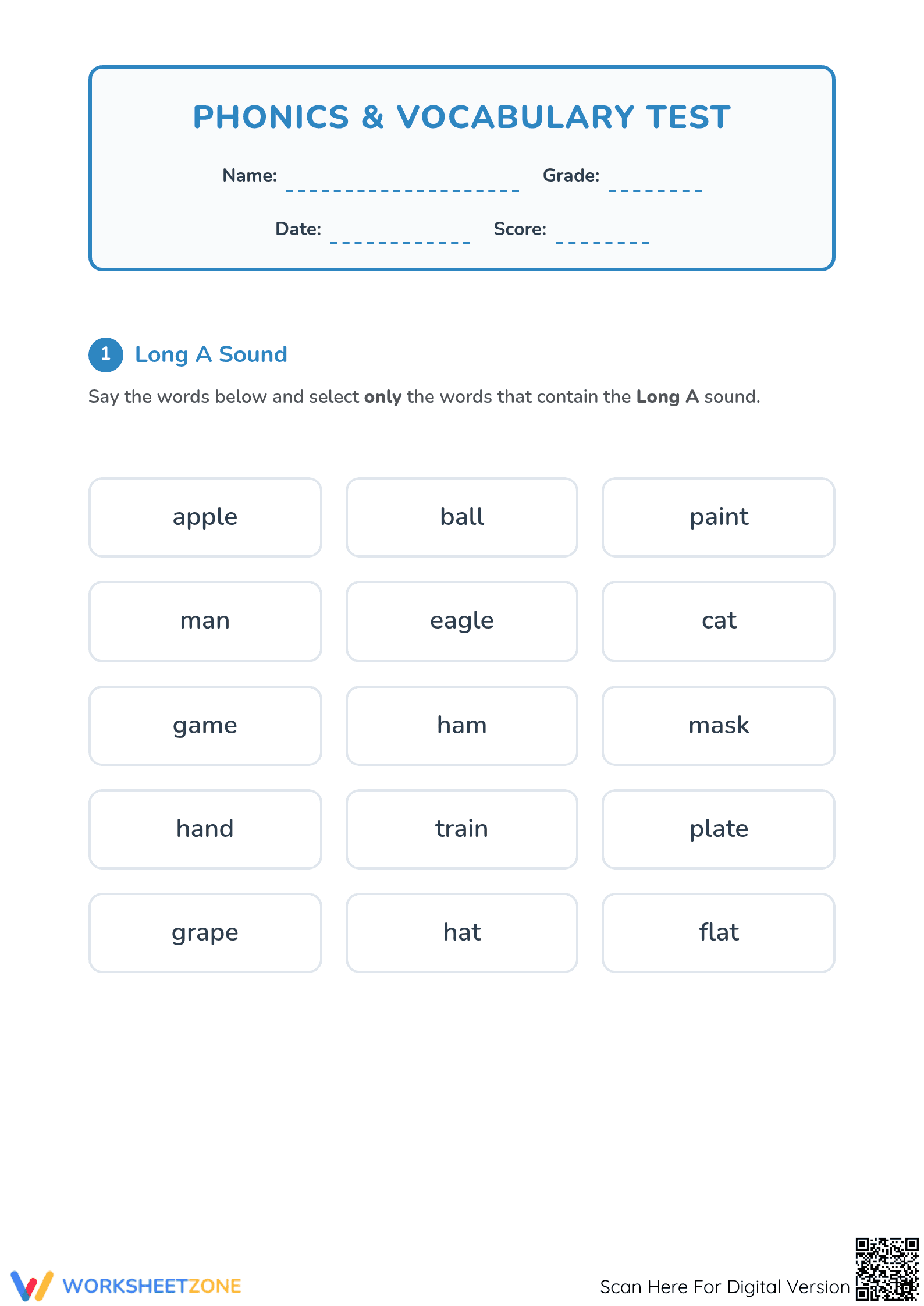
This Phonics and Vocabulary Weekly Test provides a comprehensive assessment tool for Grade 2 students to demonstrate mastery in foundational literacy skills. By integrating long vowel patterns, syllable counting, and synonyms, this worksheet ensures students can fluently decode and understand complex word structures. It is an essential resource for tracking ELA progress and identifying learning gaps.
At a Glance
- Grade: 2–3 · Subject: ELA
- Standard:
CCSS.ELA-LITERACY.RF.2.3— Know and apply grade-level phonics and word analysis skills in decoding words- Skill Focus: Phonics (Long A), Vocabulary, and Syllabication
- Format: 3 pages · 37 tasks · Answer key included · PDF
- Best For: Weekly summative assessment and progress monitoring
- Time: 20–30 minutes
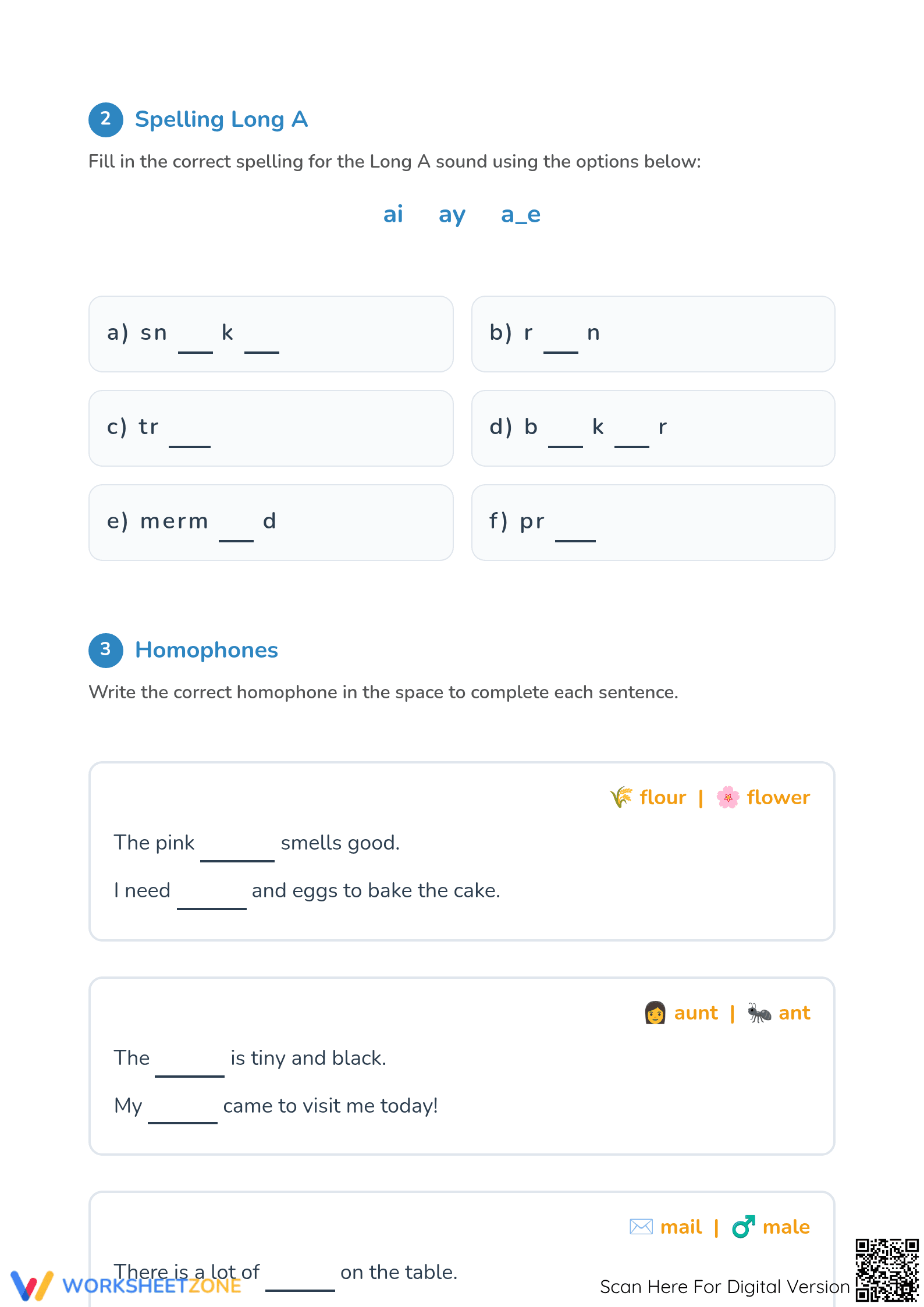
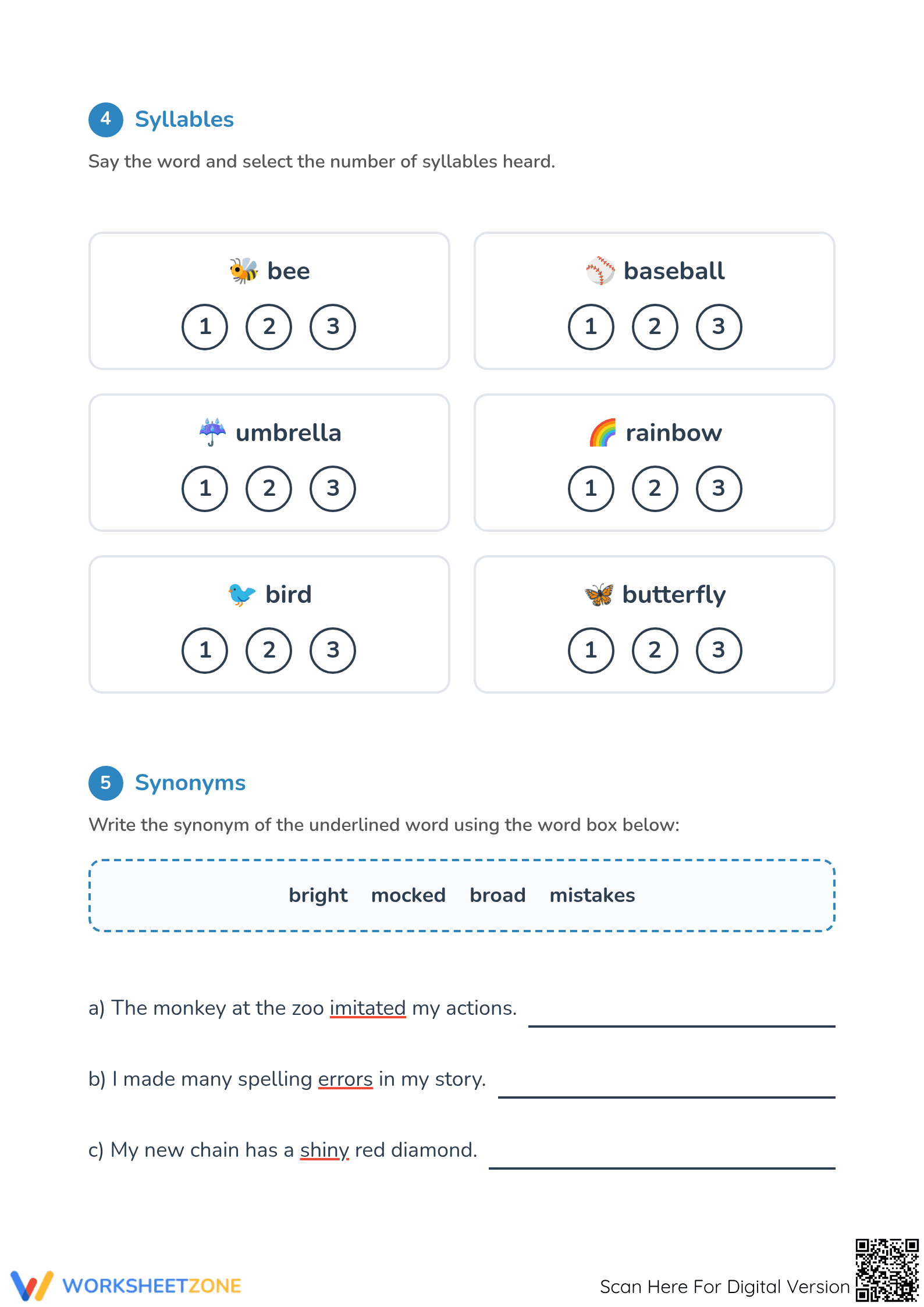
This three-page assessment features five distinct sections evaluating varied linguistic competencies. Students begin by identifying Long A sounds, followed by a spelling section focusing on vowel teams like ai, ay, and a_e. The vocabulary portion includes homophone matching with visual cues, a syllable-counting exercise with six illustrated examples, and a sentence-based synonym identification task using a provided word bank.
The assessment provides clear evidence of student mastery across the RF.2.3 and L.2.5 strands. Each section corresponds to a specific sub-skill, allowing teachers to identify if a student struggles with phonemic awareness or orthographic mapping. Clear scoring opportunities for all 37 tasks enable direct entry into gradebooks or IEP progress notes. Success here indicates readiness for complex multi-syllabic word study.
Aligned to CCSS.ELA-LITERACY.RF.2.3, this worksheet targets RF.2.3.B (long vowels) and RF.2.3.C (vowel teams). It also supports CCSS.ELA-LITERACY.L.2.5.A through synonyms and homophones. These standard codes can be copied directly into lesson plans, IEP goals, or curriculum mapping tools, ensuring that your instructional data remains focused on core state and national requirements.
Administer this as a summative assessment after a unit on long vowel patterns. Observe students' syllable-counting strategies—noting if they use tactile cues like clapping—to gain insight into their phonological awareness. The expected completion time is 25 minutes, making it an efficient tool for a standard class period or a focused small-group intervention session during literacy rotations.
This resource is designed for Grade 2 and 3 students working toward foundational ELA standards. It is particularly effective for learners benefiting from visual supports, as the homophone and syllable sections use clear illustrations to bridge meaning and sound. It pairs naturally with a Long A anchor chart or a decoding passage. Teachers can also use this for older students needing phonetic intervention.
The Phonics and Vocabulary Weekly Test aligns with the research-based Gradual Release of Responsibility model described by Fisher & Frey (2014), emphasizing independent assessment following structured instructional cycles. By evaluating students on CCSS.ELA-LITERACY.RF.2.3, this worksheet provides the necessary evidence for teachers to determine if students have moved from guided practice to independent mastery of phonetic decoding and word analysis. Research from EdReports (2024) indicates that high-quality, standards-aligned assessments are critical for reducing achievement gaps in early literacy. This tool specifically addresses the orthographic mapping of vowel teams and the morphological understanding of syllables, both of which are foundational to reading fluency and comprehension. By utilizing a mix of phonetic, orthographic, and semantic tasks, the worksheet ensures a multi-faceted evaluation of a student's linguistic profile, making it a reliable instrument for evidence-based instruction and data-driven decision-making in the US educational system.


