


























Views
Downloads
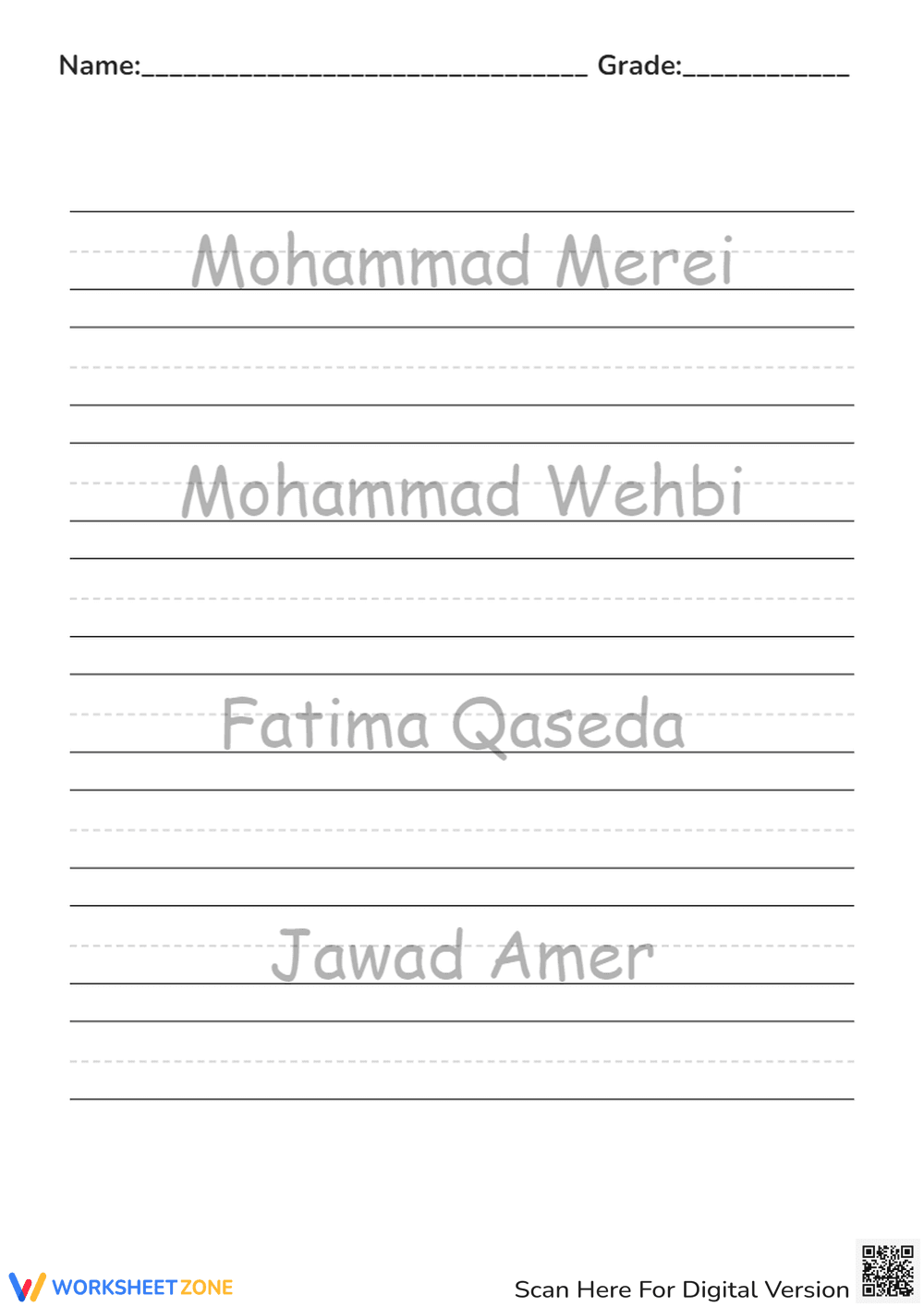

Name Tracing Worksheet | Printable Grade 1 Practice
Paste this activity's link or code into your existing LMS (Google Classroom, Canvas, Teams, Schoology, Moodle, etc.).
Students can open and work on the activity right away, with no student login required.
You'll still be able to track student progress and results from your teacher account.
This Grade 1 handwriting worksheet provides students with focused name tracing practice to develop fine motor control and proper letter formation. By tracing specific names on primary lined paper, early learners build muscle memory and confidence in their printing skills, setting a strong foundation for independent writing tasks.
At a Glance
- Grade: 1 · Subject: Handwriting
- Standard:
CCSS.ELA-LITERACY.L.1.1.A— Print all upper- and lowercase letters- Skill Focus: Name Tracing and Letter Formation
- Format: 1 page · 4 problems · No answer key · PDF
- Best For: Morning work or handwriting centers
- Time: 10–15 minutes
This single-page resource features four distinct name tracing exercises formatted on standard primary writing lines. Students will trace the names "Mohammad Merei," "Mohammad Wehbi," "Fatima Qaseda," and "Jawad Amer." The dashed midline and solid baseline structure provides clear visual boundaries, helping young writers understand proper letter height, spacing, and alignment. No answer key is required.
Zero-Prep Workflow
- Print (1 minute): Simply download the PDF and print the required number of copies. The black-and-white design is ink-friendly.
- Distribute (1 minute): Hand out the worksheets during morning routines or transition periods. The instructions are self-evident.
- Review (0 minutes): As a tracing exercise, students can self-monitor their accuracy by staying on the dotted lines, requiring no formal grading.
With a total teacher prep time of under two minutes, this resource is an excellent addition to any emergency sub plan or quick morning work folder.
Standards Alignment
This handwriting practice aligns with CCSS.ELA-LITERACY.L.1.1.A, which requires students to print all upper- and lowercase letters. By tracing complete names, students practice forming a variety of letters in sequence, reinforcing the motor patterns necessary for fluent writing. Both standard codes can be copied directly into lesson plans, IEP goals, or district curriculum mapping tools.
How to Use It
Use it as a calming morning work activity as students enter the classroom, allowing them to settle in while practicing essential fine motor skills. Alternatively, place it in a literacy center focused on handwriting and letter recognition. As a formative assessment tip, observe students while they trace to ensure they are starting their letters from the top down rather than the bottom up. Expected completion time is between 10 and 15 minutes.
Who It's For
This resource is designed for Grade 1 and Grade 2 students refining their print handwriting. It is also beneficial for occupational therapy or special education students needing targeted fine motor intervention. For differentiation, provide pencil grips or slanted writing boards for students struggling with standard pencil grasp. Pair this worksheet with a direct instruction lesson on proper pencil grip.
Developing automaticity in handwriting is a critical component of early literacy that directly impacts a student's ability to compose written text. This resource targets CCSS.ELA-LITERACY.L.1.1.A, helping students print all upper- and lowercase letters accurately. According to an extensive EdReports 2024 analysis of foundational skills instruction, explicit and repeated handwriting practice is necessary to reduce the cognitive load required for letter formation. When students no longer have to consciously think about how to shape each letter, they can dedicate significantly more working memory to spelling, vocabulary development, and complex sentence structure. Tracing exercises provide the necessary scaffolding to build this muscle memory efficiently and effectively. By integrating structured tracing tasks into daily classroom routines, educators can ensure that fine motor limitations do not impede broader expressive writing development in early elementary grades.


