


























Views
Downloads
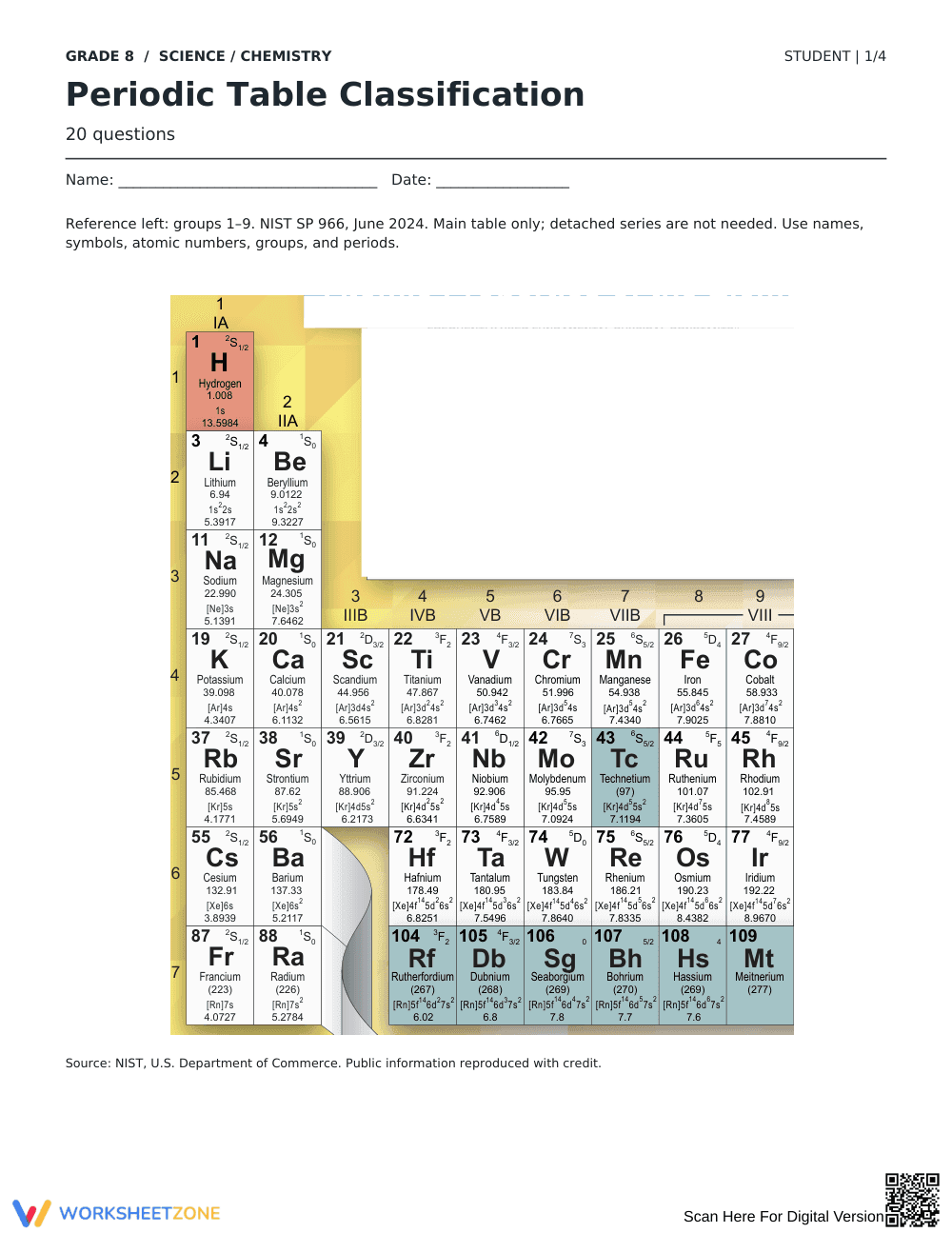
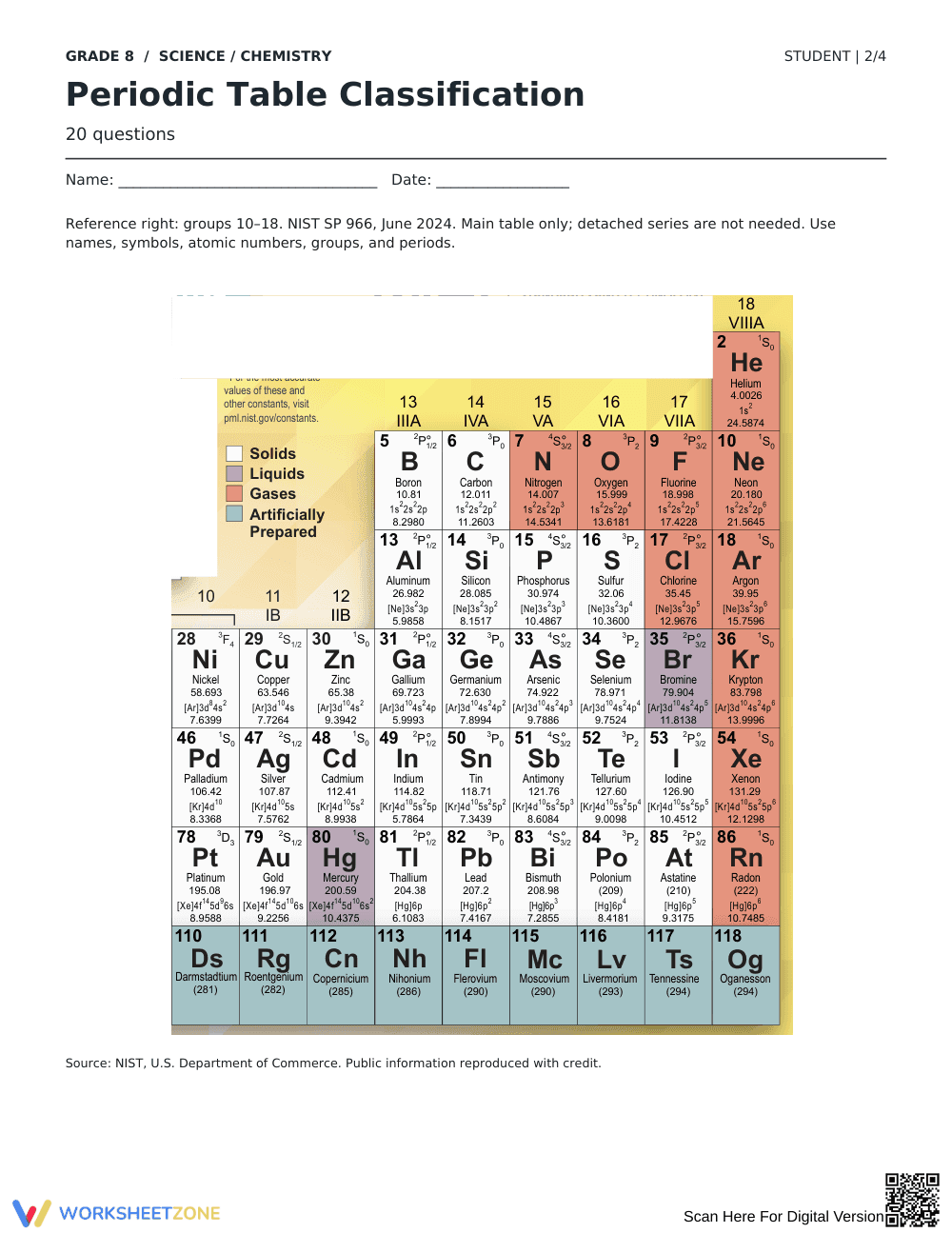

Periodic Table Worksheet | Grade 8 Science Printable
Paste this activity's link or code into your existing LMS (Google Classroom, Canvas, Teams, Schoology, Moodle, etc.).
Students can open and work on the activity right away, with no student login required.
You'll still be able to track student progress and results from your teacher account.
This periodic table classification worksheet helps eighth-grade physical science students locate elements, distinguish groups from periods, and classify metals, nonmetals, and metalloids. Using authentic reference data, students build foundational literacy to model atomic composition and analyze periodic trends.
At a Glance
- Grade: 8 · Subject: Science (Chemistry)
- Standard:
MS-PS1-1— Locate elements using periodic table organization to describe atomic structure- Skill Focus: Groups, periods, and element classification
- Format: 4 pages · 20 problems · Answer key included · PDF
- Best For: Independent practice and review
- Time: 30–45 minutes
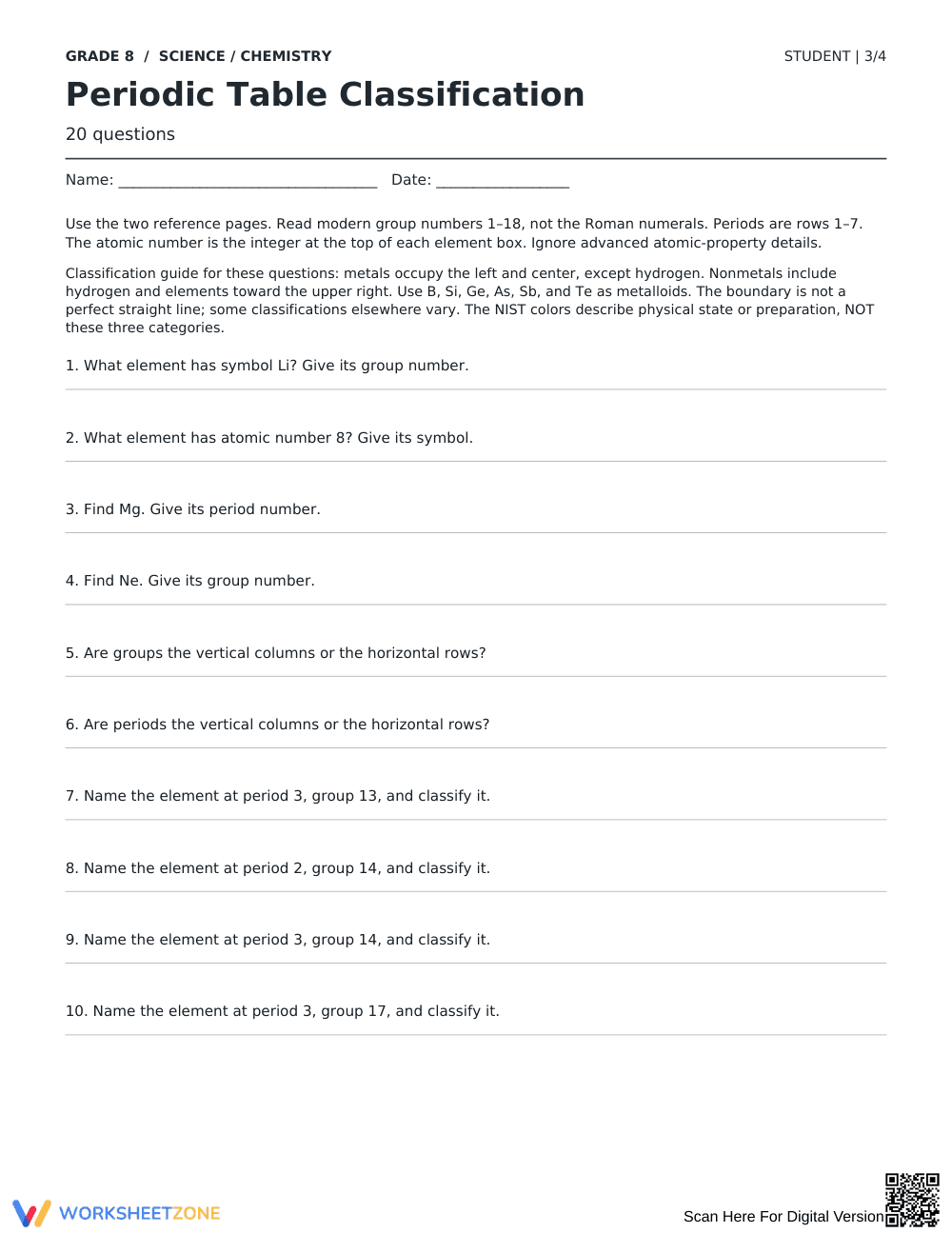
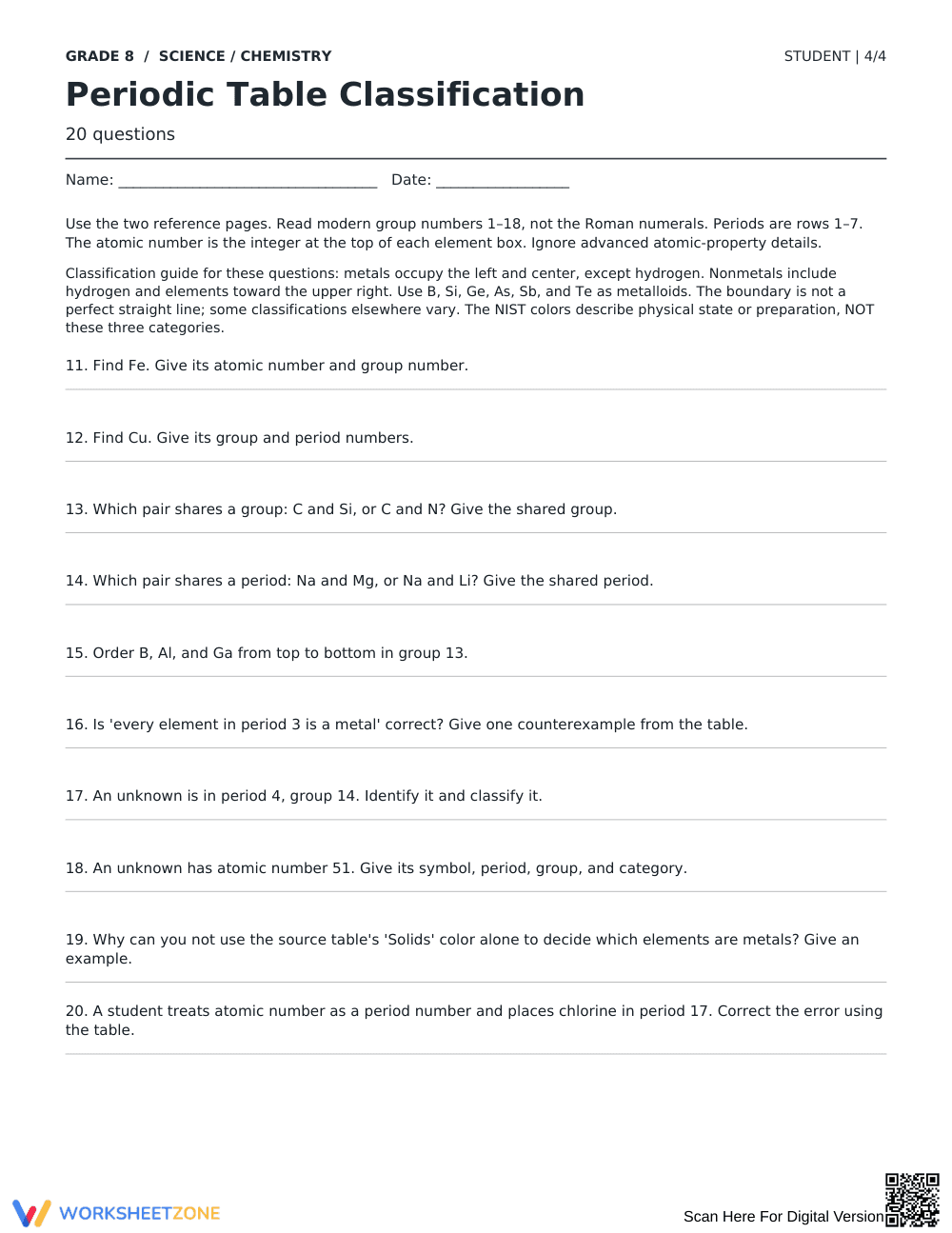
The activity includes two NIST reference sheets dividing the periodic table into left and right panels. Across 20 items, students complete direct element lookups, distinguish vertical groups from horizontal rows, classify target elements, and resolve conceptual errors regarding atomic numbers and physical states. A two-page answer key provides point values and solutions.
Skill Progression
- Guided practice (Questions 1–6): Basic retrieval locating element symbols, identifying group or period coordinates, and defining rows and columns.
- Supported practice (Questions 7–14): Two-step items requiring students to identify elements by coordinates and categorize them as metals, nonmetals, or metalloids.
- Independent practice (Questions 15–20): Analytical challenges involving group ordering, identifying counterexamples, classifying unknown elements, and correcting common conceptual misconceptions.
This sequence follows a gradual-release instructional model, building student competence from direct reference retrieval to independent structural reasoning.
Standards Alignment
Primary alignment is to `MS-PS1-1`: Develop models to describe the atomic composition of simple molecules and extended structures. Supporting alignment connects to `HS-PS1-1` for using table patterns to predict chemical properties. Both standard codes can be copied directly into lesson plans, IEP goals, or district curriculum mapping tools.
How to Use It
Use this resource after introducing periodic table organization and element properties. During independent work, check student responses to Questions 19 and 20 to verify that learners do not confuse physical states with elemental classifications. It functions effectively as classwork, homework, or a zero-prep sub plan, taking 30 to 45 minutes to finish.
Who It's For
Designed for Grade 8 physical science classrooms, this worksheet supports visual learners with included NIST reference tables while offering rigorous misconception checks for advanced students. Pair this activity with molecular model kits or element card sorts.
According to Fisher & Frey (2014), purposeful instructional design relies on deliberate scaffolding that guides students from basic knowledge retrieval to self-directed evaluation. This Grade 8 science worksheet operationalizes that framework through 20 targeted items aligned to `MS-PS1-1`. Students build fluency in periodic table navigation by reading element symbols, identifying vertical groups and horizontal periods, and classifying matter into metals, metalloids, and nonmetals. By utilizing authentic NIST reference charts, learners analyze chemical data without relying on memorization. The final sequence requires students to refute common misconceptions, such as confusing atomic numbers with period coordinates or mistaking physical states for elemental categories. Fisher & Frey (2014) emphasize that structured peer discussion and systematic error analysis accelerate conceptual retention in STEM subjects. Consequently, this worksheet bridges empirical observation and structural modeling, establishing the prerequisite schema middle school students need before undertaking advanced molecular geometry or chemical bonding investigations.


